
There’s an old story about the inventor of chess asking for a reward of rice: one grain on the first square of the board, two on the second, four on the third, doubling every square. It sounds modest until you add it up. The total is
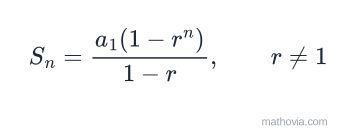
The Finite Geometric Series Formula
The sum of the first
| Symbol | Meaning |
|---|---|
| the sum of the first | |
| the first term | |
| the common ratio | |
| the number of terms |
(If
Where the Formula Comes From
Write the sum, then multiply it by
Subtract the second line from the first. Everything in the middle cancels, leaving
Example 1: A Growing Series
Find the sum of the first 8 terms of 3, 6, 12, …
Step 1 — the pieces:
Step 2 — the formula:
Example 2: A Shrinking Series
Find
Step 1 — the pieces:
Step 2 — the formula:
The Chessboard
One grain on the first square, doubling across 64 squares, is
Infinite Geometric Series
Now try adding infinitely many terms of a shrinking geometric sequence:
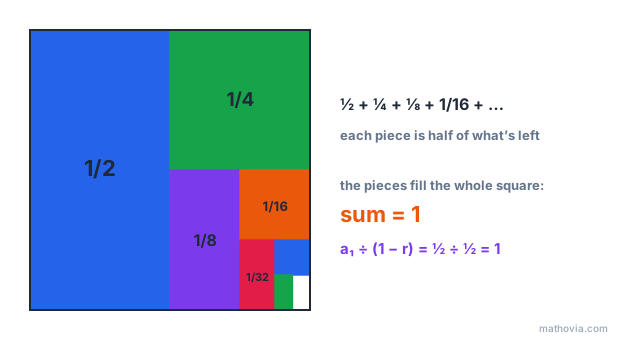
When
For
When Does a Geometric Series Converge?
An infinite series converges if its running totals (its partial sums) settle on a single number, and diverges if they don’t.
| Common ratio | The infinite series… | Example |
|---|---|---|
| converges to | ||
| diverges, it grows without bound | ||
| diverges, it swings without settling |
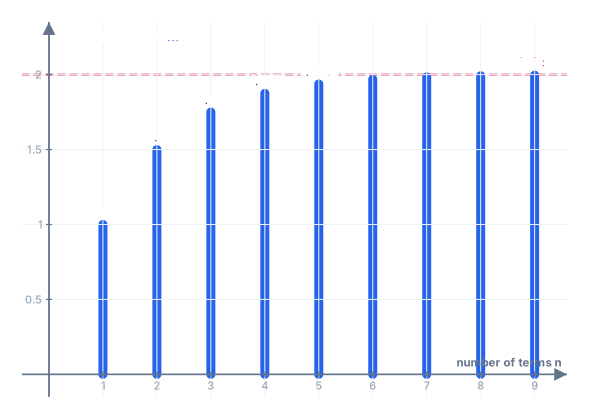
So the question “which geometric series converges?” has a one-line answer: the one whose ratio is strictly between −1 and 1.
Example 3: An Infinite Sum
Find
Step 1 — check convergence:
Step 2 — the sum:
Repeating Decimals as Fractions
Every repeating decimal is an infinite geometric series in disguise.
Example 4. Write
Example 5. Write
Worked Example: The Bouncing Ball’s Total Distance
A ball is dropped from 10 m, and each bounce reaches 80% of the previous height. Assuming it bounces forever, how far does it travel in total?
Step 1 — the first drop is 10 m. After that, each bounce goes up and comes back down, so each rebound height counts twice.
Step 2 — the rebound heights form an infinite geometric series:
Step 3 — the total distance:
Infinitely many bounces, but a finite 90 metres of travel.
Common Mistakes to Avoid
- Using the infinite formula when
. doesn’t equal . It diverges. - Using
in the sum formula. The finite sum uses . The belongs to the term formula. - Sign errors when
. Both and are negative, so the negatives cancel. Some books write to avoid them; it’s the same formula. - Using the wrong ratio for a repeating decimal. A two-digit repeating block means
, not . - Counting each bounce once. A bounce goes up and down.
Practice Problems
Work each one before opening the answer.
Problem 1. Find the sum of the first 6 terms of 2, 6, 18, …
Show answer
Answer:
Problem 2. Find
Show answer
Step 1 —
Answer:
Problem 3. Find
Show answer
Answer:
Problem 4. Write
Show answer
Answer:
Problem 5. Does
Show answer
Step 1 —
Answer: no, it diverges
Problem 6. Evaluate
Show answer
Step 1 —
Answer:
Geometric series sit behind compound interest, mortgages and loan payments. The continuous compound interest lesson shows what happens when the compounding gets infinitely frequent. The last lesson in this chapter turns to a different kind of pattern: the coefficients you get when you expand