
Integer Exponents and Rational Exponents each build their rules up from scratch and explain why every rule is true. This lesson assumes that groundwork is already done and does something those two don’t have room for: puts every rule on one page, side by side, and then works through the harder skill of combining several of them correctly in a single problem.
If a rule below looks unfamiliar, the two lessons linked above derive it in full. This page is the fast-reference version, plus the strategy for using the table instead of just reading it.
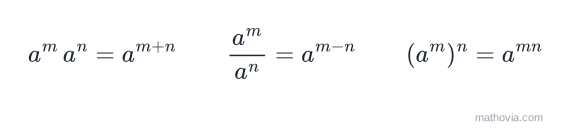
The Complete Exponent Rule Table
Assume
| Rule | Statement | Example |
|---|---|---|
| Product Rule | ||
| Quotient Rule | ||
| Power Rule | ||
| Power of a Product | ||
| Power of a Quotient | ||
| Zero Exponent | ||
| Negative Exponent | ||
| Negative Exponent of a Quotient | ||
| Rational Exponent (root form) | ||
| Rational Exponent (general form) |
Every row is a special case of two ideas: an exponent counts repeated factors, and every other rule follows from adding, subtracting, or multiplying those counts. Nothing in this table is arbitrary — see Integer Exponents for the full derivation of the top eight rows and Rational Exponents for the bottom two.
Applying Several Rules in the Right Order
Most exponent problems worth writing a lesson about combine two, three, or four rules in a single expression. A reliable order avoids most mistakes:
- Clear outer parentheses first. Apply the power of a product or power of a quotient rule so the exponent reaches every factor inside.
- Combine matching bases. Apply the product or quotient rule to any bases that now appear more than once.
- Clean up negative and zero exponents last. Move any remaining negative-exponent factors across the fraction bar, and replace any
with , only once steps 1 and 2 are finished.
Working in this order (outer parentheses, then matching bases, then negative-exponent cleanup) means each step only ever has one job, which is what keeps a four-rule problem from turning into a sign-error minefield.
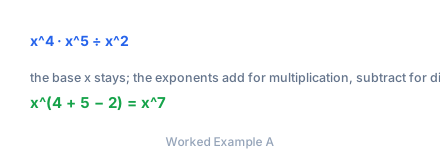
Worked Example A: Product and Quotient Rules Together
Simplify
Step 1 — apply the product rule to the numerator:
Step 2 — apply the quotient rule:
Answer:
Worked Example B: Power of a Product, Then the Quotient Rule
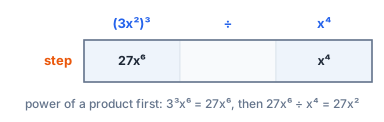
Simplify
Step 1 — clear the outer parentheses with the power of a product rule:
Step 2 — apply the quotient rule:
Answer:
Worked Example C: Negative Exponents Mixed with the Power Rule
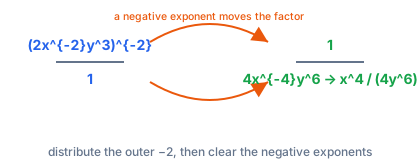
Simplify
Step 1 — apply the outer exponent to every factor (power of a product, then the power rule):
Step 2 — clean up the negative-exponent factors last:
Answer:
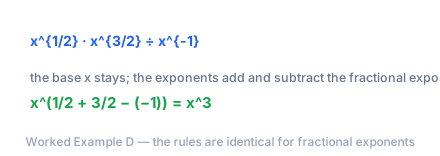
Worked Example D: Combining Rational and Integer Exponents
Simplify
Step 1 — apply the product rule to the first two factors:
Step 2 — apply the quotient rule, remembering division by
Answer:
Common Mistakes to Avoid
- Applying the product rule to different bases.
cannot be combined into a single power; the product and quotient rules only work when the base is identical. - Cleaning up negative exponents before finishing the outer parentheses. Doing steps out of order (from the strategy above) is the single most common source of a dropped sign in a multi-rule problem.
- Forgetting the outer exponent reaches the coefficient.
, not ; the coefficient is a factor inside the parentheses too. - Adding exponents when the operation is actually a power of a power.
(multiply), not (add) — the product rule is for two separate factors being multiplied, not one exponent stacked on another. - Losing a negative sign when subtracting a negative exponent.
, not — subtracting a negative number always increases the result. - Mixing up rational-exponent notation with the negative-exponent rule.
is a square root, not a reciprocal; only a literal minus sign in the exponent triggers the reciprocal rule.
Where This Shows Up Later
- Radicals. Every rational-exponent rule in the table above has a matching radical-notation version, since
and are two notations for the same operation. - Scientific notation. Multiplying or dividing measurements written as
uses the product and quotient rules on base directly from this table. - Polynomials. Multiplying monomials like
and is the product rule applied once per variable. - Rational Expressions. Simplifying a algebraic fraction to lowest terms routinely needs the quotient rule and the negative-exponent cleanup step from this lesson.
- Calculus. The power-rule derivative shortcut works for negative and fractional exponents precisely because this table already defines what they mean.
Practice Problems
Work each problem yourself before opening the answer.
Problem 1. Simplify
Show answer
Apply the product rule once, adding all three exponents:
Answer:
Problem 2. Simplify
Show answer
Step 1 — clear the outer parentheses:
Step 2 — apply the quotient rule:
Answer:
Problem 3. Simplify
Show answer
Apply the power rule, multiplying the exponents:
Answer:
Problem 4. Simplify
Show answer
Step 1 — apply the outer exponent to every factor:
Step 2 — clean up the negative exponent:
Answer:
Problem 5. Simplify
Show answer
Apply the product rule, adding all three exponents (LCD of
Answer:
Problem 6. Simplify
Show answer
Apply the quotient rule to each base:
Answer:
Problem 7. Simplify
Show answer
Step 1 — flip the fraction and drop the minus sign:
Step 2 — apply the power of a quotient rule:
Answer:
Problem 8. Simplify
Show answer
Step 1 — apply the product rule:
Step 2 — apply the quotient rule:
Answer:
Problem 9. Simplify
Show answer
Apply the zero exponent rule to the entire expression (a nonzero base raised to
Answer:
Problem 10. Simplify
Show answer
Step 1 — clear the outer parentheses:
Step 2 — apply the quotient rule:
Step 3 — clean up the negative exponent:
Answer:
Quick Reference
| Step | What to do |
|---|---|
| 1. Outer parentheses present | Distribute with the power of a product or power of a quotient rule first |
| 2. Matching bases appear more than once | Combine with the product rule (multiplying) or quotient rule (dividing) |
| 3. Any exponent is negative | Move that factor across the fraction bar last, after steps 1 and 2 |
| 3. Any exponent is zero | Replace the entire factor with |
| Fractional exponent | Same rules as an integer exponent — no special case needed |
| Different bases | The product and quotient rules don’t apply directly; rewrite one base in terms of the other if possible |
Think of this table as the shortcut version of two longer lessons: Integer Exponents works out the top eight rules from first principles, while Rational Exponents covers the bottom two and ties them to radical notation. A shaky rule is worth chasing down in Negative Exponents, which covers that one row in full. Three practice sets are ready whenever practice is needed: Exponent Rules, Integer Exponent, and Rational Exponent — or keep browsing the Algebra lessons for more.