
Dividing one polynomial by another is how you break a high-degree expression into smaller pieces you can actually work with. It is the tool behind factoring cubics and quartics, behind finding the zeros that a quadratic formula cannot reach, and behind rewriting an awkward rational expression into something you can integrate later in calculus. The good news is that you already know the algorithm — it is ordinary long division with
What Polynomial Division Produces
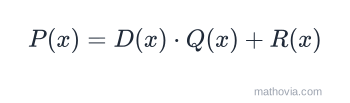
Every division of polynomials produces the same four named pieces:
| Symbol | Name | What it is |
|---|---|---|
| dividend | the polynomial being divided | |
| divisor | the polynomial you are dividing by | |
| quotient | the result of the division | |
| remainder | what is left over, too small to divide further |
This is the division algorithm for polynomials, and it is the same statement as
- The remainder
has a lower degree than the divisor . That is the stopping rule — you keep dividing until what is left is too small to divide further. - If
, then is a factor of .
Dividing by a linear divisor like
The Four Steps of Polynomial Long Division
Dividing polynomials using long division is a loop, not a formula. Each pass through the cycle removes one term from the dividend, and you keep looping until there is nothing left big enough to divide.
| Step | What you do | Why |
|---|---|---|
| 1. Divide | Divide the leading term of the current dividend by the leading term of the divisor | Gives the next term of the quotient |
| 2. Multiply | Multiply the whole divisor by that new quotient term | Produces the piece you are about to remove |
| 3. Subtract | Subtract that product from the current dividend | Cancels the leading term |
| 4. Bring down | Bring down the next term of the original dividend | Sets up the next pass |
Repeat until the degree of what remains drops below the degree of the divisor.
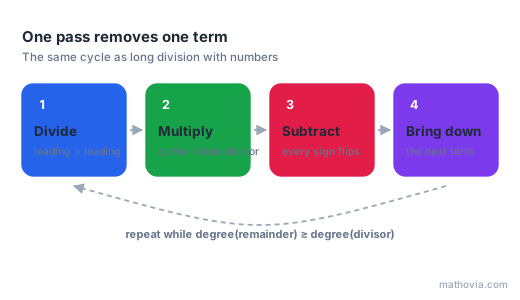
The subtraction is where most errors happen. You are subtracting a whole expression, so every sign in it flips. Writing the product and then changing all its signs before adding is slower to write but far more reliable than subtracting in your head.
Polynomial Division Examples: Remainder Zero
The two worked examples below cover the only two outcomes there are — an exact division, and one that leaves something behind. Both are done step by step so you can follow the columns.
Divide
Step 1 — divide the leading terms:
Step 2 — multiply the divisor by
Step 3 — bring down
Step 4 — bring down
The remainder is zero, so the division is exact:
And since
Long Division Examples With Polynomials: A Missing Term
Most division of polynomials examples in a textbook are tidy. This one is not, and the untidiness is the lesson.
Divide
Step 1 — insert the placeholder. There is no
Skipping this is the single most common way this problem goes wrong.
Step 2 — first pass:
Step 3 — bring down
Step 4 — bring down
The degree of
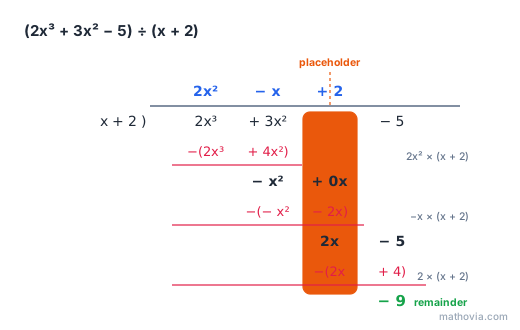
Always check by multiplying back. Expanding
Common Mistakes to Avoid
- Omitting placeholder terms. A dividend missing a power silently misaligns every column after it. Write
, — whatever is absent — before you start. - Subtracting only the first term of the product. You are subtracting the entire expression, so every sign inside it flips.
is , not . - Multiplying by only part of the divisor. Each quotient term multiplies the whole divisor, not just its leading term.
- Stopping too early or too late. The stopping rule is degree, not appearance: keep going while the current remainder’s degree is at least the divisor’s, and stop the moment it drops below.
- Forgetting the divisor’s own sign. Dividing by
is not the same as dividing by , and the sign carries through every multiply step.
Practice Problems
Six long division of polynomials problems, working up from a clean quadratic to a check-and-diagnose puzzle. Try each one before opening the answer.
Problem 1. Divide
Show answer
Step 1 — divide leading terms and subtract:
Step 2 — bring down
Answer:
Problem 2. Divide
Show answer
Step 1 — insert both placeholders:
Step 2 — first pass:
Step 3 — second pass:
Step 4 — third pass:
Answer:
Problem 3. Divide
Show answer
Step 1 — first pass:
Step 2 — bring down
Answer: quotient
Problem 4. Divide
Show answer
Step 1 — write in the placeholders:
Step 2 — first pass:
Step 3 — bring down the rest and divide again:
Answer:
Problem 5. A student divides
Show answer
Step 1 — multiply back and see whether it reproduces the dividend:
Step 2 — compare with the original. The original has no
Answer: the check fails, so the division is wrong. The student almost certainly omitted the
Problem 6. If
Show answer
Step 1 — “divides exactly” means the remainder is zero, so:
Step 2 — substitute
Answer:
Once you are comfortable with the full tableau, most divisions by a linear factor can be done far faster with synthetic division, which strips the same arithmetic down to a row of coefficients. Division also pairs naturally with end behavior when you are sketching: division finds the factors that fix the middle of the curve, end behavior fixes the two tails.