
Most features of a graph are places the curve is. A vertical asymptote is the opposite — a line the curve is permanently forbidden from touching, defined entirely by where the function fails to exist.
What Is a Vertical Asymptote?
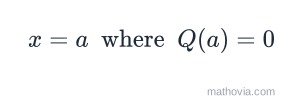
A vertical asymptote is a vertical line
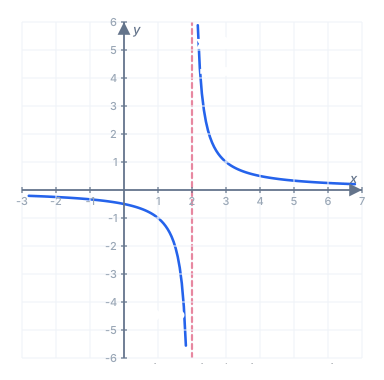
Take
| 2.1 | 10 |
| 2.01 | 100 |
| 2.001 | 1000 |
| 2.0001 | 10 000 |
The gap on the bottom shrinks, so the fraction explodes. From the left the same thing happens with a negative sign, plunging to
The graph never crosses it. The function is undefined at
How to Find Vertical Asymptotes: Four Steps

- Factor the numerator and the denominator completely.
- Cancel any factor common to both.
- Set what is left on the bottom to zero.
- Each solution is a vertical asymptote.
Step 2 is where marks are lost. Setting the original denominator to zero finds the right
For
Hole or Asymptote?
Both come from a zero denominator, and telling them apart is the single most examined idea in this topic.
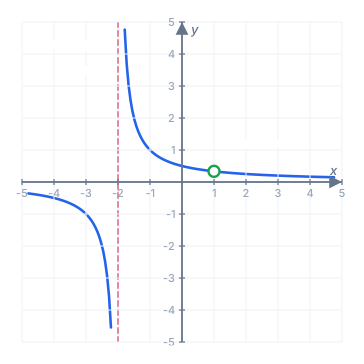
cancels → a hole at . survives → a vertical asymptote at .
| Hole | Vertical asymptote | |
|---|---|---|
| Factor | cancels | does not cancel |
| On the graph | one missing point | curve runs to infinity |
| Drawn as | open circle | dashed vertical line |
| Nearby outputs | perfectly ordinary | grow without bound |
| In the domain? | no | no |
Both are excluded from the domain — that part is identical. What differs is what the graph does around them.
To find a hole’s height, cancel first and substitute into what remains: here
Which Way Does Each Side Go?
Knowing an asymptote is at
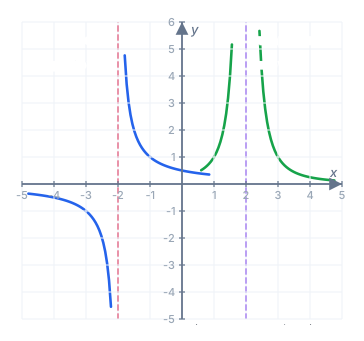
- Odd power — the factor changes sign as you pass through, so the two sides go opposite ways.
drops to on the left and climbs to on the right. - Even power — the factor stays positive on both sides, so both go the same way.
goes to from both directions.
If you would rather not reason about parity, just test a point either side. Substitute a value slightly below and slightly above the asymptote and check the sign of the result. That is quicker than it sounds and never misleads.
More Than One
Each distinct uncancelled zero gets its own asymptote.
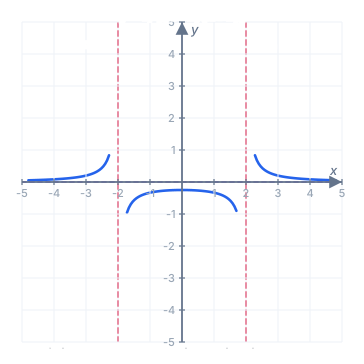
For
Vertical Asymptotes Beyond Rational Functions
Rational functions are the usual source, but not the only one:
- Logarithms.
has a vertical asymptote at ; the argument of a log must stay strictly positive. - Tangent.
has one at every odd multiple of , where its cosine denominator hits zero — infinitely many. - Any function whose output grows without bound near a particular input, whatever the reason.
Worked Example A: Straightforward
Find the vertical asymptotes of
Nothing to cancel;
Worked Example B: Two of Them
Find the vertical asymptotes of
The numerator
Worked Example C: One Cancels
Find the vertical asymptotes of
The hole’s height is
Worked Example D: One-Sided Behaviour
Describe the behaviour of
The asymptote is
Test either side:
Worked Example E: Reading a Domain Back
A function has domain all reals except
At
This is the useful reverse test: every asymptote is a domain exclusion, but not every domain exclusion is an asymptote.
Common Mistakes to Avoid
- Skipping the cancelling step. It is what separates holes from asymptotes.
- Thinking a graph can cross one. It cannot — the function does not exist there.
- Assuming both sides go the same way. Odd powers send them opposite ways.
- Using the numerator. Only the denominator produces vertical asymptotes.
- Forgetting the second solution.
is zero at two values, not one. - Calling a hole an asymptote. A hole has perfectly ordinary values on either side.
- Assuming only fractions have them. Logarithms and tangent do too.
Where Vertical Asymptotes Lead Next
- Graphing rational functions. The asymptotes are the scaffolding you draw first — see rational functions.
- Limits. “The output grows without bound as
approaches ” is an infinite limit, written . - Rational inequalities. Asymptotes and intercepts split the number line into the regions you test.
- Curve sketching in calculus. Asymptotes, turning points and inflection points together fix the shape.
- Physical limits. Time against speed for a fixed distance has an asymptote at zero speed, which is the model saying “you never arrive”.
Practice Problems
Work each one before opening the answer.
Problem 1. Find the vertical asymptote of
Show answer
Problem 2. Find the vertical asymptote of
Show answer
Problem 3. Find the vertical asymptotes of
Show answer
Problem 4. Does
Show answer
No. The factor cancels, leaving
Problem 5. Find the vertical asymptotes of
Show answer
Problem 6. How many vertical asymptotes does
Show answer
None.
Problem 7. Which way do the two sides of
Show answer
Both to
Problem 8. Which way do the two sides of
Show answer
Opposite ways:
Problem 9. Find the height of the hole in
Show answer
It simplifies to
Problem 10. Find the vertical asymptotes of
Show answer
Problem 11. State the domain of
Show answer
All reals except 1 and
Problem 12. A function is undefined at
Show answer
At
Quick Reference
| Task | Method |
|---|---|
| Definition | a line |
| Step 1 | factor top and bottom |
| Step 2 | cancel common factors |
| Step 3 | set the remaining denominator to zero |
| Cancelled factor | a hole, not an asymptote |
| Odd power | the two sides go opposite ways |
| Even power | both sides go the same way |
| Crossing it | never possible |
| How many | one per distinct uncancelled zero |
| Also found in | logarithms, tangent |
Vertical asymptotes are the defining feature of rational functions, and finding them depends on the cancelling step from simplifying rational expressions. Every asymptote is also a domain exclusion, though the reverse is not true. To drill the factoring and cancelling, try the simplifying rational expressions practice problems. More Algebra lessons are available.