
Subtracting one polynomial from another is Adding Polynomials with one extra step in front of it: flip the sign of every term in the polynomial being subtracted, then combine like terms exactly as before. Nearly every mistake in this lesson traces back to that one step being done to only part of the second polynomial instead of all of it.
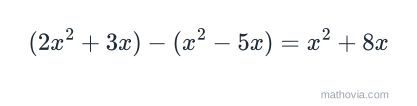
Subtraction Is Adding the Opposite
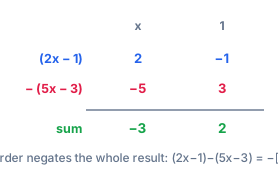
All three signs flipped: the
Subtracting Polynomials Horizontally
Distribute the negative sign across every term of the second polynomial first, then group and combine like terms exactly as in addition.
The sign-flip happens exactly once, in the step where the parentheses around the second polynomial are removed — after that, the rest of the process is identical to adding two polynomials.
Subtracting Polynomials Vertically
Flip the sign of every term in the polynomial being subtracted first, then add column by column, exactly as in vertical addition.
Rewriting the subtraction as “add the sign-flipped polynomial” turns vertical subtraction into the exact same column-by-column addition already covered in Adding Polynomials — nothing new is needed once that flip is done.
Subtracting Polynomials in More Than One Variable
The sign flip and the like-terms check both work the same way with two or more variables — every term’s sign flips, and only truly matching variable parts combine.
Worked Example A: Subtracting Two Trinomials Horizontally
Subtract
Step 1 — flip the sign of every term in the second polynomial:
Step 2 — group like terms:
Step 3 — combine each group:
Answer:
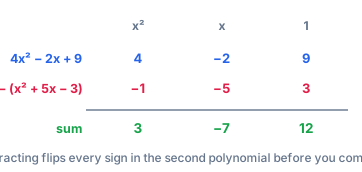
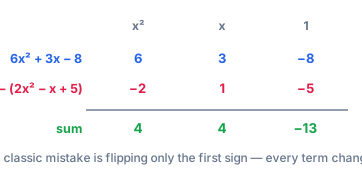
Worked Example B: A Case with Only the First Term’s Sign Flipped, Corrected
Subtract
Step 1 — flip all three signs in the second polynomial (not just the first term’s):
Step 2 — group like terms:
Step 3 — combine each group:
Answer:
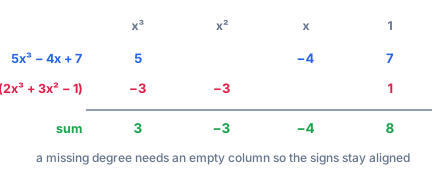
Worked Example C: Subtracting Vertically with a Missing Term
Subtract
Step 1 — flip the sign of every term in the polynomial being subtracted:
Step 2 — stack and add column by column, leaving a gap where a term is missing:
Answer:
Worked Example D: Subtracting in the Reverse Order
Subtract
Step 1 — flip the sign of every term in
Step 2 — combine like terms:
Answer:
Common Mistakes to Avoid
- Flipping the sign of only the first term. Every single term inside the second polynomial’s parentheses changes sign, not just the one right after the minus sign.
- Forgetting the negative sign is multiplication by
. Treating the subtraction sign as if it only touched the term written immediately next to it, rather than distributing across the whole polynomial, is the single most common error in this lesson. - Combining terms before finishing the sign flip. Distribute the negative sign completely first; combining prematurely risks locking in an unflipped sign.
- Assuming subtraction is commutative.
and are opposites of each other, not equal — always subtract in the exact order given. - Skipping the sign flip in vertical subtraction. Subtracting column by column directly (rather than flipping signs first and then adding) is a common source of errors specifically in the vertical layout.
- Losing track of a missing term’s sign. A term that’s missing from the polynomial being subtracted has nothing to flip and nothing to change — the corresponding term from the first polynomial just passes through unchanged.
Where This Shows Up Later
- Multiplying Polynomials. Expanding a product like
relies on tracking signs exactly as carefully as this lesson does, just across a multiplication instead of a direct subtraction. - Factoring Polynomials. Checking a factored answer by re-expanding it and subtracting the original polynomial (expecting
) is a fast way to verify factoring was done correctly. - Solving equations. Moving a polynomial expression from one side of an equation to the other, in Linear Equations and beyond, is subtraction of an entire polynomial at once.
- Functions.
is defined as subtracting one function’s output from another’s, which is exactly this term-by-term process applied to two function rules.
Practice Problems
Work each problem yourself before opening the answer.
Problem 1. Subtract
Show answer
Answer:
Problem 2. Subtract
Show answer
Answer:
Problem 3. Subtract
Show answer
Every term flips sign and then cancels exactly against the matching term above it:
Answer:
Problem 4. Subtract
Show answer
Answer:
Problem 5. Subtract
Show answer
Answer:
Problem 6. Subtract
Show answer
Step 1 — flip the sign of every term being subtracted (a double negative on the
Step 2 — combine like terms:
Answer:
Problem 7. Subtract
Show answer
Answer:
Problem 8. Subtract
Show answer
Answer:
Problem 9. Subtract
Show answer
Subtracting from
Answer:
Problem 10. Subtract
Show answer
First order:
Reverse order:
Answer:
Quick Reference
| Situation | Move |
|---|---|
| Rewrite as | |
| Subtracting horizontally | Distribute the negative sign fully first, then group and combine like terms |
| Subtracting vertically | Flip every sign in the bottom row first, then add column by column |
| A term is missing from the polynomial being subtracted | Nothing to flip in that column — the other term passes through unchanged |
| Always opposites of each other, never equal (unless both are | |
| Checking a subtraction | Add your answer back to the polynomial that was subtracted; it should reproduce the first polynomial |
Multiplying Polynomials is a good next lesson, since expanding a product depends on tracking signs through every term the same way. If the sign-flip step ever feels shaky, Adding Polynomials is worth revisiting, and Polynomials has the broader overview these lessons are drawn from. The Subtracting Polynomials Practice Problems is ready for practice, or browse more of the Algebra lessons.