
A circle is the set of every point that sits a fixed distance from one fixed point. That sentence is the whole definition, and remarkably, translating it directly into coordinates gives you the equation with no extra work.
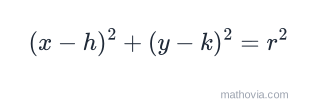
The Standard Equation
is the centre. is the radius.
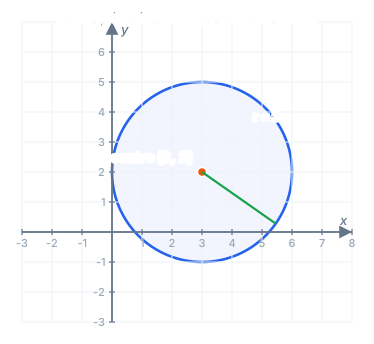
Centred at the origin,
Where It Comes From
Take the centre
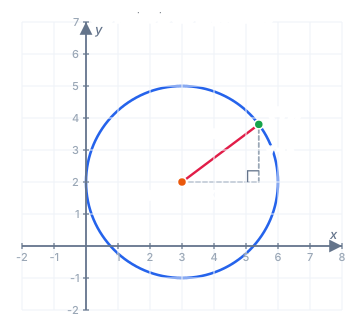
Pythagoras gives
Two consequences fall out of that derivation:
- The right side is
, not . If the equation reads , the radius is . - Squaring removes any sign problem.
is the same whether the point is left or right of the centre, which is exactly what you want.
Reading Centre and Radius
The equation subtracts the centre coordinates, so reading one back means negating what you see.
| Equation | Centre | Radius |
|---|---|---|
A plus sign inside a bracket always means a negative coordinate. Rewriting
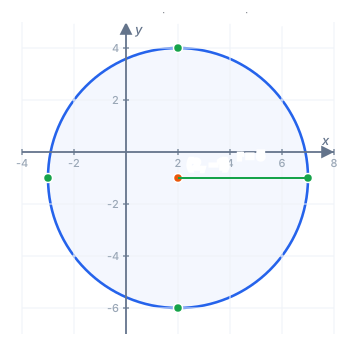
To sketch a circle quickly, plot the centre and then mark four points at distance
General Form and Completing the Square
Expanding the standard form scatters everything:
That second shape is general form,
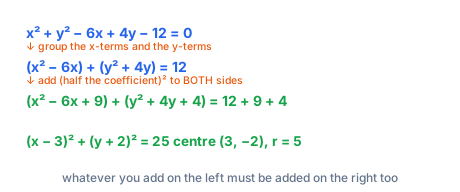
The procedure, in order:
- Move the constant to the right side.
- Group the
-terms together and the -terms together. - Complete each square. For
, add . Do the same for . - Add the same amounts to the right side. This is the step people skip, and skipping it changes the radius.
- Factor each group into a squared bracket.
If the equation has a coefficient in front of
When It Is Not a Circle
After completing the square you have
: a genuine circle of radius . : a single point at . Sometimes called a degenerate circle. : no graph at all. Two real squares cannot add to a negative number.
Getting a negative on the right is usually a sign you forgot step 4 above — but not always, so check the arithmetic before assuming an error.
Finding the Equation From Given Information
Centre and radius given. Substitute straight in.
Centre and one point on the circle. The distance between them is the radius.
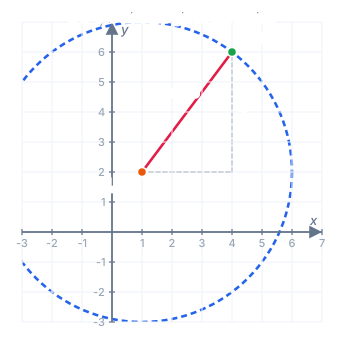
For centre
Endpoints of a diameter given. The centre is the midpoint, and the radius is half the diameter’s length.
Worked Example A: Read It Off
State the centre and radius of
Centre
Worked Example B: Complete the Square
Find the centre and radius of
Half of 10 is 5, and
Centre
Worked Example C: From a Diameter
A circle has diameter endpoints
Centre is the midpoint:
Diameter length:
Worked Example D: Is a Point Inside or Outside?
Is
Substitute:
Since
Worked Example E: A Degenerate Case
What does
The only way two squares sum to zero is if both are zero, so the “circle” is the single point
Common Mistakes to Avoid
- Forgetting to square-root the right-hand side.
means radius , not 36. - Getting the centre’s signs backwards.
means . - Only adding to the left when completing the square. Whatever you add inside must be added on the right too.
- Halving before squaring, or squaring before halving. The rule is half first, then square: for
, half is , squared is . - Not dividing out a leading coefficient.
must become first. - Calling an unequal-coefficient equation a circle.
is an ellipse. - Assuming a negative right-hand side is an error. It can be, but it can also be a legitimate “no graph” answer.
Where Circles Lead Next
- Conic sections. Circles are the simplest conic; ellipses, parabolas and hyperbolas follow the same completing-the-square treatment.
- Tangent lines. A tangent meets the circle once and is perpendicular to the radius at the point of contact.
- Circumscribed circles. The centre of a circle through three points is where the perpendicular bisectors of the sides meet.
- Trigonometry. The unit circle
is the foundation of sine and cosine. - Distance-based modelling — signal range, safety radii, and collision detection all reduce to “is this point within
?”
Practice Problems
Work each one before opening the answer.
Problem 1. State the centre and radius of
Show answer
Centre
Problem 2. State the centre and radius of
Show answer
Centre
Problem 3. Write the equation of the circle with centre
Show answer
Problem 4. Write the equation of the circle with centre
Show answer
Problem 5. Find the centre and radius of
Show answer
Problem 6. Find the centre and radius of
Show answer
Problem 7. A circle has centre
Show answer
Problem 8. A diameter runs from
Show answer
Centre
Problem 9. Is
Show answer
Problem 10. What is the graph of
Show answer
Problem 11. Convert
Show answer
Problem 12. Find the centre and radius of
Show answer
Divide by 2:
Quick Reference
| Task | Method |
|---|---|
| Standard form | |
| Centre from the equation | Negate the numbers inside the brackets |
| Radius from the equation | Square-root the right-hand side |
| Centred at the origin | |
| General to standard | Complete the square on |
| Completing the square | Add |
| Radius from centre + point | Distance formula between them |
| Inside / on / outside | Substitute and compare with |
| Right side | A single point |
| Right side | No graph |
Circles extend the distance formula into a curve, and converting from general form relies on completing the square. Tangents to a circle use perpendicular slopes, and the plotting technique is the one from Graphing Equations. More Algebra lessons are available.