Mathovia

Algebra / Graphing and Functions

Function Notation: Reading and Using f(x)

Function notation replaces y with f(x), and the change is not cosmetic. Writing f(3) = 11 says the input and the output in one breath, which y = 11 cannot do. This lesson covers how to read the notation, how to evaluate a function at a number, a variable or a whole expression, how to work backwards from an output, how to read f(x) off a graph, and the difference between changing the input and changing the output.

Practice Problems
M
Written by
Mathovia Team
Editorial Team

Once you know a relation is a function, you can name it and talk about its outputs precisely. That is what function notation is for, and it is worth more than it first appears.

Function notation showing f of x equals an expression
Function notation

Reading the Notation

Three parts, each doing a job:
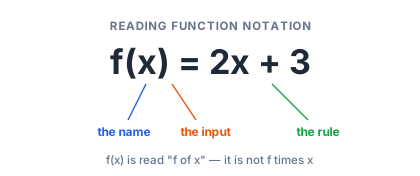
The expression f(x) = 2x + 3 with callout lines labelling f as the name, x as the input and 2x + 3 as the rule
The name, the input, and the rule.
  • is the function’s name. Others in common use are , , and in applications things like for cost or for area.
  • inside the brackets is the input — sometimes called the argument.
  • is the rule — what gets done to the input.

Say it out loud as “f of x”. The single most common beginner error is reading the brackets as multiplication: is not times , and does not mean .

Why Not Just Use y?

Both describe the same value, and is a true statement. But carries extra information.

Writing tells you an output. Writing tells you an output and the input that produced it. When a problem involves several functions — , , — or several inputs at once, that extra precision stops the whole thing collapsing into ambiguity.

It also lets you write questions compactly. “Solve ” and “find ” are unmistakable instructions.

Evaluating at a Number

To evaluate, replace every in the rule with what is inside the brackets, then simplify.
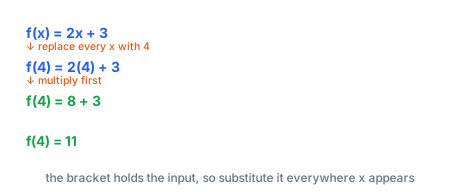
Step-by-step evaluation showing f(4) = 2(4) + 3 = 8 + 3 = 11
Substitute, then simplify.

Keep the brackets when you substitute. With and an input of :

Dropping those brackets gives , which is wrong — the square applies to the negative number, not just the 2. Negative inputs are where most evaluation errors live.

Evaluating at an Expression

The input does not have to be a number. Anything can go in the brackets, and the same rule applies: replace every with the whole thing.

For :

The brackets are not optional here. is , not — the whole input gets squared.

That last one, , turns up constantly in calculus as part of the difference quotient .

Input Changes vs Output Changes

This distinction catches people out, and it is worth being deliberate about.
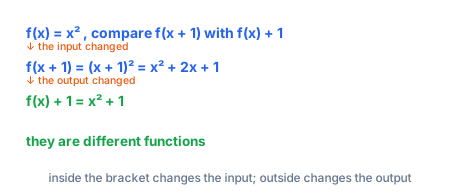
Comparison showing f(x+1) expands to x squared plus 2x plus 1 while f(x)+1 is x squared plus 1
Inside the bracket changes the input; outside changes the output.
  • — the input is altered before the rule runs. On a graph this shifts the curve horizontally.
  • — the rule runs, then the result is altered. On a graph this shifts the curve vertically.

For : , while . Genuinely different functions.

Similarly doubles the output, while doubles the input. These are the foundations of function transformations.

Reading Values Off a Graph

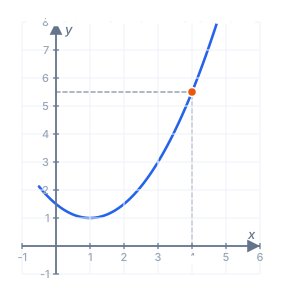
A graph is a complete record of a function, so of anything can be read from it.

To find : locate on the -axis, move vertically to the curve, then horizontally to the -axis.

A curve with dashed guide lines going up from x = 4 to the curve and across to the y-axis to read f(4)
Up from the input, across to the output.

To solve : run it backwards. Find on the -axis, move horizontally to the curve, then down to the -axis. There may be more than one answer — a horizontal line can cut a curve several times, and every crossing is a solution.

To solve : these are where the curve crosses the -axis, also called the zeros or roots. See x- and y-Intercepts.

Note the asymmetry: always has one answer, but can have none, one, or many. That is the one-output rule showing up again — it constrains outputs per input, not inputs per output.

Other Notations You Will Meet

NotationMeaning
standard function notation
the same value, named as a coordinate
, different names, different input letters
applied naming, e.g. cost as a function of quantity
“maps to” notation, common in the UK
the derivative of , in calculus
the inverse function — not a reciprocal

That last row is a genuine trap: means the inverse function, whereas means .

Worked Example A: Numbers In

For , find , and .

Worked Example B: A Negative Input With a Square

For , find .

Both brackets matter: the square gives , and subtracting a negative gives .

Worked Example C: Working Backwards

For , find when .

Evaluating goes forwards; this goes backwards, and is just solving an equation.

Worked Example D: An Expression In

For , find .

Worked Example E: A Real Model

A taxi charges £3 plus £1.50 per mile: .

  • — the fare before moving.
  • .
  • gives , so miles.

Common Mistakes to Avoid

  • Reading as multiplication. The brackets hold an input.
  • Dropping brackets around a negative input. with is , not .
  • Substituting into only some of the s. Every occurrence gets replaced.
  • Confusing with . Inside changes the input, outside the output.
  • Reading as . It is the inverse function.
  • Expecting to have one answer. It may have several, or none.
  • Assuming the input letter matters. and are the same function.

Where Function Notation Leads Next

  • Domain and range — which inputs are allowed, and what comes out.
  • Transformations. describes shifting a graph.
  • Composite functions, written — the output of one becomes the input of the next.
  • Inverse functions, , which undo .
  • Calculus. , and the difference quotient built from .
  • Programming, where f(x) is literally how a function call is written.

Practice Problems

Work each one before opening the answer.

Problem 1. For , find .

Show answer

.

Problem 2. For , find .

Show answer

.

Problem 3. For , find .

Show answer

.

Problem 4. For , find and .

Show answer

; .

Problem 5. For , solve .

Show answer

.

Problem 6. For , write in simplest form.

Show answer

.

Problem 7. For , compare and .

Show answer

; . Different.

Problem 8. For , find .

Show answer

.

Problem 9. A graph passes through . Write that using function notation.

Show answer

.

Problem 10. For , solve .

Show answer

, so or . Two zeros.

Problem 11. For and , find .

Show answer

, then .

Problem 12. A phone plan costs pounds for gigabytes. What does mean?

Show answer

The fixed monthly charge — £20 before using any data.

Quick Reference

TaskMethod
Read “f of x” — the output for input
Evaluate Replace every with , keeping brackets
Negative inputAlways bracket it:
Expression inputSubstitute the whole expression
Changes the input (horizontal shift)
Changes the output (vertical shift)
Read from a graphUp from , across to the -axis
Solve Across from , down to the -axis
The -intercepts, or zeros
The inverse function, not a reciprocal

Function notation only works because a function returns exactly one output; the underlying idea is a relation. What may go in is the domain and what comes out is the range. See Graphing Functions for the visual side. More Algebra lessons are available.

Frequently Asked Questions

What does f(x) mean?+

It is read "f of x" and means the output of the function named when the input is . It is a single value, not a product — the brackets hold the input rather than indicating multiplication.

How do you evaluate a function?+

Replace every in the rule with whatever is inside the brackets, then simplify. For , .

Is f(x) the same as y?+

They are the same value, and . The difference is that also records which input produced it, so is more informative than .

What is the difference between f(x + 1) and f(x) + 1?+

changes the input before the rule runs; runs the rule and then changes the output. For , but .

How do you read f(3) from a graph?+

Find on the horizontal axis, go straight up or down to the curve, then straight across to the vertical axis. The value you land on is .

What does it mean to solve f(x) = 0?+

It asks which inputs produce an output of zero. Those inputs are the -intercepts of the graph, also called the zeros or roots of the function.

Related lessons