
Every technique in this lesson traces back to one fact proven in Rational Exponents: a radical is a fractional exponent,
What Is a Radical?
A radical expression has three parts: the radical sign
When no index is written, it defaults to
A simplifying convention. As in the previous lesson, assume every variable here is positive. That means
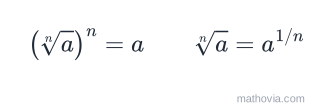
Why the Radical of a Power Returns the Base
This isn’t a separate rule to memorize — it falls directly out of the Power Rule for exponents. Since
Raising the
Properties of Radicals
| Rule | Statement |
|---|---|
| Product Rule for Radicals | |
| Quotient Rule for Radicals | |
| Power of a Radical | |
| Radical of a Power | |
| Exponent Form | |
| Exponent Form of a Power |
The Product and Quotient Rules are exactly how every simplification technique in this lesson works — everything below is one of those two rules applied with a specific goal.
Simplifying Radicals
To simplify
Stopping at a smaller factor still works arithmetically but leaves a second simplification step behind —
Example 1: Simplifying Radicals
| Expression | Perfect-Power Factor | Simplified |
|---|---|---|
Combining Like Radicals
Just as only like terms combine in a polynomial, only like radicals — the same index and the same radicand — combine, by adding or subtracting their coefficients:
Example 2: Combining and Multiplying Radicals
| Expression | Rule Applied | Result |
|---|---|---|
| Combine like radicals | ||
| Combine like radicals | ||
| Product Rule | ||
| Multiply coefficients, then the Product Rule | ||
| Product Rule |
Rationalizing Denominators
A denominator with a single radical term clears by multiplying top and bottom by that same radical:
A denominator with a radical binomial, like
Example 3: Rationalizing Denominators
| Expression | Multiply By | Result |
|---|---|---|
Worked Example A: Simplifying and Combining
Simplify
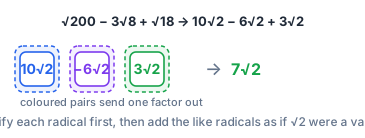
Step 1 — simplify each radical separately:
Step 2 — combine, since every term is now a like radical:
Nothing can be combined until every radical is simplified first — three unlike-looking radicals turned out to be the same radical in disguise.
Worked Example B: Rationalizing with a Conjugate
Simplify
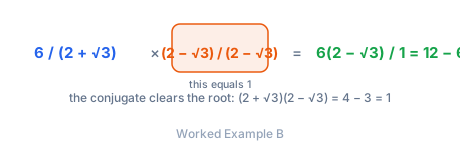
Step 1 — multiply by the conjugate of the denominator:
Step 2 — the denominator becomes a difference of squares:
Step 3 — distribute the numerator:
Since the denominator simplified all the way to
Worked Example C: Radicals with Variables
Simplify
Step 1 — factor out the largest perfect-square factor:
Step 2 — apply the Product Rule:

Common Mistakes to Avoid
- Stopping at a partial factorization.
is technically true but incomplete — still has a perfect-square factor. Always use the largest perfect-power factor, or re-check what’s left. - Adding radicals with different radicands or indices.
stays exactly as it is; it never becomes . - Multiplying radicals but forgetting the coefficients.
, not — the coefficients multiply too. - Assuming a radical distributes over a sum.
. Test it: , but . - Leaving a radical in the denominator. A radical answer isn’t fully simplified until the denominator is rationalized.
- Getting the conjugate’s sign backward. The conjugate of
is — only the middle sign flips, not both terms.
Practice Problems
Work each problem yourself before opening the answer.
Problem 1. Simplify
Show answer
Answer:
Problem 2. Simplify
Show answer
Answer:
Problem 3. Simplify
Show answer
Answer:
Problem 4. Simplify
Show answer
Answer:
Problem 5. Simplify
Show answer
Step 1 — multiply the coefficients and the radicands separately:
Step 2 — simplify the resulting radical:
Answer:
Problem 6. Rationalize
Show answer
Answer:
Problem 7. Rationalize
Show answer
Step 1 — multiply by the conjugate:
Step 2 — the denominator becomes a difference of squares:
Step 3 — distribute the numerator:
Answer:
Problem 8. Simplify
Show answer
Answer:
Problem 9. Evaluate
Show answer
Answer:
Problem 10. Simplify
Show answer
Answer:
Quick Reference
| Situation | Move |
|---|---|
| Radicand has a perfect | Pull it out with the Product Rule |
| Same index and radicand | Combine by adding/subtracting coefficients |
| Multiplying radicals | Multiply coefficients together, radicands together, then simplify |
| One radical term in the denominator | Multiply by that same radical over itself |
| A radical binomial in the denominator | Multiply by its conjugate |
| Different radicands, or a sum inside the radical | No rule applies; simplify separately instead |
Solving radical equations comes next, and the conjugate trick used here to rationalize a denominator reappears almost unchanged in Complex Numbers, just clearing an imaginary denominator instead of a radical one. If Rational Exponents or Integer Exponents would help as a refresher, they’re both there. For more practice, try the Radical Practice Problems; for everything else, the Algebra lessons and the site’s calculators are worth a look too.