
Ask three people to write down “the polynomial with terms

What Is Polynomial Standard Form?
A polynomial in one variable is in standard form when its terms are arranged from the highest exponent to the lowest:
Reading left to right, the exponents strictly decrease:
| Polynomial | In standard form? | Why |
|---|---|---|
| yes | exponents | |
| no | ||
| yes | ||
| no | ascending order | |
| no | like terms not combined |
The third row matters. Standard form does not require every power to be present —
How to Write a Polynomial in Standard Form
Three steps, and the first two are only needed if the polynomial is not already a plain sum of terms.
Step 1 — expand. Multiply out any brackets so the polynomial is a sum of individual terms. This is where multiplying polynomials comes in.
Step 2 — simplify. Combine like terms — terms with the same power of
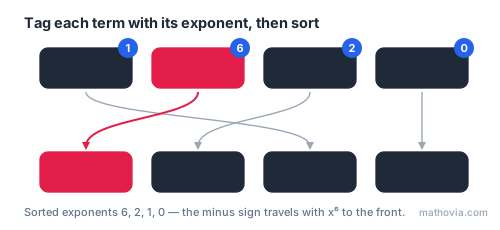
Step 3 — order. Identify the exponent on every term and rewrite from largest to smallest, carrying each term’s sign with it.
For a polynomial that is already expanded and simplified, only Step 3 applies:
The exponents were
Standard Form With More Than One Variable
For a polynomial in two variables, “descending order” is usually taken with respect to one chosen variable, most often
Some textbooks instead order by the total degree of each term (the sum of the exponents), which would put
Worked Example: Simplify the Expression to a Polynomial in Standard Form
Write
Step 1 — expand. Multiply each term of the first bracket by each term of the second:
Step 2 — simplify. Combine the
Step 3 — order. The exponents are already
Degree
Worked Example: Terms That Cancel
Write
Step 1 — expand both pieces, distributing the minus sign across the whole second bracket:
Step 2 — simplify. The
Step 3 — order. Exponents
The expression looked cubic and turned out to be quadratic. Until you have simplified, you do not know the degree — which is why simplifying comes before reading off the leading term, never after.
Worked Example: Reordering a Scrambled Polynomial
Write
Step 1 — expand. Nothing to expand.
Step 2 — simplify. Two
Step 3 — order. Exponents
Degree
Why Standard Form Matters
It is tempting to treat this as pedantry. It is not — nearly everything downstream assumes the ordering:
- Degree and leading coefficient are read from the first term, which is only the leading term if the polynomial is in standard form. The end behavior of the graph depends on exactly those two numbers.
- Polynomial long division and synthetic division work column by column in descending powers. A polynomial out of order gives a wrong quotient; a polynomial with a missing power needs a
placeholder in that column. - Comparing polynomials — checking whether two expressions are equal — is a term-by-term comparison, which only works if both are laid out the same way.
- The rational root theorem uses the leading coefficient and constant term specifically, so both must be correctly identified.
Standard form is the state a polynomial should be in before you do anything else with it.
Common Mistakes to Avoid
- Ordering before simplifying.
is not “a quartic in standard form” — the terms cancel and it is really . Combine like terms first. - Losing a sign when moving a term. In
, the is negative and stays negative when it moves to the front: , not . - Writing ascending order.
is a perfectly good polynomial but it is not in standard form. Standard form always starts with the highest power. - Padding with zero terms.
is not wrong, but it is not required, and outside of a division setup it just clutters the answer. Write . - Forgetting to distribute a minus sign. In
, every term inside flips: . Flipping only the first term is the most common expansion error. - Ordering by coefficient size.
might look “biggest first”, but standard form sorts by exponent: .
Practice Problems
Work each one before opening the answer.
Problem 1. Write
Show answer
Step 1 — exponents are
Answer:
Problem 2. Write
Show answer
Step 1 — exponents
Answer:
Problem 3. Simplify
Show answer
Step 1 — combine like terms:
Step 2 — already in descending order.
Answer:
Problem 4. Express
Show answer
Step 1 — expand:
Step 2 — simplify:
Answer:
Problem 5. Write
Show answer
Step 1 — expand, distributing the minus sign through the second bracket:
Step 2 — simplify:
Answer:
Problem 6. Which of these is in standard form? For each that is not, say why.
(a)
Show answer
(a) No —
(b) No — the like terms are not combined. Standard form is
(c) Yes — exponents
(d) Yes — a constant on its own is trivially in standard form.
Answer: (c) and (d)
Standard form is a small habit with a large payoff. Once a polynomial is expanded, simplified, and ordered, its degree and leading coefficient are the first things on the page, its end behavior follows immediately, and it is ready to be divided, factored, or graphed without any further rearranging.