
Earthquakes range from tremors that only a sensitive instrument can detect to ruptures that level cities, and the biggest shake the ground millions of times harder than the smallest. Writing those numbers out would be hopeless. In 1935 the seismologist Charles Richter solved the problem with a common logarithm: instead of recording the size of the shaking itself, record its power of ten. The result, the Richter scale, turns a range of millions into the single-digit numbers you hear on the news, and it is one of the best real-world reasons to learn logarithms.
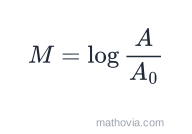
The Richter Scale Formula
| Symbol | Meaning |
|---|---|
| the earthquake’s magnitude | |
| the maximum amplitude of the seismic waves, read from a seismograph | |
| a fixed reference amplitude, the reading a “magnitude 0” quake would produce | |
| the common logarithm, base |
The fraction
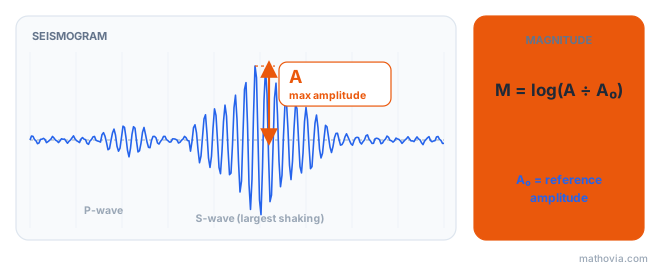
Writing the definition in exponential form gives the reverse question, “how big was the shaking for a given magnitude?”:
Why Each Step Is 10 Times Bigger
Because the magnitude is an exponent, adding
Energy grows even faster. Seismologists use the Gutenberg–Richter energy relation,
So one step up the scale means
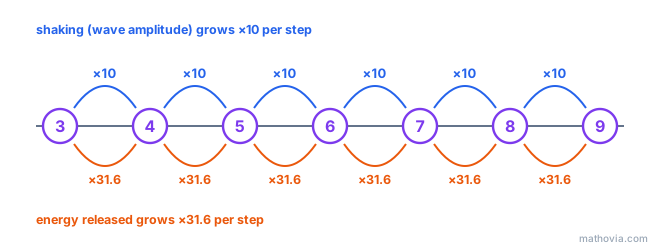
| Magnitude difference | Amplitude ratio | Energy ratio |
|---|---|---|
The first row surprises most people: a quake just
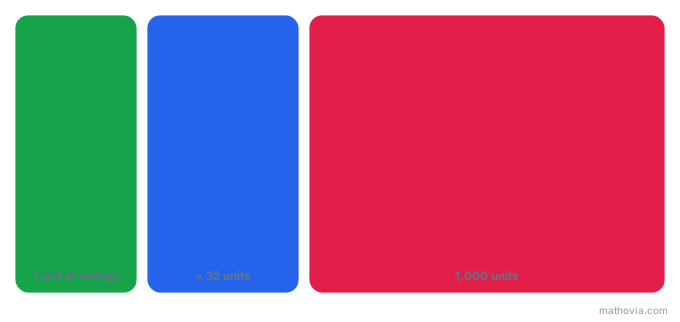
Energy Released by Magnitude
Using
| Magnitude | Energy (joules) | TNT equivalent | What it feels like |
|---|---|---|---|
| about | usually not felt | ||
| about | rattles windows and dishes | ||
| about | damage near the epicenter | ||
| about | major earthquake | ||
| about | among the largest ever recorded |
A magnitude
Magnitude vs Intensity: Richter vs Mercalli
News reports use two different scales, and they measure different things.
| Richter (magnitude) | Modified Mercalli (intensity) | |
|---|---|---|
| Measures | the size of the earthquake at its source | the shaking and damage at one location |
| Based on | seismograph readings | what people feel and what gets damaged |
| Values | decimal numbers, e.g. | Roman numerals I to XII |
| One earthquake has | one magnitude | many intensities, strongest near the epicenter |
| Mathematics | logarithmic | descriptive categories |
On the Mercalli scale, intensity II is felt only by a few people at rest, V is felt by nearly everyone and can break dishes, VIII causes considerable damage to ordinary buildings, and XII means near-total destruction. A magnitude
Richter Scale Word Problems
Almost every Richter scale word problem is one of four types. The method for each:
| Question type | What to use |
|---|---|
| Find the magnitude from an amplitude | |
| How many times stronger is the shaking? | |
| How many times more energy? | |
| Find a magnitude from a comparison |
Worked Example
The 2011 earthquake off the coast of Japan measured
Step 1 — find the magnitude difference:
Step 2 — compare the amplitudes:
Step 3 — compare the energies:
The Japan earthquake’s waves were about
Linear vs Logarithmic Scale
On a linear scale, equal steps add the same amount:
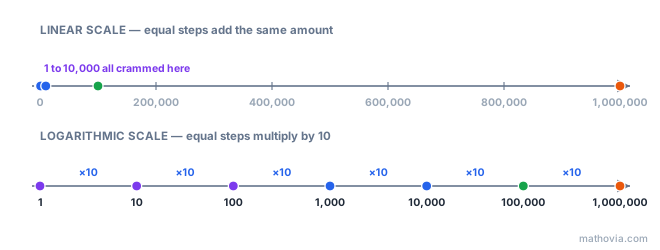
How to read a logarithmic scale: each labeled step is a power of ten, so moving one step multiplies by
Other Logarithmic Scales
The Richter scale has plenty of relatives. Each uses a logarithm for the same reason: the quantity spans too many powers of ten to write out comfortably.
| Scale | Formula | One step means |
|---|---|---|
| Richter magnitude | ||
| pH (acidity) | ||
| Decibels (sound) | ||
| Moment magnitude | based on the energy of the fault slip | same steps as Richter, accurate for large quakes |
Decibel problems use the same moves as the ones on this page. There are worked examples in the exponential vs logarithmic functions lesson.
Common Mistakes to Avoid
- Treating magnitude as linear. A magnitude
is not twice a magnitude . Its amplitude is times larger. - Using
for the energy ratio. Energy grows by per step, not . Read the question carefully: “shaking” or “amplitude” means , “energy” means . - Subtracting amplitudes instead of dividing. The magnitude difference comes from the ratio
, never from . - Using
instead of . The Richter scale is defined with the base- logarithm. - Confusing magnitude with intensity. A single quake has one magnitude, but its Mercalli intensity changes from place to place.
Practice Problems
Work each one before opening the answer.
Problem 1. A seismograph records waves
Show answer
Step 1 — apply the formula:
Step 2 —
Answer: magnitude
Problem 2. An earthquake’s waves are
Show answer
Step 1 — apply the formula:
Step 2 — evaluate with a calculator:
Answer: magnitude
Problem 3. How many times larger is the wave amplitude of a magnitude
Show answer
Step 1 — the magnitude difference:
Step 2 — raise
Answer: about
Problem 4. How many times more energy does a magnitude
Show answer
Step 1 — the magnitude difference:
Step 2 — use the energy ratio:
Answer: about
Problem 5. An earthquake produces waves
Show answer
Step 1 — the ratio gives the magnitude difference:
Step 2 — add it to the smaller magnitude:
Answer: magnitude
Problem 6. Use
Show answer
Step 1 — substitute
Step 2 — rewrite in exponential form:
Answer:
Every one of these problems uses the same idea: a logarithm turns multiplication into addition. That’s why the Richter scale can describe both a tremor you’d sleep through and the largest quake ever recorded using numbers that fit between