Mathovia

Algebra / Systems of Equations

Inverse of a Matrix

The inverse of a matrix undoes it, the way dividing undoes multiplying. For a 2×2 matrix there's a three-move shortcut; for a 3×3 you row-reduce. Either way, the inverse turns a whole system of equations into a single multiplication.

Practice Problems
Written by
MPhil in Mathematics, Founder of Mathovia
Published

Mathematics verification: Mathematical formulas, calculations, worked examples and solutions are reviewed for accuracy before publication. How we check our work

With ordinary numbers, you undo multiplying by 4 by multiplying by . Matrices can’t be divided, but many of them have an inverse that does the same job: multiply by it and the original matrix is undone. Finding that inverse is a standard Algebra 2 and precalculus skill, and it has a very practical payoff. A whole system of linear equations becomes one matrix multiplication, which is how calculators and computers solve them.
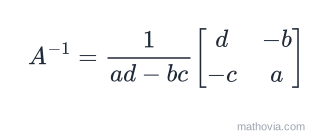
The inverse of the 2 by 2 matrix with rows a, b and c, d is 1 over (ad minus bc) times the matrix with rows d, minus b and minus c, a
The inverse of a 2×2 matrix

What Is the Inverse of a Matrix?

The identity matrix has 1s down the main diagonal and 0s everywhere else. Multiplying any matrix by leaves it unchanged, so behaves like the number 1:

The inverse of a square matrix , written , is the matrix that multiplies with to give the identity:

Only square matrices can have inverses, and not all of them do. The deciding number is the determinant, the same one used in Cramer’s rule.

The Inverse of a 2×2 Matrix

For , the inverse is

which comes down to three moves:

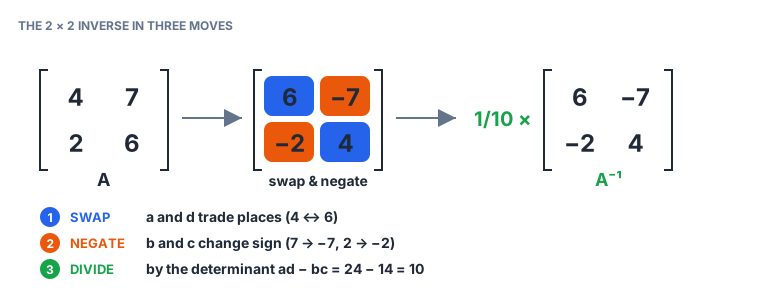
The matrix with rows 4, 7 and 2, 6 becomes the matrix with rows 6, −7 and −2, 4 after swapping 4 and 6 and negating 7 and 2, then multiplying by 1/10 because the determinant is 24 − 14 = 10
Swap the diagonal, negate the other two, divide by the determinant

Example 1: A 2×2 Inverse

Find the inverse of .

Step 1 — the determinant. . It isn’t zero, so the inverse exists.

Step 2 — swap and negate. Swap 4 and 6; change the signs of 7 and 2:

Step 3 — divide by the determinant.

Check. Multiply back: the top-left entry of is , and the top-right is . The other two entries work the same way, giving .

When a Matrix Has No Inverse

If the determinant is zero, the formula would divide by zero, and the matrix has no inverse. It’s called singular. For example,

so has no inverse. Notice that its second row is half of the first. A singular matrix always has rows (or columns) that depend on each other like that, which is also why the matching system of equations has no unique solution.

The Inverse of a 3×3 Matrix

There’s no quick three-move shortcut for a 3×3 matrix. The reliable method is row reduction, the same technique used to solve a system with an augmented matrix:

  1. Write and the identity matrix side by side as .
  2. Use row operations to turn the left half into .
  3. The right half is now .
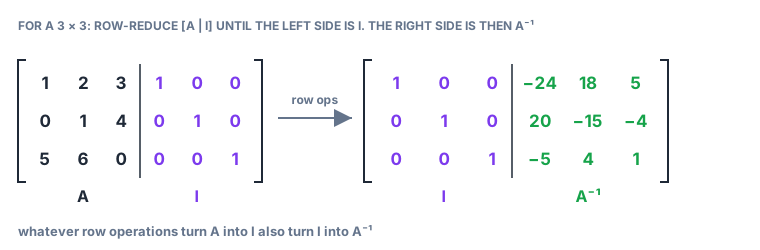
The augmented matrix with A on the left (rows 1, 2, 3 / 0, 1, 4 / 5, 6, 0) and the identity on the right is row-reduced to the identity on the left and A inverse on the right (rows −24, 18, 5 / 20, −15, −4 / −5, 4, 1)
The row operations that turn A into I turn I into A⁻¹

Example 2: A 3×3 Inverse

For , row-reducing gives

It’s a long calculation by hand, with eight or nine row operations. The check is quick, though: the first row of times the first column of is , as it should be for the top-left entry of . For more than a quick check, the Gaussian elimination calculator shows row operations step by step.

Solving a System With an Inverse Matrix

Any system of linear equations can be written as one matrix equation:

where holds the coefficients, the unknowns and the constants. Multiplying both sides on the left by gives the solution in one step:

Example 3: A System Solved by the Inverse

Solve and .

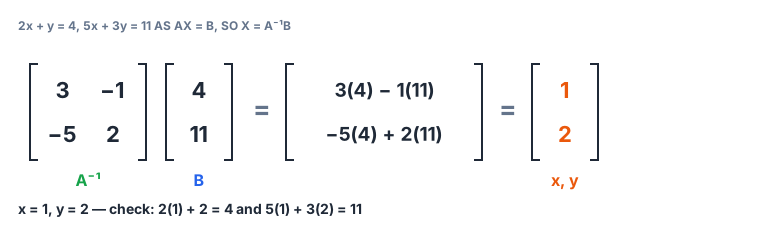
Step 1 — the inverse. has determinant , so .

Step 2 — multiply by the constants.

The inverse matrix with rows 3, −1 and −5, 2 times the column 4, 11 equals the column 3(4) − 1(11), −5(4) + 2(11), which is 1, 2, so x = 1 and y = 2
X = A⁻¹B turns the system into one multiplication

So and . The real advantage shows when several systems share the same coefficients and only the constants change: find once, then each new system is a single multiplication.

Properties of Inverse Matrices

A few facts about inverses save work and catch errors:

PropertyWhat it means
inverting twice gets you back where you started
to undo two steps, undo them in reverse order, like taking off socks after shoes
the inverse’s determinant is the reciprocal of the original’s
the identity is its own inverse

The determinant property gives a quick sanity check. In Example 1, , so the inverse should have determinant . Indeed, . If that check fails, there’s an arithmetic slip somewhere.

Common Mistakes to Avoid

  • Negating the wrong entries. The main diagonal ( and ) swaps; the other two ( and ) change sign.
  • Forgetting to divide by the determinant, or dividing by .
  • Not checking the determinant first. If it’s zero, there’s no inverse to find.
  • Multiplying in the wrong order. , not ; matrix multiplication isn’t commutative.
  • Treating as entry by entry. The inverse of a matrix is not the matrix of reciprocals.

Practice Problems

Work each one before opening the answer.

Problem 1. Find the inverse of .

Show answer

The determinant is . Swap and negate:

Answer:

Problem 2. Does have an inverse?

Show answer

Its determinant is , so it is singular.

Answer: no

Problem 3. Find the inverse of .

Show answer

For a diagonal matrix, take the reciprocal of each diagonal entry.

Answer:

Problem 4. Find the inverse of .

Show answer

The determinant is :

Answer:

Problem 5. Use the inverse from Problem 1 to solve , .

Show answer

Answer: ,

Problem 6. For which value of does have no inverse?

Show answer

Set the determinant to zero: .

Answer:

Inverses and determinants are the core of matrix algebra, and they come back in any later course in linear algebra or computer graphics, where transformations are undone by multiplying by an inverse.

Frequently Asked Questions

What is the inverse of a matrix?+

The inverse of a square matrix is the matrix that gives the identity matrix when multiplied by : . The identity matrix has 1s on the main diagonal and 0s everywhere else, and it plays the role of the number 1.

How do you find the inverse of a 2×2 matrix?+

Swap the two entries on the main diagonal, change the sign of the other two, and divide every entry by the determinant . For a matrix with rows 4, 7 and 2, 6, the determinant is 10 and the inverse has rows 0.6, −0.7 and −0.2, 0.4.

How do you find the inverse of a 3×3 matrix?+

Write the matrix next to the 3×3 identity matrix, as , and use row operations until the left side becomes the identity. The right side is then . If the left side can't be reduced to the identity, the matrix has no inverse.

When does a matrix not have an inverse?+

When its determinant is zero. Such a matrix is called singular. For a 2×2 matrix, the shortcut would mean dividing by zero. Only square matrices can have inverses at all.

How do you solve a system of equations with an inverse matrix?+

Write the system as , with the coefficient matrix, the column of unknowns and the column of constants. Then : multiply the inverse by the constants and read off the values.

Related lessons

Calculators for this topic