Mathovia

Algebra / Exponential & Logarithmic Functions

Exponential Growth and Decay

Anything that changes by the same percentage each period — a population, a bank balance, a drug in the bloodstream — follows an exponential model. Growth and decay are the same formula; the only difference is whether the factor is above or below 1.

Practice Problems
Written by
MPhil in Mathematics, Founder of Mathovia
Published

Mathematics verification: Mathematical formulas, calculations, worked examples and solutions are reviewed for accuracy before publication. How we check our work

Exponential functions earn their place in algebra because the world is full of quantities that change by a percentage rather than a fixed amount. A savings account earns interest on its interest; a bacteria colony’s growth rate rises with its size; a radioactive sample loses the same fraction of what remains every hour. All of these are exponential growth and decay, and a single formula handles every one of them — the same one behind the half-life calculator and every compound-interest table you will ever see.
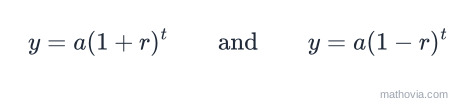
Growth formula y = a(1 + r)^t and decay formula y = a(1 - r)^t
Exponential growth and decay formulas

The Growth and Decay Formulas

Start from the general exponential function , with for time. When the change is given as a percentage rate (written as a decimal), the factor is built from it:

SymbolMeaning
initial amount, at
rate per period, as a decimal ()
growth factor — what the amount is multiplied by each period
decay factor — the fraction that remains each period
number of periods elapsed

The reason for the is that you keep the whole amount and add the percentage. Growing by means multiplying by , not by .

Exponential Growth vs Decay

Exponential growthExponential decay
Factor
Graphrises, steeper and steeperfalls, flatter and flatter
Long runincreases without boundapproaches , never reaches it
Examplespopulations, compound interest, viral spreadradioactive decay, depreciation, medicine leaving the body

Which equation represents exponential growth? Look only at the base. is growth; is decay; is decay too, because and .
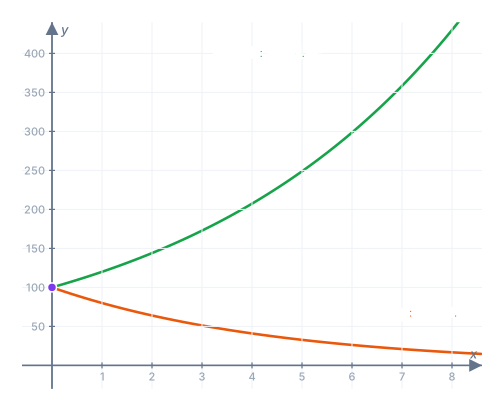
y = 100(1.2)^t rising and y = 100(0.8)^t falling from the same starting value of 100
Same start, factor 1.2 versus factor 0.8

Converting Between Rates and Factors

DescriptionRate Factor
grows per year
grows per hour
decays per year
decays per month
doubles each period
halves each period

Reading a factor backwards is just as quick: is growth, and is decay, because .

Doubling Time and Half-Life

Some quantities are described by how long they take to double or halve rather than by a percentage. Put the time scale into the exponent:

Here is the doubling time and the half-life. The fraction counts how many doublings have happened: after hours with a -hour doubling time, , so the amount has been multiplied by .

Compound Interest

Money is the most common growth model. When an annual rate is compounded times a year for years:

and when it is compounded continuously, the base becomes :

For at for years, monthly compounding gives , and continuous compounding gives . More frequent compounding always helps, but with sharply diminishing returns. The continuous compound interest lesson shows where comes from and how to solve for the time or the rate.

Logistic and Exponential Growth

Pure exponential growth cannot last. A population doubling every generation would outgrow its food, space or host. Logistic growth models that limit:

Early on, the logistic curve is almost identical to an exponential one. As approaches the carrying capacity , growth slows and the curve levels off into an S shape. Use an exponential model for the early stage of growth, and a logistic one when a ceiling is part of the story. The full comparison, including the three phases and where growth is fastest, is in exponential vs logistic growth.
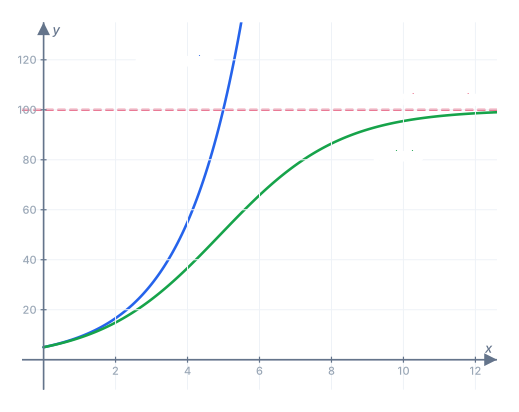
An exponential curve rising without limit beside a logistic S-curve that levels off at the carrying capacity K
Exponential growth accelerates forever; logistic growth levels off at K

Example 1: Exponential Function Word Problems With Answers

SituationModelResult
people, per year, years people
car, per year, years
bacteria, doubling every h, h
mg drug, half-life h, h mg
at , monthly, years

Worked Example

A town of people grows by per year. Write a model and predict the population after years and after years.

Step 1 — identify the initial amount and the rate:

Step 2 — build the growth factor:

Step 3 — write the model:

Step 4 — evaluate at :

Step 5 — evaluate at :

The population grows by about in the first ten years but by about in the next fifteen — the yearly increase keeps getting larger because is taken of an ever-larger number.

Common Mistakes to Avoid

  • Using as the factor. A growth rate gives , not . Multiplying by would wipe out of the amount each year.
  • Subtracting the percentage once instead of every period. Losing a year for years is , a total loss — not .
  • Mismatching time units. If the rate is per month, must be in months. A half-life in hours needs in hours.
  • Expecting decay to reach zero. is always positive. In practice you round to zero when the amount becomes negligible, but the model never gets there.

Practice Problems

Work each one before opening the answer.

Problem 1. Classify each as growth or decay and give the percentage rate: and .

Show answer

Step 1 — , so the first is growth:

Step 2 — , so the second is decay:

Answer: growth; decay

Problem 2. A town of shrinks by per year. Write the model and find the population after years.

Show answer

Step 1 — the decay factor is :

Step 2 — evaluate at :

Answer: about people

Problem 3. is invested at compounded annually. How much is there after years?

Show answer

Step 1 — annual compounding means , so the factor is :

Step 2 — evaluate:

Answer:

Problem 4. A g sample has a half-life of days. How much remains after days?

Show answer

Step 1 — count the half-lives:

Step 2 — halve three times:

Answer: g

Problem 5. A culture of cells triples every hours. How many cells are there after hours?

Show answer

Step 1 — the number of tripling periods:

Step 2 — apply the factor four times:

Answer: cells

Problem 6. A phone loses of its value each year. After how many whole years is it first worth less than ?

Show answer

Step 1 — the model is . Evaluate year by year:

Step 2 — one more year:

Answer: after years (it is still after )

Problem 6 was solved by trial because the unknown is in the exponent. To solve for time directly — “when will the balance double?” — you need the inverse of an exponential function, which is the subject of the logarithms lesson.

Frequently Asked Questions

What is the difference between exponential growth and decay?+

Both use . In growth the factor is greater than , so the quantity is multiplied by more than itself each period and increases. In decay , so each period keeps only a fraction and the quantity shrinks toward zero without ever reaching it.

How do you find the growth factor from a percentage?+

Write the percentage as a decimal . For growth the factor is , so 6% growth gives . For decay the factor is , so 6% decay gives . Reading it backwards, means 25% decay per period.

How is logistic growth different from exponential growth?+

Exponential growth keeps accelerating forever. Logistic growth starts out looking exponential but slows as it approaches a ceiling called the carrying capacity, giving an S-shaped curve. Real populations follow the logistic pattern once food or space runs short.

Related lessons

Calculators for this topic