
There are two ways to describe a sequence. You can give a formula that produces any term directly from its position, or you can say where the sequence starts and how each term follows from the last. The second way is a recursive formula, and it’s often the more natural one. “Start with
What Is a Recursive Formula?
A recursive formula has two parts:
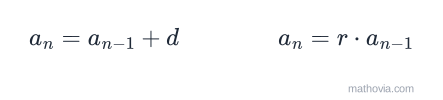
- A starting value, such as
. - A rule that gives each term in terms of the one before, such as
.
Read
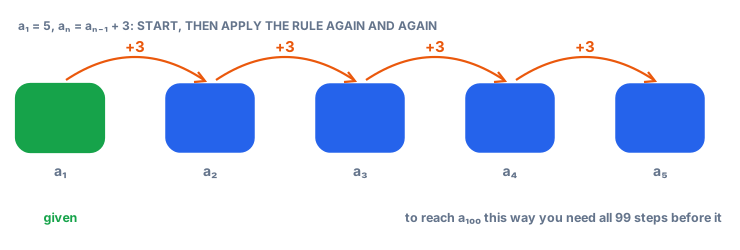
That’s the strength and the weakness of the recursive approach. It describes the process clearly, but to find the 100th term you have to work out the 99 terms before it.
Using a Recursive Formula to List Terms
Example 1. List the first four terms of
Step 1 — the first term is given:
Step 2 — apply the rule to it:
Step 3 — keep going, each time using the term you just found:
The first four terms are 4, 10, 28, 82. This sequence is neither arithmetic nor geometric, and the recursive formula still describes it perfectly well.
Writing Recursive Formulas
Arithmetic Sequences
An arithmetic sequence adds the same amount each time, so its rule adds the common difference
Example 2. Write a recursive formula for 7, 11, 15, 19, …
The first term is 7 and each term is 4 more than the last, so
Geometric Sequences
A geometric sequence multiplies by the same number each time, so its rule multiplies by the common ratio
Example 3. Write a recursive formula for 80, 40, 20, 10, …
Each term is half the one before:
Rules That Use Two Previous Terms
Some sequences need more than one earlier term. In the Fibonacci sequence each term is the sum of the two before it.
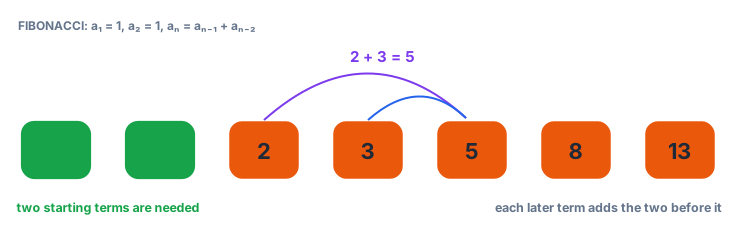
Because the rule reaches back two terms, it needs two starting values. With only
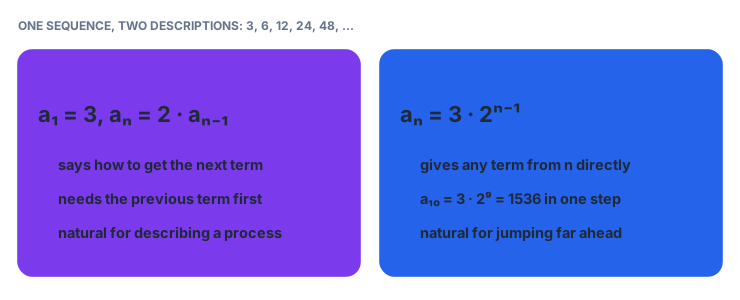
Recursive vs Explicit Formulas
An explicit formula gives
| Recursive | Explicit | |
|---|---|---|
| Arithmetic | ||
| Geometric | ||
| Needs | the first term and the previous term | only |
| Best for | describing a step-by-step process | finding a term far along |
Converting Recursive to Explicit
Example 4. Find an explicit formula for
The rule adds 5, so the sequence is arithmetic with
Check:
Converting Explicit to Recursive
Example 5. Write
The first term is
When the Rule Is Neither
Example 6.
It isn’t arithmetic or geometric, but listing the terms shows each is one less than a power of 2, so the explicit formula is
Other Ways Recursive Formulas Are Written
Textbooks and calculators use a few different notations for the same idea:
| Notation | Meaning |
|---|---|
| each term is the previous term plus 3 | |
| the next term is this term plus 3 | |
| the same rule in function notation | |
| NEXT = NOW + 3 | the plain-language version some courses use |
They all describe the same sequence once the first term is given. Watch the starting index: some books start at
Common Mistakes to Avoid
- Leaving out the first term. A rule on its own describes infinitely many sequences.
- Using
in place of the previous term. In , multiply the previous term, not the position. - Skipping a term. Each term must come from the one immediately before it.
- Giving only one starting term for a two-term rule. Fibonacci-type rules need two.
- Mixing up
and . Arithmetic rules add; geometric rules multiply.
Practice Problems
Work each one before opening the answer.
Problem 1. List the first four terms of
Show answer
Start at 6 and subtract 4 each time.
Answer: 6, 2, −2, −6
Problem 2. List the first four terms of
Show answer
Start at 2 and multiply by 5 each time.
Answer: 2, 10, 50, 250
Problem 3. Write a recursive formula for 9, 13, 17, 21, …
Show answer
The first term is 9 and the common difference is 4.
Answer:
Problem 4. Write a recursive formula for 1, −3, 9, −27, …
Show answer
Each term is
Answer:
Problem 5. Find an explicit formula for
Show answer
It’s arithmetic with
Answer:
Problem 6. Given
Show answer
Each term adds the two before it:
Answer: 5, 8, 13
Recursive formulas describe how a sequence grows one step at a time. When you need to add up many of those steps at once, sigma notation and the series formulas take over.