
Every pattern in this lesson is the reverse of one from Polynomials. Multiplying
What Is Factoring?
Factoring means rewriting a polynomial as a product of simpler polynomials, called factors. A polynomial is factored completely when none of its factors can be broken down any further — no common factor left to pull out, and no recognizable pattern left hiding inside a factor.
Factoring Out the GCF
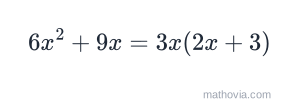
The first move on every factoring problem, no exceptions: find the greatest common factor (GCF) of every term, and factor it out using the distributive property in reverse.
Here the GCF is
Properties of Factoring
| Pattern | Name | Statement |
|---|---|---|
| GCF | ||
| Difference of Squares | ||
| Perfect Square Trinomial | (sum) | |
| Perfect Square Trinomial | (difference) | |
| Trinomial, leading coefficient 1 |
The last row is the key to factoring
Example 1: Factoring Out the GCF
| Expression | GCF | Factored |
|---|---|---|
Example 2: Factoring Special Patterns
| Expression | Pattern | Factored |
|---|---|---|
| Difference of squares | ||
| Difference of squares | ||
| Perfect square trinomial | ||
| Perfect square trinomial |
Example 3: Factoring x² + bx + c
Find two numbers that multiply to
| Expression | Two Numbers | Factored |
|---|---|---|
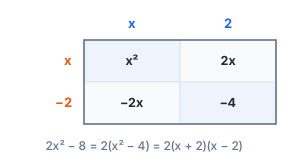
Worked Example A: GCF, Then a Pattern
Factor
Step 1 — factor out the GCF:
Step 2 — recognize the difference of squares inside:
Final answer:
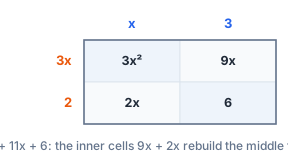
Worked Example B: The ac Method
Factor
Step 1 — multiply
Step 2 — split the middle term using those two numbers:
Step 3 — factor by grouping, pulling a common factor from each pair:
Check by expanding:
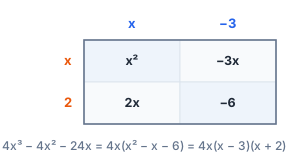
Worked Example C: GCF, Then a Trinomial
Factor
Step 1 — factor out the GCF:
Step 2 — factor the trinomial: find two numbers multiplying to
Step 3 — write the factored trinomial:
Final answer:
Common Mistakes to Avoid
- Skipping the GCF. Missing a common factor doesn’t make the rest wrong, but it often hides the pattern that would have made the problem simple.
- Sign errors on the two-numbers step. For
, the numbers need a product of (one positive, one negative) and a sum of — check both conditions, not just one. - Assuming
factors like . It doesn’t; a sum of squares has no real-number factorization. - Stopping before it’s complete.
still has a difference of squares inside — always re-check every factor for one more pattern. - Never checking the answer. Multiplying the factors back out catches sign and arithmetic errors in seconds.
Practice Problems
Work each problem yourself before opening the answer.
Problem 1. Factor
Show answer
Answer:
Problem 2. Factor
Show answer
Answer:
Problem 3. Factor
Show answer
Answer:
Problem 4. Factor
Show answer
Answer:
Problem 5. Factor
Show answer
Two numbers multiplying to
Answer:
Problem 6. Factor
Show answer
Two numbers multiplying to
Answer:
Problem 7. Factor
Show answer
Step 1 — multiply
Step 2 — split and group:
Answer:
Problem 8. Factor
Show answer
Step 1 — factor out the GCF:
Step 2 — factor the difference of squares:
Answer:
Problem 9. Factor
Show answer
Step 1 — factor out the GCF:
Step 2 — factor the trinomial (numbers multiplying to
Answer:
Problem 10. Factor
Show answer
Answer:
Quick Reference
| Situation | Move |
|---|---|
| Every term shares a common factor | Factor out the GCF first, always |
| Find two numbers multiplying to | |
| The ac method: split the middle term, factor by grouping | |
| Does not factor over the real numbers |
These patterns become the main tool in Rational Expressions, where factoring is exactly what simplifies, multiplies, and divides fractions built from polynomials. Polynomials is worth a second look if any pattern above didn’t quite click. From here, the Factoring Practice Problems offers unlimited practice, and both the Algebra lessons list and the site’s calculators keep expanding.