Mathovia

Algebra / Preliminaries

Complex Numbers

A complex number extends the real numbers by defining a new number, i, whose square is negative — something no real number can do. This lesson covers the arithmetic of complex numbers, and reuses the exact conjugate trick from Radicals to divide them.

Practice Problems
Written by
MPhil in Mathematics, Founder of Mathovia
Published

Mathematics verification: Mathematical formulas, calculations, worked examples and solutions are reviewed for accuracy before publication. How we check our work

Radicals stops just short of one question: what is ? No real number answers it, since no real number squared gives a negative result. Complex numbers exist to answer that question directly, and the conjugate trick that rationalizes a radical denominator turns out to be exactly the tool that divides complex numbers too.
Complex Numbers — key formula
Key formula

What Is a Complex Number?

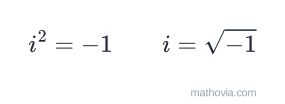
Define , the imaginary unit, as the number whose square is :

A complex number has the standard form , where is the real part and is the imaginary part (both ordinary real numbers). , , and (where ) are all complex numbers — every real number is a complex number with imaginary part zero.

Powers of i: A Repeating Cycle

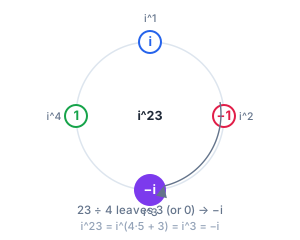
Powers of repeat in a cycle of four, which follows directly from :

Since , multiplying by again just returns to , and the pattern repeats forever. To simplify any power of , divide the exponent by and use the remainder: , , , .

Properties of Complex Numbers

RuleStatement
Definition
Addition
Subtraction
Multiplication
Complex ConjugateThe conjugate of is
Conjugate Product

Addition and subtraction combine real parts with real parts and imaginary parts with imaginary parts, exactly like combining like terms in a polynomial. Multiplication is FOIL, followed by replacing with .

Example 1: Adding and Subtracting

ExpressionResult

Example 2: Multiplying Complex Numbers

ExpressionRule AppliedResult
FOIL, then
FOIL, then
Conjugate Product
Distribute, then

Dividing Complex Numbers

A denominator with an in it clears the same way a radical denominator does: multiply top and bottom by the denominator’s conjugate. The Conjugate Product rule guarantees the denominator becomes a real number with no left at all.

Example 3: Dividing Complex Numbers

ExpressionMultiply ByResult

Worked Example A: Multiplying Two Complex Numbers

Multiply .

Step 1 — apply FOIL:

Step 2 — replace with :

Step 3 — combine real and imaginary parts:
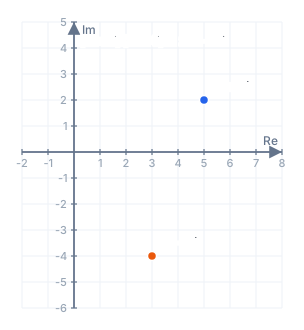
Worked Example A: the product 23 − 14i on the complex plane.

Worked Example B: Dividing with a Conjugate

Divide .

Step 1 — multiply by the conjugate of the denominator:

Step 2 — the denominator becomes a real number (Conjugate Product):

Step 3 — expand the numerator:

Final answer: .
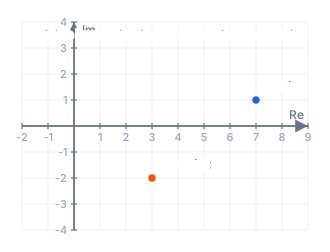
Worked Example B: divide by multiplying by the conjugate.

Worked Example C: A High Power of i

Simplify .

Step 1 — divide the exponent by 4 and find the remainder:

Step 2 — a remainder of 3 corresponds to :

Step 3 — evaluate:

Worked Example C: i^23 lands on i³ = −i after five full cycles.

Common Mistakes to Avoid

  • Treating as instead of . This single substitution is the source of almost every step in this lesson — get it backward and everything downstream breaks.
  • Multiplying straight across instead of using FOIL. needs all four products, exactly like multiplying two binomials.
  • Forgetting to clear from a denominator. A “final” answer with still in the denominator isn’t fully simplified.
  • Getting a conjugate’s sign backward. The conjugate of is — only the middle sign flips.
  • Losing track of the power-of-i cycle. A remainder of means , not left unsimplified — always reduce to the final value.

Practice Problems

Work each problem yourself before opening the answer.

Problem 1. Add .

Show answer

Answer:

Problem 2. Subtract .

Show answer

Answer:

Problem 3. Multiply .

Show answer

Answer:

Problem 4. Multiply .

Show answer

Answer:

Problem 5. Simplify .

Show answer

Answer:

Problem 6. Simplify .

Show answer

Answer:

Problem 7. Divide .

Show answer

Answer:

Problem 8. Divide .

Show answer

Step 1 — multiply by the conjugate:

Step 2 — denominator:

Step 3 — numerator:

Answer:

Problem 9. Multiply .

Show answer

Answer:

Problem 10. Simplify .

Show answer

Answer:

Quick Reference

SituationMove
Always replace with
Adding/subtractingCombine real parts together, imaginary parts together
MultiplyingFOIL, then simplify to
DividingMultiply by the conjugate of the denominator
Always equals — a real number, no left
raised to a powerDivide the exponent by 4; the remainder gives , , , or

These rules make it possible to solve any quadratic equation, even one with no real solutions, and they set up graphing complex numbers on the complex plane later on. The conjugate technique above traces back to Radicals, worth another look if it felt unfamiliar. For practice, the Complex Number Practice Problems is available any time, alongside the rest of the Algebra lessons and the site’s calculators.

Frequently Asked Questions

What is i, exactly?+

is defined as the number whose square is : , equivalently . It isn't a real number — no real number squares to a negative value — which is exactly why it needed its own definition.

Why does (a+bi)(a-bi) always give a real number?+

It's a difference of squares: , since flips that last sign. The imaginary part cancels out completely, leaving a real number — the same reason a radical conjugate always clears a radical.

How do I simplify a high power of i, like i to the 50th?+

Divide the exponent by 4 and look at the remainder: 0 means the answer is 1, 1 means , 2 means , 3 means . , remainder 2, so .

Is every real number also a complex number?+

Yes. A complex number has the form , and setting gives back a plain real number, . The real numbers are a subset of the complex numbers, not a separate system.

Why do we need complex numbers at all?+

Some polynomial equations, like , have no real solution — no real number squares to . Complex numbers guarantee every polynomial equation has a solution, a result significant enough to be called the Fundamental Theorem of Algebra.

How is dividing complex numbers related to rationalizing a radical denominator?+

They're the same technique aimed at two different targets. Rationalizing multiplies by a radical's conjugate to clear a root from the denominator; dividing complex numbers multiplies by the complex conjugate to clear an from the denominator. Both work because a conjugate pair always produces a difference of squares with nothing left to simplify.

Related lessons