
Everything so far has been preparation for this. Division gave you a way to break a polynomial down, the factor theorem turned that into a test, and the rational root theorem narrowed the search to a finite list. This lesson assembles them into a single method for finding every zero of a polynomial — and explains why the number of zeros and the number of

How Many Zeros to Expect
Before hunting, it helps to know when to stop. That is what the Fundamental Theorem of Algebra provides:
Every polynomial of degree
with complex coefficients has exactly complex zeros, counted with multiplicity.
Two pieces of small print carry all the weight:
- “Complex” includes real. Every real number is a complex number with zero imaginary part, so the count covers real zeros too. Some of the
may simply be non-real. - “With multiplicity” means repeats count separately. A zero appearing twice in the factorisation contributes
to the total.
So a quartic has four zeros. Its graph might cross the
That cubic has zeros
How to Find Zeros of a Polynomial: The Method
The procedure below is the same whatever the degree, and it is how to find zeros of polynomials that refuse to factor by inspection.
| Step | What you do |
|---|---|
| 1 | Factor out any obvious common factor, including a power of |
| 2 | List candidate rational roots — factors of the constant over factors of the leading coefficient |
| 3 | Test candidates by synthetic division until one gives remainder |
| 4 | Divide that factor out and repeat on the smaller quotient |
| 5 | Stop when the quotient is quadratic — factor it or use the quadratic formula |
Step 5 matters more than it looks. The candidate list only ever contains rational numbers, so it can never find
Multiplicities of Zeros
When the same factor appears more than once, its exponent is the zero’s multiplicity. How to find multiplicity is simply a matter of reading that exponent off the fully factored form — or, if you found the zero by dividing, counting how many times the same divisor worked before the remainder stopped being zero.
Here
Zeros with multiplicity greater than one are not a bookkeeping detail. Multiplicity changes what the graph of the function actually does at that point:
| Multiplicity | Behaviour at the zero | Shape |
|---|---|---|
| crosses straight through | like a line | |
| touches the axis and turns back | like a parabola vertex | |
| crosses, but flattens as it passes | like a cubic inflection | |
| even | always touches, never crosses | bounce |
| odd | always crosses | pass-through |
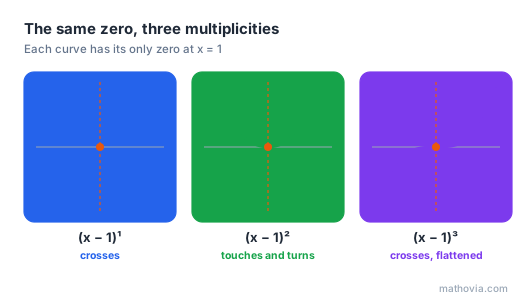
The reason is sign. Near a zero
Finding Zeros of Polynomials: A Worked Example With a Repeat
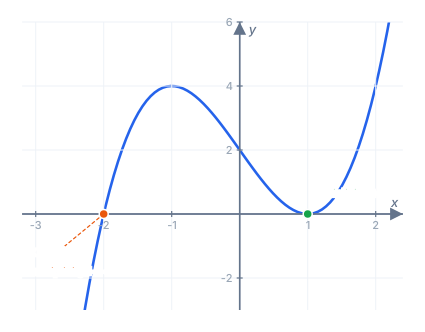
Find all zeros of
Step 1 — the degree is
Step 2 — the leading coefficient is
Step 3 — test
Step 4 — remainder
Step 5 — factor the quadratic:
Step 6 — assemble, collecting the repeated factor:
The zeros are
What the graph does: at
Worked Example: When the Candidates Run Out
Find all zeros of
Step 1 — candidates are the factors of
Step 2 — test
Step 3 — the quotient is
Step 4 — solve the quadratic. It has no real roots, so go to complex:
The three zeros are
Notice also that the complex zeros arrived as a conjugate pair. For a polynomial with real coefficients they always do: if
Common Mistakes to Avoid
- Counting
-intercepts as the number of zeros. A double zero is one intercept but two zeros. A complex pair is two zeros and no intercept at all. - Stopping at the first zero. Finding one factor reduces the problem; it does not finish it. Keep dividing until the quotient is quadratic.
- Never leaving the rational candidates. If every candidate fails, the polynomial still has zeros — reach for the quadratic formula, not the conclusion that there are none.
- Reading multiplicity from an unfactored polynomial. Multiplicity is the exponent in the complete factorisation. You cannot see it in
; you can see it immediately in . - Assuming even multiplicity means the graph stops there. It touches and turns — the curve continues, it simply does not change side.
Practice Problems
Work each before opening the answer.
Problem 1. How many zeros does
Show answer
Step 1 — read the degree. The highest power is
Step 2 — the Fundamental Theorem of Algebra gives exactly
Answer: five. How many are real, and how many the graph shows as crossings, is a separate question.
Problem 2. State the zeros and multiplicities of
Show answer
Step 1 — read each factor’s exponent.
Step 2 —
Step 3 — check the degree:
Answer:
Problem 3. Find all zeros of
Show answer
Step 1 — candidates are the factors of
Step 2 — test
Step 3 — the quotient is
Answer: zeros at
Problem 4. A polynomial of degree
Show answer
Step 1 — build a factor for each zero, raised to its multiplicity:
Step 2 — check the degree:
Step 3 — read the behaviour from each multiplicity.
Answer:
Problem 5. The graph of a degree-
Show answer
Step 1 — degree
Step 2 — one crossing accounts for at least one zero of odd multiplicity. That leaves three more to place.
Step 3 — the remaining zeros must be doing something invisible: a complex conjugate pair, an even-multiplicity real zero that touches without crossing, or the crossing itself having multiplicity
Answer: the other zeros are some combination of complex pairs and even-multiplicity real zeros — or the single crossing has multiplicity
Problem 6. Explain why a cubic with real coefficients must have at least one real zero.
Show answer
Step 1 — a cubic has three zeros counted with multiplicity.
Step 2 — for real coefficients, non-real zeros come in conjugate pairs, so the number of non-real zeros is even:
Step 3 — three minus an even number is odd, and therefore at least
Answer: at least one zero must be real. Graphically the same fact appears as end behavior: an odd-degree polynomial runs from
With the zeros found and their multiplicities known, you have everything the middle of the graph needs — where it meets the axis and how it behaves there. Combine that with the two tails from end behavior and the sketch almost draws itself, which is exactly what the next lesson does.