
Adding two polynomials is genuinely just combining like terms — the same operation used throughout Polynomials — but longer polynomials make it easy to miss a term or combine two terms that only look alike. This lesson isolates the addition case specifically and drills the one habit that prevents both mistakes: identify every like term first, then combine.

What Are Like Terms?
Like terms share the exact same variable part, including every exponent. Only the coefficient is allowed to differ.
Combining like terms adds their coefficients and leaves the variable part completely unchanged:
Adding Polynomials Horizontally
To add two polynomials written left to right, drop the parentheses (addition never changes any sign inside them), then group and combine like terms.
Grouping by matching exponent (all the
Adding Polynomials Vertically
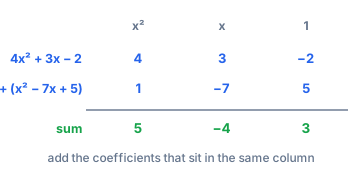
For polynomials with several terms, stacking them so matching exponents line up in the same column makes every like term visually obvious, and combining becomes column-by-column addition.
Each column adds its own coefficients independently:
Adding Polynomials in More Than One Variable
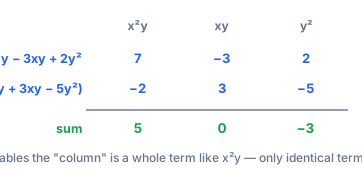
With two or more variables, the “like terms” check needs every variable’s exponent to match, not just one of them.
Worked Example A: Adding Two Trinomials Horizontally
Add
Step 1 — remove the parentheses:
Step 2 — group like terms:
Step 3 — combine each group:
Answer:
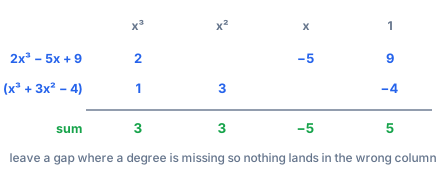
Worked Example B: Adding Vertically with a Missing Term
Add
Step 1 — stack the polynomials, leaving a gap where a term is missing:
Step 2 — read off the sum column by column:
Answer:
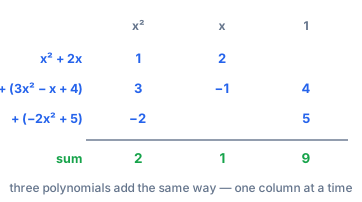
Worked Example C: Adding Three Polynomials at Once
Add
Step 1 — remove parentheses and group like terms:
Step 2 — combine each group:
Answer:
Worked Example D: Adding Polynomials in Two Variables
Add
Step 1 — group like terms (matching both variables and both exponents):
Step 2 — combine each group:
Answer:
Common Mistakes to Avoid
- Combining terms that only look similar.
and are not like terms — the exponents differ — and can never be combined into a single term. - Adding exponents instead of coefficients.
, not ; only the coefficients change when like terms combine. - Losing a term when one polynomial is missing it. A missing term acts like a coefficient of
, not like the alignment should shift to skip that column. - Mixing up which variable an exponent belongs to.
and look similar but are not like terms, since the applies to a different variable in each. - Forgetting a negative sign belongs to the term that follows it. In
, the term carries a coefficient of , not with a separate subtraction floating nearby. - Skipping the grouping step on a longer sum. Combining terms in the order they happen to appear, rather than grouping by matching exponent first, is the most common source of an accidentally-skipped or double-counted term.
Where This Shows Up Later
- Subtracting Polynomials. Subtraction is addition of the opposite polynomial, so every technique here — grouping, vertical alignment, handling missing terms — carries over directly.
- Multiplying Polynomials. Multiplying two polynomials produces several partial products that then have to be added together using exactly this like-terms process.
- Factoring Polynomials. Recognizing that a factored expression expands back to the original polynomial requires being able to add the resulting terms correctly as a check.
- Functions. Adding two polynomial functions, written
, is defined as adding their outputs, which is this same term-by-term combination applied to two function rules instead of two standalone polynomials.
Practice Problems
Work each problem yourself before opening the answer.
Problem 1. Add
Show answer
Answer:
Problem 2. Add
Show answer
Answer:
Problem 3. Add
Show answer
Answer:
Problem 4. Add
Show answer
Answer:
Problem 5. Add
Show answer
Answer:
Problem 6. Add
Show answer
Answer:
Problem 7. Add
Show answer
Answer:
Problem 8. Add
Show answer
Answer:
Problem 9. Add
Show answer
Answer:
Problem 10. Add
Show answer
Adding
Answer:
Quick Reference
| Situation | Move |
|---|---|
| Two terms have the same variable part | Add their coefficients; the variable part stays the same |
| Two terms have different exponents (or different variables) | They are not like terms — leave both as separate terms |
| Adding horizontally | Drop parentheses, then group all like terms together before combining |
| Adding vertically | Align matching exponents in the same column; leave a blank for any missing term |
| A term is missing from one polynomial | Treat it as a coefficient of |
| More than one variable | Every variable’s exponent must match for two terms to be alike |
Subtracting Polynomials applies this same grouping habit with one extra sign-distribution step, and Multiplying Polynomials leans on this addition process to combine the partial products of a multiplication. Polynomials has the full overview these three lessons are drawn from. When you’re ready to practice, the Adding Polynomials Practice Problems is a good next stop, and the Algebra lessons list keeps growing.