
The rational root theorem produces a list of candidate zeros, and for a polynomial like

What a Sign Change Is
Write the polynomial in standard form, then read the signs of the coefficients left to right, skipping any missing powers. A sign change (or variation in sign) is any place where a
For
and there are three changes:
Descartes’ Rule of Signs
Let
Positive real zeros. The number of positive real zeros of
is equal to the number of sign changes in , or less than that by an even number. Negative real zeros. The number of negative real zeros of
is equal to the number of sign changes in , or less than that by an even number.
Each zero is counted with its multiplicity. So three sign changes in
The “less by an even number” clause is the conjugate pairs theorem showing through: the zeros that fail to be real go missing two at a time.
How to Use It: The Three Steps
Step 1 — count the sign changes in
Step 2 — form
Step 3 — build the table. List every combination of (positive, negative) allowed by Steps 1 and 2. Each row’s non-real count is what is left over: degree minus positive minus negative. Since non-real zeros come in pairs, that leftover must be even — and it always will be, which is a useful check on your counting.
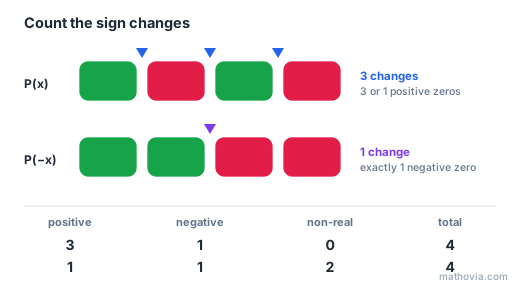
For
Signs
| Positive | Negative | Non-real | Total |
|---|---|---|---|
Two possible profiles for the four zeros, and either way exactly one of the eight negative rational-root candidates can be a zero.
Two Things the Rule Needs
A non-zero constant term. If
Real coefficients. The rule relies on non-real zeros pairing off, which only happens when the coefficients are real.
Worked Example: Descartes’ Rule of Signs Step by Step
Use Descartes’ rule of signs on
Step 1 — sign changes in
Four changes. Positive zeros:
Step 2 — sign changes in
Signs
Step 3 — the table. Degree
| Positive | Negative | Non-real |
|---|---|---|
Every row has an even number of non-real zeros. ✓
Answer.
Worked Example: No Sign Changes
Show that
Step 1 —
Step 2 —
Step 3 — zero is not a zero, since the constant term is
Answer. No real zeros at all; all four zeros are non-real. (In fact
Worked Example: Trimming the Candidate List
Find all real zeros of
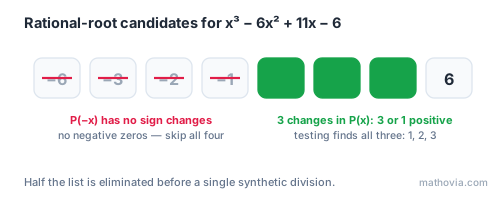
Step 1 — rational candidates. Constant
Step 2 — Descartes on
Step 3 — Descartes on
Signs
Step 4 — test the positive candidates with synthetic division.
Answer. Zeros
Common Mistakes to Avoid
- Counting sign changes in a polynomial that is out of order. The rule reads consecutive coefficients in descending powers. Put the polynomial in standard form first.
- Treating a missing term as a sign change. A zero coefficient is skipped. In
the signs are : two changes, not more. - Flipping the wrong terms in
. Only odd powers change sign: but . The constant never changes. - Reading the rule as an exact count. Three sign changes means
or . Only a count of or is exact. - Forgetting that
is neither positive nor negative. Factor out any power of before applying the rule, and remember to add those zeros back at the end. - Expecting the rule to find the zeros. It counts; the rational root theorem and synthetic division find. Use them together.
Practice Problems
Work each one before opening the answer.
Problem 1. How many sign changes does
Show answer
Step 1 — signs
Answer:
Problem 2. Find
Show answer
Step 1 — flip the odd powers:
Step 2 — signs
Answer: exactly
Problem 3. Build the full table of possibilities for
Show answer
Step 1 — combine Problems 1 and 2 with degree
| Positive | Negative | Non-real |
|---|---|---|
Answer: either
Problem 4. Use Descartes’ rule of signs to show that
Show answer
Step 1 —
Step 2 — every power is even, so
Step 3 — the constant is
Answer: no real zeros; all six are non-real
Problem 5.
Show answer
Step 1 —
Step 2 —
Step 3 — all six candidates are still possible in principle, but you now know to expect exactly one negative zero and an even number of positive ones. Testing:
Answer: zeros
Problem 6. Apply Descartes’ rule of signs to
Show answer
Step 1 — the constant term is zero, so factor out
The factor
Step 2 — apply the rule to
Answer: one positive zero (
Descartes’ rule of signs is a counting tool, and it earns its place by what it removes: candidates you never have to test, and cases you can close without solving. It sits naturally between the rational root theorem, which supplies the candidates, and the complex zeros lesson, which explains where the missing real zeros went.