
You probably know
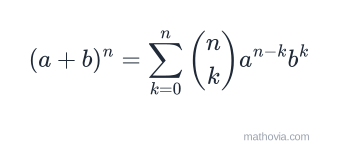
The Binomial Theorem
Written out, that’s
Three patterns make it easy to use:
| Pattern | For |
|---|---|
| the power of | |
| the power of | |
| the powers in each term add to | |
| there are | 5 terms |
The coefficients
Binomial Coefficients
The binomial coefficient
where
It counts how many ways there are to choose
Pascal’s Triangle
You don’t need factorials for small powers. Start with a 1 at the top, and build each new row by adding the two numbers above.
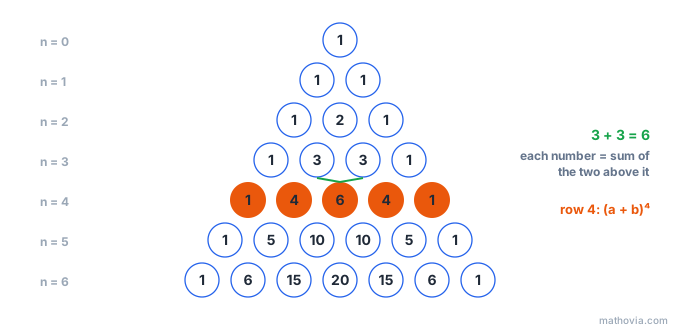
| Row | Coefficients | Expansion |
|---|---|---|
| 0 | 1 | |
| 1 | 1, 1 | |
| 2 | 1, 2, 1 | |
| 3 | 1, 3, 3, 1 | |
| 4 | 1, 4, 6, 4, 1 | |
| 5 | 1, 5, 10, 10, 5, 1 | |
| 6 | 1, 6, 15, 20, 15, 6, 1 |
Row
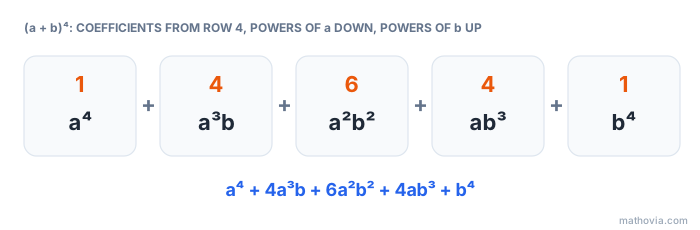
How to Expand a Binomial
- Write the coefficients from row
of Pascal’s triangle (or compute ). - Write the powers of the first term counting down from
to . - Write the powers of the second term counting up from
to . - Multiply each column together and simplify, keeping track of any coefficients and signs inside the binomial.
Example 1: Expand (x + 2)⁴
Step 1 — row 4: 1, 4, 6, 4, 1.
Step 2 — build each term, with
Step 3 — simplify:
Example 2: Expand (2x − 1)³
Treat the binomial as
A negative second term makes the signs alternate. Put brackets around
Finding a Specific Term
You don’t have to expand everything to get one term. The term containing
and it’s the
Example 3. Find the coefficient of
Step 1 — the power of
Step 2 — build that term:
The coefficient is 80.
Example 4. Find the 4th term of
Step 1 — the 4th term has
Step 2 — build it:
Patterns in Pascal’s Triangle
Pascal’s triangle is full of patterns beyond binomial coefficients:
| Pattern | Where to look |
|---|---|
| each row adds to | row 4: |
| symmetry | every row reads the same both ways |
| counting numbers | the second diagonal: 1, 2, 3, 4, … |
| triangular numbers | the third diagonal: 1, 3, 6, 10, 15, … |
The first pattern has a binomial-theorem explanation: set
Common Mistakes to Avoid
- Starting Pascal’s triangle at row 1. The single 1 at the top is row 0, so
uses the row that starts 1, 4. - Forgetting to raise the coefficient. In
, the 2 is cubed too: , not . - Losing the sign. For
, use , and odd powers of are negative. - Off-by-one term numbers. The 4th term uses
, not . - Writing
. The binomial theorem shows exactly what’s missing: the middle terms.
Practice Problems
Work each one before opening the answer. To check an expansion of your own, the binomial expansion calculator shows every term and highlights the row of Pascal’s triangle it uses.
Problem 1. Write row 7 of Pascal’s triangle.
Show answer
Step 1 — add pairs from row 6 (1, 6, 15, 20, 15, 6, 1).
Answer: 1, 7, 21, 35, 35, 21, 7, 1
Problem 2. Evaluate
Show answer
Answer:
Problem 3. Expand
Show answer
Step 1 — row 3: 1, 3, 3, 1.
Answer:
Problem 4. Expand
Show answer
Step 1 — row 4: 1, 4, 6, 4, 1, with alternating signs because
Answer:
Problem 5. Find the coefficient of
Show answer
Step 1 — the power of
Answer:
Problem 6. Find the 4th term of
Show answer
Answer:
The binomial theorem finishes this chapter. It connects back to sequences, since each row of Pascal’s triangle is a sequence of its own and its sum,