
Every polynomial, scientific-notation figure, and compound-interest formula you’ll meet later leans on a small set of exponent rules. This lesson collects all of them in one place, explains why each one is true instead of asking you to memorize it, shows each one in action with numbers and then with variables, and finishes with practice problems you can work yourself before checking the hidden answer.
If you only take one thing away: every rule below is a consequence of a single idea, that an exponent counts repeated factors. Once you see that, the eight rules stop being eight separate facts and become one fact viewed from eight angles.
What Is an Integer Exponent?
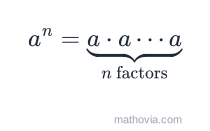
An exponent tells you how many times to multiply a number (the base) by itself. In the expression
For example,
How to read them.
Where the base stops. The base is only the thing the exponent is physically attached to. In
“Integer” exponents extend this idea to every whole number — positive, zero, and negative. The table below states the rule for each case; every one of them can be re-derived from the repeated-multiplication definition above if you ever forget it.
Why Zero and Negative Exponents Have to Mean What They Mean
Repeated multiplication makes sense for
| Power | Value | Step from the row above |
|---|---|---|
| — | ||
Dropping the exponent by one always divides by the base. Keep that single habit going past
Notice also what this table does not say: none of the negative-exponent values are negative. Going down the ladder shrinks the value toward zero, it never crosses into negatives.
Building the Rules from Repeated Multiplication
Before the reference table, here is where each rule comes from. Read these once and you will never need to memorize the table — you can rebuild any row in ten seconds on scratch paper.
Product Rule. Count the factors on each side:
Multiplying powers of the same base pools their factors, so the counts add.
Quotient Rule. Cancel matching factors:
Dividing removes factors, so the counts subtract.
Power Rule. A power of a power means repeating the whole block:
Two groups of three factors is six factors, so the counts multiply.
Power of a Product. Multiplication can be reordered freely:
Power of a Quotient. Same argument with division:
Zero Exponent. Divide a power by itself two different ways and set the results equal:
Negative Exponent. Now let the bottom exponent win:
Negative Exponent of a Quotient. Chain the two previous rules:
Every derivation above used positive exponents and basic arithmetic only, which is exactly the point: the rules are consistent with each other by construction.
Properties of Integer Exponents
Assume
| Rule | Statement | Example | What it does |
|---|---|---|---|
| Product Rule | Same base multiplied: add exponents | ||
| Quotient Rule | Same base divided: subtract exponents | ||
| Power Rule | Power of a power: multiply exponents | ||
| Power of a Product | Exponent hits every factor inside | ||
| Power of a Quotient | Exponent hits top and bottom | ||
| Zero Exponent | Any nonzero base, one step | ||
| Negative Exponent | Flip the factor, drop the minus | ||
| Negative Exponent of a Quotient | Invert the fraction, drop the minus |
Two structural things to notice. First, the last rule is really just the Negative Exponent rule applied to a fraction: flipping the fraction and dropping the minus sign lands on the same value. Second, the two “power of” rules distribute across multiplication and division only. There is no rule for
Why the
Example 1: Evaluating Numeric Expressions
Each row applies exactly one rule from the table above to a purely numeric expression. Work down the column and say the rule name out loud as you go — naming the rule is what makes it stick.
| Expression | Rule Applied | Result |
|---|---|---|
| Product Rule: | ||
| Product Rule: | ||
| Zero Exponent Rule | ||
| Zero Exponent Rule (negative base still works) | ||
| Negative Exponent Rule | ||
| Quotient Rule: | ||
| Quotient Rule: | ||
| Power Rule: | ||
| Power of a Product: | ||
| Power of a Quotient | ||
| Negative Exponent of a Quotient: |
Sanity-check the third-from-last row a second way:
Example 2: Simplifying Variable Expressions
The same rules apply when the base is a variable instead of a number — you’re never actually “computing” a final value, just rewriting the expression in its simplest form. By convention, “simplest form” means each base appears once and no exponent is negative.
| Expression | Rule Applied | Simplified Form |
|---|---|---|
| Power Rule: | ||
| Power of a Product | ||
| Negative Exponent of a Quotient | ||
| Product Rule, applied to each base separately | ||
| Quotient Rule, applied to each base separately | ||
| Power of a Product, then Negative Exponent | ||
| Power of a Quotient, then Power of a Product | ||
| Zero Exponent Rule (with |
For the fourth row, group matching bases before combining:
The sixth row is worth slowing down on, because two rules stack. The outer
Working with Negative Exponents Across the Fraction Bar
Most textbook simplification problems become much faster with one reframing: a negative exponent means the factor is on the wrong side of the fraction bar. Move it, flip the sign of its exponent, and you’re done.
The
Two guardrails on this shortcut:
- It applies to factors, not terms. In
, the is added, not multiplied, so it cannot be relocated on its own. Rewrite it in place as and combine with a common denominator instead. - A coefficient with a positive exponent stays home.
. The 5 never moves, because the was never attached to it.
Worked Example A: Combining Several Rules
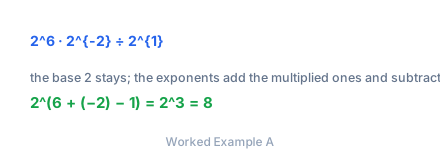
Simplify
Step 1 — apply the Product Rule to the numerator:
Step 2 — apply the Quotient Rule to divide by the denominator:
Step 3 — evaluate the remaining power:
The final answer is
Worked Example B: Coefficients, Variables, and Negative Exponents Together
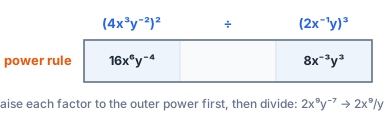
Simplify
Step 1 — clear the outer exponents with Power of a Product and the Power Rule. Each outer exponent reaches every factor inside, coefficients included:
Step 2 — divide the coefficients and apply the Quotient Rule base by base:
Step 3 — clean up the negative exponent:
The order matters here. Outer exponents first, then combine like bases, then remove negative exponents last. Trying to fix negative exponents while outer parentheses are still in play is where most sign errors are born. Also watch
Worked Example C: Exponents in Scientific Notation
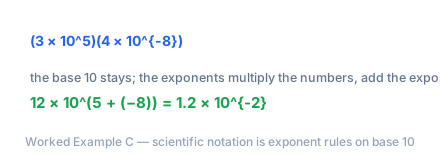
Scientific notation is nothing but exponent rules applied to base 10, which is why it shows up in this chapter. Multiply
Step 1 — regroup so the numbers and the powers of ten are together:
Step 2 — apply the Product Rule to the powers of ten:
Step 3 — renormalize so the leading factor is between 1 and 10:
Same rules, no new machinery. This is a good preview of why the rules are worth automating: in science and engineering you use them dozens of times a page without thinking about them.
Exponents and the Order of Operations
Exponents are evaluated before multiplication, division, addition, and subtraction, but after anything inside grouping symbols. Three consequences trip people up constantly:
, not . The exponent acts on the 2 before the multiplication happens. , while . The unary minus is applied after the exponent unless parentheses say otherwise. - Stacked exponents evaluate top-down:
, not . If you mean the second one, write the parentheses.
When in doubt, add parentheses to your own work. They cost nothing and they remove all ambiguity for whoever reads it next, including future you.
Where These Rules Show Up Later
- Polynomials. Multiplying
by to get is the Product Rule; every polynomial multiplication is just this repeated across terms. - Scientific notation. Distances, masses, and tolerances are all written as
, and every calculation with them uses the product and quotient rules on base 10. - Compound interest and growth.
is a power of a product; comparing balances at two different times means dividing two such powers, which is the Quotient Rule. - Rational exponents and radicals. The next step is letting
be a fraction, where . Those rules are the exact eight above with fractional exponents allowed, so nothing new has to be memorized. - Calculus. The derivative shortcut
works for negative integers precisely because is defined the way it is here.
Common Mistakes to Avoid
- Confusing
with . , not . - Treating a negative exponent as a negative number.
, a small positive fraction — the minus sign moves the term to a denominator, it doesn’t make the value negative. - Mixing up
and . Without parentheses, the exponent binds to only, so . With parentheses, . These are genuinely different values — always check which one a problem is actually asking for. - Applying the Product or Quotient Rule to different bases.
cannot be combined into a single power — those rules only work when the base is identical on both sides. (You can sometimes force a match: .) - Adding exponents when you should multiply them.
, not . Multiplication of powers adds; a power of a power multiplies. - Distributing an exponent over a sum.
. Test it: but . - Letting an exponent reach a coefficient it isn’t attached to.
, not . Compare . - Forgetting to raise the coefficient inside parentheses.
, not . If the coefficient is inside, it gets the exponent too. - Sign slips when subtracting negative exponents.
, not . - Assuming
. It’s 1 for every nonzero base, and is left undefined in this lesson.
Practice Problems
Work each problem yourself before opening the answer. Every solution shows the rule used, not just the final number.
Problem 1. Evaluate
Show answer
Step 1 — apply the Product Rule:
Step 2 — apply the Negative Exponent Rule:
Answer:
Problem 2. Simplify
Show answer
Step 1 — apply the Power of a Product Rule:
Step 2 — apply the Power Rule to the variable factor:
Answer:
Problem 3. Evaluate
Show answer
Step 1 — apply the Quotient Rule:
Step 2 — apply the Negative Exponent Rule:
Answer:
Problem 4. Simplify
Show answer
Step 1 — apply the Negative Exponent of a Quotient Rule:
Step 2 — apply the Power of a Quotient Rule:
Answer:
Problem 5. Evaluate both
Show answer
With parentheses, the exponent applies to
Without parentheses, the exponent applies to
The parentheses in
Problem 6. Simplify
Show answer
Step 1 — apply the Quotient Rule to each base separately:
Step 2 — apply the Negative Exponent Rule to
Answer:
Problem 7. Evaluate
Show answer
Step 1 — rewrite each negative exponent inside the parentheses (no rule distributes over a sum, so the inside must be simplified first):
Step 2 — apply the Negative Exponent of a Quotient Rule to the result:
Answer:
Problem 8. Simplify
Show answer
Step 1 — simplify inside the parentheses with the Quotient Rule:
Step 2 — apply the outer exponent to every factor (Power of a Product, then the Power Rule):
Step 3 — clear the negative exponent:
Answer:
Problem 9. Evaluate
Show answer
Step 1 — regroup the numeric factors and the powers of ten:
Step 2 — apply the Product Rule to the powers of ten:
Step 3 — renormalize so the leading factor sits between 1 and 10:
Answer:
Problem 10. Simplify
Show answer
Step 1 — apply Power of a Product, then the Power Rule to each factor:
Step 2 — apply the Negative Exponent Rule:
Answer:
Quick Reference
If you want a single card to keep next to your homework, this is it:
| Situation | Move |
|---|---|
| Same base, multiplied | Add the exponents |
| Same base, divided | Subtract the exponents (top minus bottom) |
| Power raised to a power | Multiply the exponents |
| Exponent outside parentheses | Give it to every factor inside, coefficients included |
| Exponent of zero | The whole factor becomes 1 (nonzero base) |
| Negative exponent | Move the factor across the fraction bar, make the exponent positive |
| Negative exponent on a fraction | Flip the fraction, make the exponent positive |
| Different bases, or a sum inside | No rule applies; evaluate or expand instead |
These rules don’t stay confined to this lesson — Polynomials leans on them immediately, and scientific notation, Rational Exponents, Radicals, and eventually the power rule in calculus all build on the same foundation. Try the Integer Exponent Practice Problems for extra practice, look through the growing list of Algebra lessons, or use the site’s calculators to double-check your own arithmetic.