
Most line problems hand you a slope and a point. Almost none of them hand you the
What Point-Slope Form Says
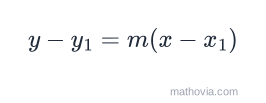
Here
Read out loud, the equation says something quite ordinary: the rise from your known point is always the slope times the run from your known point. Move 3 to the right of
Where the Formula Comes From
It is the slope formula with one point left general. Take a fixed point
Multiply both sides by
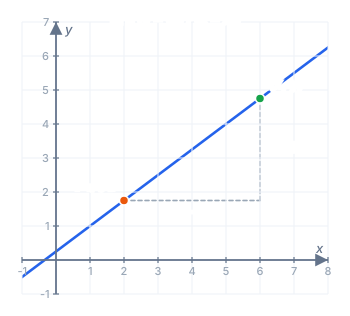
That derivation also tells you the form’s one limitation. Clearing the fraction is only legal when
Using It From a Slope and a Point
This is the everyday case. Substitute and stop.
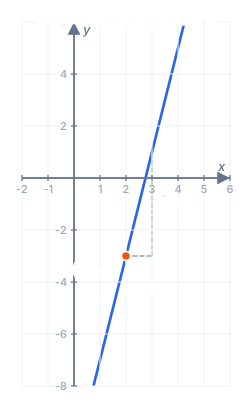
Line with slope
That is already a correct equation of the line. If the question wants slope-intercept form, expand and tidy:
Using It From Two Points
Two points do not go straight into the formula, because the formula wants a slope. So find the slope first, then substitute.
Through
Either point works
Students often worry about picking the “right” point. There isn’t one. Substituting
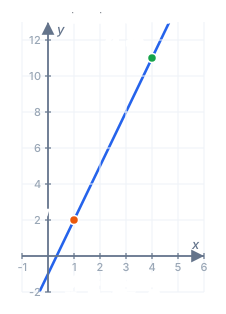
The two point-slope equations look different and are equally valid. Only after expanding do they collapse into the same slope-intercept form, which is one reason teachers ask for a specific final form: it makes answers comparable.
The Sign Trap
Far and away the most common error is mishandling a negative coordinate. The formula subtracts
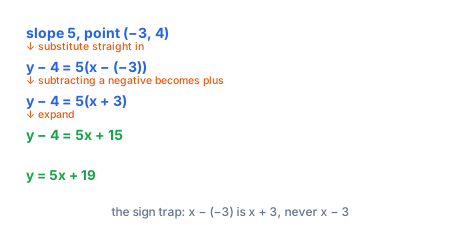
Write the substitution with the brackets in first, before you simplify anything:
Then clean it up. Doing it in two deliberate steps costs three seconds and removes the guesswork.
Converting Out of Point-Slope Form
Point-slope is usually a means, not an end. Both conversions are short.
To slope-intercept form: expand the bracket and isolate
To standard form: expand, then collect
Reading the y-intercept straight from point-slope form
You don’t have to convert the whole equation to find where the line crosses the
Worked Example A: Slope and a Point
Write the line with slope
The fraction stayed manageable because
Worked Example B: Two Negative Coordinates
Write the line through
Check with the other point:
Worked Example C: A Horizontal Line
Write the line with slope
Point-slope handles horizontal lines fine — a slope of zero kills the
Worked Example D: From a Graph
A line passes through
Falling 3 over a run of 4 means
Worked Example E: A Parallel or Perpendicular Line
Write the equation of the line through
Find the slope. Perpendicular lines have negative reciprocal slopes, so the new slope is
Use point-slope form with
Simplify if the question asks for slope-intercept form:
For the parallel line through the same point, keep the original slope instead:
Common Mistakes to Avoid
- Dropping the double negative. With
the bracket is , not . Substitute with brackets first, simplify second. - Swapping
and . The -coordinate goes on the left with ; the -coordinate goes inside the bracket. - Subtracting the coordinates in different orders when finding the slope. If you do
on top, you must do on the bottom. Reversing one and not the other flips the sign of the slope. - Trying to use it on a vertical line. No slope means no substitution. Write
. - Expanding before you have checked what form is wanted. If the question says “leave in point-slope form”, expanding it loses marks for no reason.
- Forgetting to distribute to both terms.
is , not .
Where Point-Slope Form Gets Used
- Writing the equation of a line from a graph — read one clear point and the slope, then substitute.
- Parallel and perpendicular line problems, where you are given a new point and derive the slope from another line.
- Tangent lines in calculus. The derivative gives the slope at a point, and the point is known — point-slope is the natural way to write the tangent.
- Linear modelling. “Costs were $40 at 3 hours and rise $15 per hour” is a point and a slope.
- Perpendicular bisectors, where the midpoint supplies the point and the negative reciprocal supplies the slope.
Practice Problems
Work each one before opening the answer.
Problem 1. Write the line with slope
Show answer
Problem 2. Write the line with slope
Show answer
Problem 3. Convert
Show answer
Problem 4. Write the line through
Show answer
Problem 5. Write the line through
Show answer
Problem 6. A line has slope
Show answer
Problem 7. Write the line with slope
Show answer
Problem 8. Convert
Show answer
Multiply by 4:
Problem 9. Two points on a line are
Show answer
Problem 10. Explain why
Show answer
Whatever
Quick Reference
| Situation | What to do |
|---|---|
| Slope and a point | Substitute directly into |
| Two points | Find |
| Negative coordinate | Keep the brackets: |
| Want | Expand the bracket, isolate |
| Want | Expand, clear fractions, collect on the left |
| Vertical line | Point-slope cannot be used — write |
Point-slope is one of the three forms of a line; the other two are slope-intercept form for graphing and standard form for intercepts. Everything here rests on slope, and you can browse all Algebra lessons for related topics.