
Two job offers. One pays

Arithmetic vs Geometric Sequences at a Glance
| Arithmetic sequence | Geometric sequence | |
|---|---|---|
| Each step | adds a constant | multiplies by a constant |
| The constant | common difference | common ratio |
| How to find it | subtract consecutive terms | divide consecutive terms |
| Explicit formula | ||
| Recursive formula | ||
| Graph of the terms | points on a straight line | points on an exponential curve |
| Related function | linear | exponential |
| Example | 2, 8, 14, 20, … | 2, 4, 8, 16, … |
How to Tell Them Apart
Use a two-step test on any sequence:
- Subtract each term from the next. If every difference is the same, the sequence is arithmetic.
- If not, divide each term by the one before it. If every ratio is the same, the sequence is geometric.
- If neither is constant, the sequence is neither.
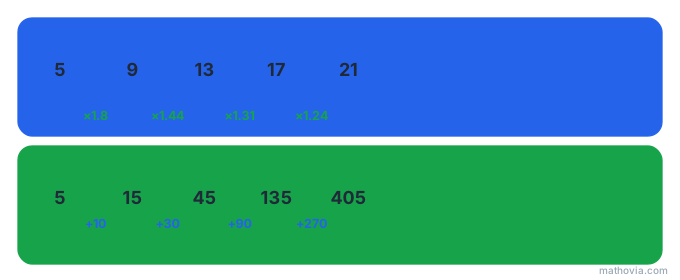
Both sequences above start at 5, but only one test comes out constant for each. That’s how you know which family a sequence belongs to.
Classify Each Sequence
| Sequence | Differences | Ratios | Type |
|---|---|---|---|
| 2, 4, 8, 16, … | 2, 4, 8 | 2, 2, 2 | geometric, |
| 2, 4, 6, 8, … | 2, 2, 2 | 2, 1.5, 1.33 | arithmetic, |
| 100, 90, 80, 70, … | −10, −10, −10 | — | arithmetic, |
| 81, −27, 9, −3, … | — | −⅓, −⅓, −⅓ | geometric, |
| 1, 4, 9, 16, … | 3, 5, 7 | 4, 2.25, 1.78 | neither (perfect squares) |
| 1, 1, 2, 3, 5, 8, … | 0, 1, 1, 2, 3 | 1, 2, 1.5, … | neither (Fibonacci) |
Comparing Their Graphs
Plot the terms of an arithmetic and a geometric sequence that start at the same value, and the difference jumps out.
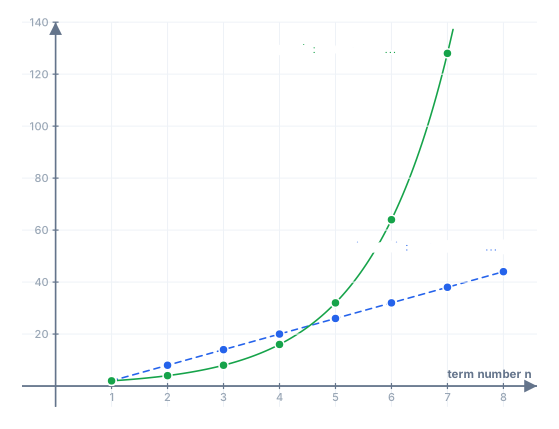
The arithmetic sequence 2, 8, 14, 20, … climbs by 6 each step, so its points lie on a straight line. The geometric sequence 2, 4, 8, 16, … starts slower, but because it doubles, it passes the arithmetic one at the fifth term (32 vs 26) and then leaves it far behind. By term 10 it’s at 1,024 while the arithmetic sequence has only reached 56.
The Job Offers, Revisited
| Year | Offer A: + | Offer B: +5% a year (geometric) |
|---|---|---|
| 1 | ||
| 5 | ||
| 10 | ||
| 15 | ||
| 20 |
Offer A is ahead for nearly two decades, but Offer B catches up and passes it in year 18. After that the gap widens every year. That’s the long-run power of multiplying instead of adding, and it’s the same reason compound interest beats simple interest.
Sums of Arithmetic and Geometric Sequences
Adding up the terms of a sequence gives a series, and each type has its own sum formula:
| Sum of the first | |
|---|---|
| Arithmetic series | |
| Geometric series |
These are covered in arithmetic series and geometric series.
Real-World Examples
| Situation | Type | Why |
|---|---|---|
| a salary rising | arithmetic | same amount added |
| a population growing 3% a year | geometric | same percentage, so same multiplier |
| a taxi charging | arithmetic | |
| a car losing 15% of its value each year | geometric | multiplied by 0.85 each year |
| boxes stacked in rows of 10, 9, 8, … | arithmetic | one fewer each row |
| a chain letter where each person sends it to 3 more | geometric | ×3 per round |
The rule of thumb: a fixed amount of change means arithmetic; a fixed percentage or factor means geometric.
Common Mistakes to Avoid
- Checking only the first two terms. 2, 4 could start either 2, 4, 6 or 2, 4, 8. Test at least three terms.
- Calling any growing sequence geometric. 2, 5, 8, 11 grows, but by addition. It’s arithmetic.
- Testing ratios when a term is 0. You can’t divide by zero, and a sequence containing 0 can’t be geometric.
- Mixing up the formulas. Arithmetic uses
, multiplication; geometric uses , a power.
Practice Problems
Work each one before opening the answer. For a list that might be neither, the sequence calculator tests the common patterns and continues the sequence.
Problem 1. Is 3, 9, 27, 81, … arithmetic, geometric or neither?
Show answer
Step 1 — differences: 6, 18, 54, not equal.
Step 2 — ratios: 3, 3, 3, equal.
Answer: geometric,
Problem 2. Is 50, 45, 40, 35, … arithmetic, geometric or neither?
Show answer
Step 1 — differences: −5, −5, −5.
Answer: arithmetic,
Problem 3. Is 1, 3, 6, 10, … arithmetic, geometric or neither?
Show answer
Step 1 — differences: 2, 3, 4, not equal.
Step 2 — ratios: 3, 2, 1.67, not equal.
Answer: neither (these are the triangular numbers)
Problem 4. Find the next term of each: (a) 6, 11, 16, … (b) 6, 12, 24, …
Show answer
Step 1 — (a) is arithmetic with
Step 2 — (b) is geometric with
Answer: (a) 21, (b) 48
Problem 5. Find the 6th term of both sequences that start 4, 8, …, assuming one is arithmetic and the other geometric.
Show answer
Step 1 — arithmetic,
Step 2 — geometric,
Answer: 24 (arithmetic) and 128 (geometric)
Problem 6. A town’s population is 10,000 and grows by 400 people a year. Another town of 10,000 grows by 4% a year. Which sequence is which, and which town is bigger after 10 years?
Show answer
Step 1 — town A adds 400 a year (arithmetic): after 10 years,
Step 2 — town B multiplies by 1.04 a year (geometric):
Answer: town B, at about 14,802 vs 14,000
Once you can recognize the two kinds of sequence, the next question is how to add up their terms quickly. Before the sum formulas, though, there’s a compact way to write a long sum: sigma notation.