
Every formula you’ve used so far — perimeter, simple interest, distance equals rate times time — happens to already be solved for one particular letter. But a problem doesn’t always hand you the formula in the form you need: sometimes you know the perimeter and one side of a rectangle and need the other, or you know a Fahrenheit temperature and need the Celsius formula rearranged. This lesson is about doing that rearrangement, called solving a literal equation.
Nothing about the algebra changes. Every move is the same distribute, combine, isolate process from Linear Equations — the only difference is that the “constants” surrounding your target variable are letters instead of numbers, so the final answer is an expression instead of a single value.
What Is a Literal Equation?
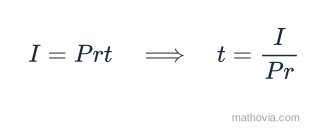
A literal equation (or formula) is any equation containing two or more variables. To solve a literal equation for a specified variable means isolating that one letter on one side of the equation, with an expression made of the remaining letters (and numbers) on the other side.
Both equations say exactly the same thing about how
The Same Method, One New Rule
Treat every letter other than the one you are solving for exactly like a number: it can be added to both sides, subtracted, multiplied, or divided, using the identical four-step method from Linear Equations. The one habit worth building deliberately is identifying the target variable before starting, so every move is clearly aimed at isolating that one letter and nothing else.
Solving for a Variable That Appears Once
When the target variable shows up in exactly one term, the four-step method finishes the job directly: simplify, move other terms away from it, then divide by whatever is still multiplying it.
Solving for a Variable That Appears More Than Once
When the target variable shows up in two or more terms, gather every one of those terms on the same side first, then factor the variable out of them, turning the sum into a single product. Dividing by whatever remains inside the parentheses finishes the isolation.
Factoring the variable out is genuinely the one new technique in this lesson — every other step so far has come straight from Linear Equations.
Common Formulas Solved for a Different Variable
| Formula | Solved for | Rearranged |
|---|---|---|
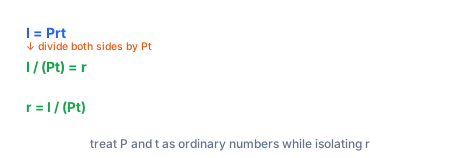
Worked Example A: Solving the Simple Interest Formula for r
Solve
Step 1 — the target variable
Step 2 — divide both sides by everything currently multiplying
Answer:
Worked Example B: A Variable That Appears More Than Once
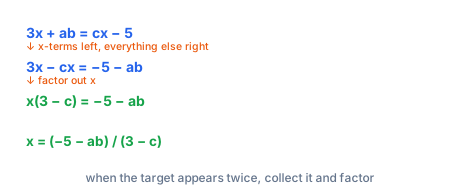
Solve
Step 1 — move every
Step 2 — factor
Step 3 — divide both sides by whatever remains multiplying
Answer:
Worked Example C: A Formula with a Fraction
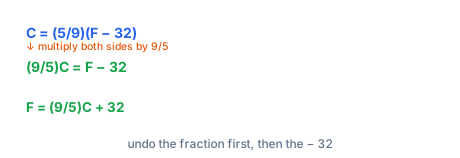
Solve
Step 1 — clear the fraction by multiplying both sides by
Step 2 — add
Answer:
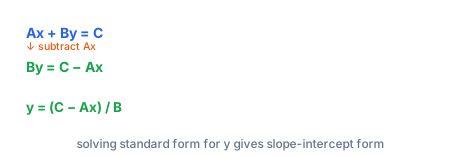
Worked Example D: Solving Standard Form for y
Solve
Step 1 — move the
Step 2 — divide both sides by
Answer:
Common Mistakes to Avoid
- Treating other letters as if they could be combined with the target variable.
cannot be simplified to or any single term — and are not like terms just because they’re both made of letters. - Forgetting to factor before dividing when the variable appears twice.
must be factored first; dividing by without factoring is not a legal algebra step. - Dividing only one term by the divisor. In
, both and are divided by — writing drops the division on the second term. - Losing track of which letter is the target. Before moving anything, identify the one letter being solved for; every other letter, no matter how it looks, is treated as a constant for the rest of the problem.
- Assuming the divisor can’t be zero without checking the context. Dividing by an expression like
requires ; most formula contexts guarantee this, but it’s worth a mental check when the expression could plausibly be zero. - Multiplying by the reciprocal incorrectly when clearing a fraction. Multiplying both sides by
is the same as dividing by — reversing which fraction gets used flips the formula.
Where This Shows Up Later
- Rational Expressions and rational equations. Clearing a fraction and factoring a shared variable are exactly the two skills that carry over most directly.
- Systems of equations. Solving one equation for one variable in terms of the other, exactly as in Worked Example D, is the first step of the substitution method.
- Functions and graphing. Rewriting a line’s equation from standard form to slope-intercept form (Worked Example D) is what makes its slope and
-intercept easy to read off directly. - Science and finance formulas. Every formula in physics, chemistry, and finance eventually needs to be solved for a variable other than the one it’s written for — exactly this lesson’s skill, applied to a new formula each time.
Practice Problems
Work each problem yourself before opening the answer.
Problem 1. Solve
Show answer
Step 1 — subtract
Step 2 — divide both sides by
Answer:
Problem 2. Solve
Show answer
Step 1 — the target variable
Answer:
Problem 3. Solve
Show answer
Step 1 — subtract
Step 2 — divide both sides by
Answer:
Problem 4. Solve
Show answer
Step 1 — subtract
Step 2 — divide both sides by
Answer:
Problem 5. Solve
Show answer
Step 1 — add
Step 2 — divide both sides by
Answer:
Problem 6. Solve
Show answer
Step 1 — subtract
Step 2 — divide both sides by
Answer:
Problem 7. Solve
Show answer
Step 1 — distribute the right side:
Step 2 — subtract
Step 3 — divide both sides by
Answer:
Problem 8. Solve
Show answer
Step 1 — move the
Step 2 — combine like terms:
Step 3 — divide both sides by
Answer:
Problem 9. Solve
Show answer
Step 1 — the LCD of
Step 2 — factor
Step 3 — divide both sides by
Answer:
Problem 10. Solve
Show answer
Step 1 — subtract
Step 2 — multiply both sides by
Answer:
Quick Reference
| Situation | What to do |
|---|---|
| Target variable appears once | Isolate it directly: move other terms away, then divide by its coefficient |
| Target variable appears more than once | Gather all its terms on one side, factor it out, then divide by what remains |
| Equation has a fraction | Clear it first by multiplying every term by the LCD, or by the reciprocal of a single fraction |
| Every other letter | Treat exactly like a number — add, subtract, multiply, or divide it same as any constant |
| Final answer | An expression in the remaining letters, not a single number |
The Linear Equations toolkit — distributing, clearing fractions, isolating a variable — is what every formula here actually depends on, and those same techniques carry into Rational Expressions once letters start showing up in denominators. Applications of Linear Equations uses several of these same formulas the other way, solving for a number instead of a letter. From here, the rest of the Algebra lessons are worth a look.