Mathovia

Algebra / Common Graphs

Function Transformations: Shifts, Stretches, and Reflections

Learn a handful of parent graphs and transformations give you every relative of them for free — no new plotting required. This lesson is the overview: what each letter in a·f(x − h) + k does, the inside-outside rule that explains why horizontal changes behave backwards, the order transformations must be applied in, and how to describe a composite transformation correctly.

Written by
Zohaib
Founder & Mathematics Content Creator
Updated

Mathematics verification: Mathematical formulas, calculations, worked examples and solutions are reviewed for accuracy before publication.

You do not need to learn a new graph for . It is the parabola you already know, moved and stretched. Transformations are the rules for that, and once you have them, one parent graph gives you an entire family.
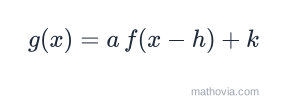
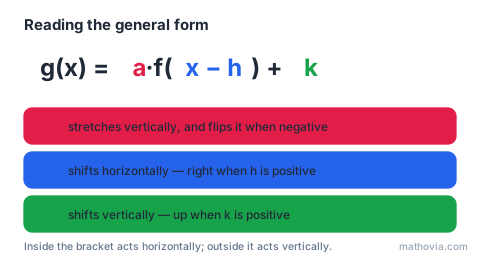
The general transformation form of a function
Every transformation lives in this one form

The General Form

The general form annotated, showing that a stretches and flips, h shifts horizontally and k shifts vertically
Three letters, three jobs.
LetterEffectDirection
horizontal shiftright when positive
vertical shiftup when positive
vertical stretchtaller
vertical compressionflatter
reflectionacross the -axis

The Inside-Outside Rule

This one idea explains why half of transformations feel backwards.
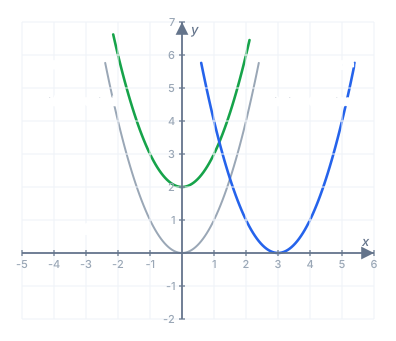
A parabola with two transformations shown: plus 2 outside the bracket moving it up, and minus 3 inside the bracket moving it right
Outside the bracket acts vertically; inside acts horizontally.

Outside the function, — changes the output, so it acts vertically and does exactly what it looks like. Add 2, the graph rises 2.

Inside the function, — changes the input before ever sees it, so it acts horizontally and behaves in the opposite direction. Subtract 3, the graph moves right 3.

The reason is worth holding on to: has to wait until reaches 3 to produce what produced at 0. It is running late, so its graph is pushed forward. The full argument is in horizontal shifts.

A memory hook that survives exams: horizontal transformations lie, vertical ones tell the truth.

All Four on One Graph
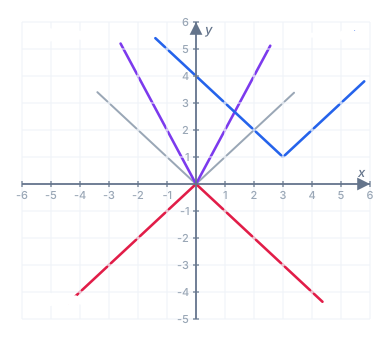
One absolute value parent graph shown with three transformations: a vertical stretch, a reflection, and a combined shift
Stretch, reflect, shift — the same parent underneath all of them.

Each transformation is independent. You can apply one, or all of them, and the underlying shape is never destroyed — a parabola stays a parabola, a V stays a V.

The Order Matters

Applying transformations in the wrong sequence gives the wrong graph.
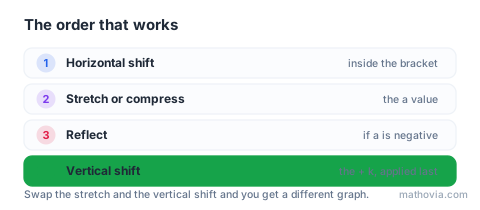
The correct order: horizontal shift, then stretch or compress, then reflect, then vertical shift last
The vertical shift goes last, or the stretch multiplies it too.

Take and a point where .

  • Stretch first, then shift: , then . ✔
  • Shift first, then stretch: , then . ✘

The second is wrong because the stretch multiplied the as well. Order of operations decides it: in the multiplication happens before the addition, so the stretch must be applied before the vertical shift.

Tracking a Point

The fastest way to transform a graph is to transform a few of its points. For , a point on moves to

The -coordinate gains ; the -coordinate is multiplied by and then gains . Transform three or four key points and draw the curve through them.

Domain and Range

TransformationDomainRange
Horizontal shiftshifts by unchanged
Vertical shiftunchangedshifts by
Vertical stretchunchangedscaled by
Reflection in the -axisunchangedflipped
Reflection in the -axisflippedunchanged

The pattern is the inside-outside rule again: horizontal changes touch the domain, vertical changes touch the range.

Worked Example A: Describe It

Describe .

Inside the bracket: means , so left 2. Outside: means down 5.

Worked Example B: With a Stretch

Describe .

Right 1, then stretched vertically by a factor of 3. No vertical shift.

Worked Example C: A Reflection

Describe .

Reflected across the -axis, then moved up 4. The reflection happens first — the is added after the negation.

Worked Example D: Building the Composite
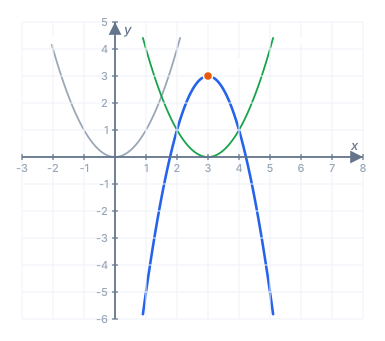
A parabola transformed in stages: first shifted right 3, then stretched by negative 2 and raised 3, giving a downward parabola with vertex (3, 3)
Built in stages: shift, then stretch and reflect, then raise.

Sketch where .

  1. Right 3 gives , vertex .
  2. Stretch by 2 and reflect, giving , vertex still but opening downward and twice as steep.
  3. Up 3, so the vertex lands at .

Tracking a point confirms it: on moves to .

Worked Example E: Reading It Backwards

A parabola has been moved 4 left and 6 down from , and reflected across the -axis. Write its equation.

Left 4 means , so . Reflected means . Down 6 means .

Common Mistakes to Avoid

  • Reading the horizontal shift the way it looks. moves right.
  • Applying the vertical shift before the stretch. The stretch would multiply it.
  • Thinking moves the graph. It scales and flips; it never shifts.
  • Swapping which transformation hits the domain. Horizontal changes the domain, vertical changes the range.
  • Assuming the shape changes. A parabola stays a parabola however you move it.
  • Forgetting a reflection is a stretch by a negative. does both jobs at once.
  • Multiplying by when tracking a point. It is , not .

Where Transformations Lead Next

  • The individual moves. Horizontal shifts, vertical shifts and reflections each get a lesson of their own.
  • Symmetry. A graph unchanged by a reflection has symmetry, which is transformations applied to a function’s own definition.
  • Vertex form everywhere. Parabolas, absolute value functions and square root functions all use the same , , pattern.
  • Horizontal stretches. compresses by a factor of — backwards again, for the same reason.
  • Trigonometric graphs. Amplitude, period and phase shift are exactly these transformations under different names.

Practice Problems

Work each one before opening the answer.

Problem 1. Describe .

Show answer

Up 7.

Problem 2. Describe .

Show answer

Right 5.

Problem 3. Describe .

Show answer

Left 3.

Problem 4. Describe .

Show answer

Reflected across the -axis.

Problem 5. Describe .

Show answer

Stretched vertically by a factor of 4.

Problem 6. Describe .

Show answer

Compressed vertically to half its height.

Problem 7. Describe .

Show answer

Right 2 and up 6.

Problem 8. Where does move under ?

Show answer

, so goes to 2; goes to 3. The point becomes .

Problem 9. Where does move under ?

Show answer

is unchanged; becomes . So .

Problem 10. is moved right 2 and down 9. Write the equation.

Show answer

.

Problem 11. In which order should be applied?

Show answer

Stretch by 3, reflect across the -axis, then move up 2 last.

Problem 12. has domain and range . What are they for ?

Show answer

Domain ; range . The horizontal shift moved the domain, the vertical shift moved the range.

Quick Reference

TransformationFormEffect
Horizontal shiftright by
Vertical shiftup by
Vertical stretch, taller
Vertical compression, flatter
Reflect in the -axisflips top to bottom
Reflect in the -axisflips left to right
Inside the brackethorizontal, and backwards
Outside the bracketvertical, and as it reads
Point rule
Ordershift across, stretch, reflect, shift up

Transformations turn one parent graph into a whole family, which is why parabolas, absolute value functions and square root functions all share the same vertex form. The individual moves are covered in horizontal shifts, vertical shifts and reflections, and a graph that survives a reflection unchanged has symmetry. More Algebra lessons are available.

Frequently Asked Questions

What are the four main function transformations?+

Horizontal shifts, vertical shifts, stretches or compressions, and reflections. In the form , the letter covers stretching and reflecting, covers horizontal shifts and covers vertical ones.

Why do horizontal transformations work backwards?+

Because they act on the input before the function does. needs to reach 3 before it produces what produced at 0, so the graph is delayed — pushed right. Vertical changes act after and behave normally.

What is the difference between inside and outside the bracket?+

Anything inside the function's bracket affects the input and so acts horizontally, in the counterintuitive direction. Anything outside affects the output and acts vertically, in the direction you would expect.

In what order do you apply transformations?+

Horizontal shift first, then the stretch or compression, then any reflection, then the vertical shift last. Applying the vertical shift before the stretch gives a different graph, because the stretch would multiply the shift too.

What does the a value do in a transformation?+

Its size stretches the graph vertically when and compresses it when . Its sign reflects the graph across the -axis when negative.

Do transformations change the domain or the range?+

Horizontal transformations move the domain and leave the range alone; vertical transformations move the range and leave the domain alone. A reflection across the -axis flips the range.

What is a parent function?+

The simplest form of a family of graphs, before any shifting or stretching — , , , and are the usual ones.

Related lessons