
Ask a question about a quadratic — where it turns, what its greatest value is, how to sketch it, where its mirror line runs — and the answer is almost always the vertex. It is the single most valuable point on the curve, and there are three good ways to find it.
The Vertex and the Axis
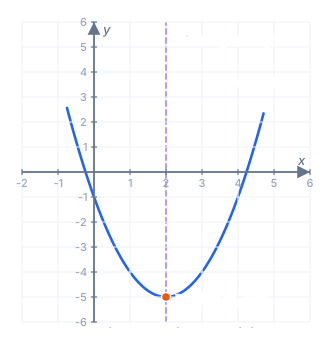
The vertex is the turning point of a parabola: the lowest point if the curve opens upward, the highest if it opens downward.
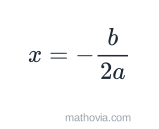
The axis of symmetry is the vertical line through the vertex that splits the curve into two mirror halves. Since it is vertical and passes through the vertex
Two details students routinely lose marks on:
- The axis is a line, so it needs an equation. Write
, not just “2”. - The vertex is a point, so it needs both coordinates. Write
, not just .
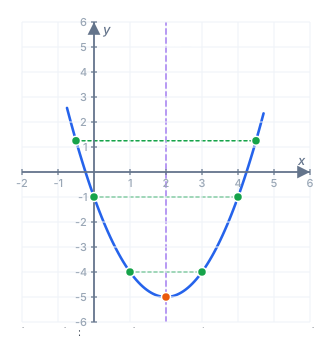
Symmetry is what makes the axis practical. Any two points on the parabola at the same height are the same distance from it, so plotting one side of the curve gives you the other side free.
Method 1: The −b/2a Formula
For
Then substitute that
For
So the vertex is
Watch the signs. The formula already contains a minus, so a negative
Where the Formula Comes From
It is not arbitrary. The two
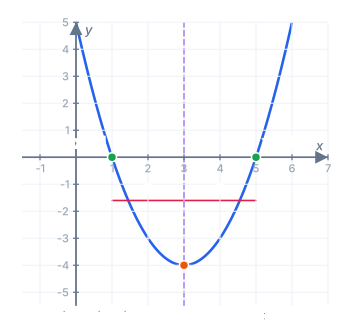
The quadratic formula gives those roots as
Average them. The two square-root terms are equal and opposite, so they cancel, leaving
Notice the discriminant disappeared. That is why the formula still works when the parabola has no real roots at all — the axis exists whether or not the curve ever crosses the
Method 2: Completing the Square
Completing the square converts standard form into vertex form, after which the vertex is simply readable.
Take
Vertex
The step people get wrong is the bookkeeping. Here 9 was added inside the bracket, so 9 must be subtracted outside to keep the expression equal to what it was. Nothing is added to the other side — this is an expression being rewritten, not an equation being balanced, which is the difference from the circle version of the same technique.
When
Vertex
Method 3: Average the Roots
If the
For
This only works when the parabola actually has two real x-intercepts. When it doesn’t, fall back on one of the other two methods.
Maximum or Minimum
The sign of
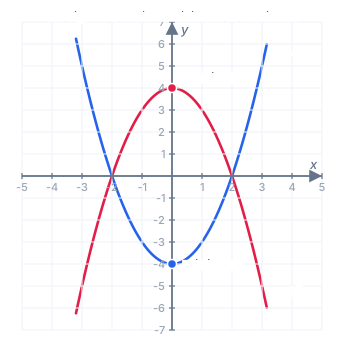
: opens upward, vertex is the minimum. The range is . : opens downward, vertex is the maximum. The range is .
Note which coordinate is the answer. “Where is the maximum?” wants
Worked Example A: Vertex From Standard Form
Find the vertex and axis of
Vertex
Worked Example B: A Negative Leading Coefficient
Find the vertex of
Vertex
Worked Example C: By Completing the Square
Write
Half of 10 is 5, and
Vertex
Worked Example D: Maximum Height
A ball is thrown so that its height after
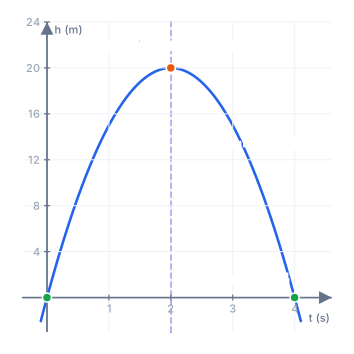
The vertex gives both answers:
Worked Example E: Largest Area
A farmer has 40 m of fencing for three sides of a rectangular pen against a wall. What width gives the greatest area?
With width
A width of 10 m gives area
Common Mistakes to Avoid
- Dropping the minus in the formula. It is
, so gives . - Stopping at the axis.
is the axis; the vertex needs the too. - Quoting
when the question wants . “What is the maximum value” is asking for the -coordinate. - Balancing both sides when completing the square on a function. Add and subtract on the same side — you are rewriting, not solving.
- Forgetting to factor
out first. With the constant you add gets multiplied by on the way back out. - Averaging the roots when there are none. That method needs two real intercepts.
- Writing the axis without ”
”. A line is an equation, not a number.
Where the Vertex Leads Next
- Optimisation. Every “largest area” or “maximum profit” question with a quadratic model is a vertex calculation.
- Range. The vertex fixes one end of the range:
or . - Transformations. In
, and are exactly the horizontal and vertical shifts. - Calculus. Setting the derivative to zero locates the same point;
gives . - Symmetry in other curves. Ellipses and hyperbolas have centres that play a similar organising role.
Practice Problems
Work each one before opening the answer.
Problem 1. Find the axis of symmetry of
Show answer
Problem 2. Find the vertex of
Show answer
At
Problem 3. Find the vertex of
Show answer
Problem 4. State the vertex of
Show answer
Problem 5. A parabola has
Show answer
Problem 6. Write
Show answer
Problem 7. Does
Show answer
Problem 8. Find the vertex of
Show answer
Problem 9. What is the range of
Show answer
Problem 10. A rocket’s height is
Show answer
Problem 11. Two points on a parabola,
Show answer
Problem 12. A rectangle has perimeter 24 cm. What dimensions give the largest area?
Show answer
With width
Quick Reference
| Task | Method |
|---|---|
| Axis of symmetry | |
| Vertex | substitute the axis value back in |
| From vertex form | |
| From the roots | |
| Maximum or minimum | |
| Maximum/minimum value | the |
| Range, | |
| Range, | |
| Axis notation | an equation, |
The vertex is the anchor of every parabola sketch, and locating it from standard form uses completing the square or the quadratic formula. It also fixes the range of the function. To drill the algebra, try the completing the square practice problems. More Algebra lessons are available.