
The zeros lesson finds where a polynomial crosses the
What Is a Complex Zero?
A zero of a polynomial is any input that makes the output zero. If you only allow real inputs, some polynomials have fewer zeros than their degree, or none at all. Allowing inputs from the complex numbers — numbers of the form
For
So
A real zero is a complex zero whose imaginary part happens to be
The Fundamental Theorem of Algebra
Every polynomial of degree
A polynomial of degree
has exactly complex zeros, counting each zero as many times as its multiplicity.
That is the complete answer to how many solutions does the equation have over the complex number system: as many as the degree. Some may be real, some may repeat, but the count always comes out to
| Polynomial | Degree | Real zeros | Non-real zeros | Total |
|---|---|---|---|---|
| — | ||||
| — | ||||
| — | ||||
| — |
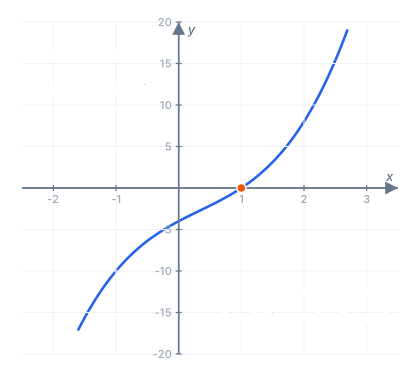
The fourth row is the cubic from the introduction: one crossing on the graph, two zeros hiding off it.
The Conjugate Pairs Theorem
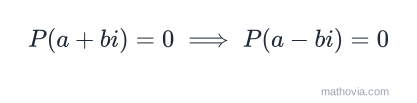
If a polynomial has real coefficients and
The reason is short. Take the conjugate of both sides of
Two consequences that get used constantly:
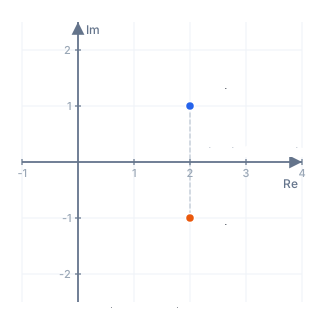
- Non-real zeros always come in pairs. A real-coefficient polynomial cannot have an odd number of non-real zeros. So a cubic has either three real zeros or one real zero plus a complex pair — never two real and one complex.
- Every odd-degree polynomial has at least one real zero. With
odd and the non-real zeros paired off, at least one zero is left over unpaired, and it must be real. (The graph says the same thing: odd degree means the tails go opposite ways, so the curve has to cross.)
The theorem needs real coefficients.
The Linear Factorization Theorem
Putting the two theorems together: a degree-
Over the complex numbers, every polynomial splits into linear factors — there is no such thing as an irreducible quadratic once
which has a negative discriminant and cannot be factored further with real numbers. So the real factorization of any real-coefficient polynomial is a product of linear factors (one per real zero) and irreducible quadratics (one per conjugate pair):
How to Find the Complex Zeros of a Polynomial
The strategy is to reduce the polynomial to a quadratic, because the quadratic formula handles complex zeros automatically — a negative discriminant simply produces a
- Find the real zeros first. Use the rational root theorem to list candidates and synthetic division to test them, dividing each one out as you find it.
- Stop when the quotient is quadratic. If its discriminant
is negative, the last two zeros are a conjugate pair from the quadratic formula. - If you are given a complex zero, write down its conjugate too, multiply the pair into the real quadratic
, and divide the polynomial by that quadratic. The quotient holds the remaining zeros. - Count. The zeros you have found, with multiplicity, should number exactly the degree.
Worked Example: Reducing to a Quadratic
Find all complex zeros of
Step 1 — rational candidates. Constant
Step 2 — test
The bottom row is
Step 3 — solve the quadratic.
Step 4 — count. Three zeros for a cubic:
The graph confirms it — one crossing at
Worked Example: Given One Complex Zero
Step 1 — the conjugate
Step 2 — multiply the pair into a real quadratic, using
Step 3 — divide
(Check the leading terms:
Step 4 — factor the quotient:
Step 5 — count. Zeros:
Worked Example: A Quadratic in Disguise
Find all complex zeros of
Step 1 — recognise the pattern. Only even powers appear, so substitute
Step 2 — return to
Step 3 — each factor gives a conjugate pair:
Step 4 — count. Four zeros, all imaginary, for a quartic. ✓ The graph of this polynomial never touches the
Common Mistakes to Avoid
- Reporting only the real zeros. “Find all complex zeros of a cubic” expects three answers. If you have one, the other two are a conjugate pair waiting in the quadratic quotient.
- Forgetting the conjugate. Given that
is a zero, comes free. Dividing by alone means complex arithmetic in the division for no reason. - Applying the conjugate pairs theorem to complex coefficients. It only holds when every coefficient is real.
has the double zero and no . - Expanding a conjugate pair term by term.
is a difference of squares in disguise: . Four-term expansion invites a sign error on . - Saying a polynomial “has no zeros”. Over the reals,
has no zeros; over the complex numbers it has two. Be clear which you mean — an exam question about complex zeros always means the second. - Losing count of multiplicity.
has four zeros — — not three. The repeated counts twice.
Practice Problems
Work each one before opening the answer.
Problem 1. How many complex zeros does
Show answer
Step 1 — the Fundamental Theorem of Algebra says the count equals the degree.
Answer:
Problem 2. Find all complex zeros of
Show answer
Step 1 — solve
Answer:
Problem 3. A polynomial with real coefficients has zeros
Show answer
Step 1 —
Step 2 — that is three zeros, so the degree is at least
Answer: degree
Problem 4. Find all complex zeros of
Show answer
Step 1 — factor by grouping:
Step 2 — solve each factor.
Answer:
Problem 5. Find all complex zeros of
Show answer
Step 1 — discriminant:
Step 2 — quadratic formula:
Answer:
Problem 6.
Show answer
Step 1 — the conjugate
Step 2 — divide:
Step 3 — factor the quotient:
Answer:
Complex zeros complete the story that real zeros start: exactly