
Change one plus sign to a minus in the ellipse equation and the closed oval breaks apart into two open branches racing away from each other. That is a hyperbola — the curve of a shadow cast on a wall by a lampshade, and of a spacecraft moving too fast to be captured by a planet.
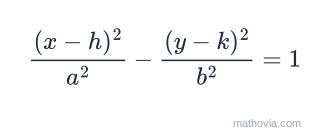
The Standard Equations
There are two, depending on which way the branches open.
Opening left and right:
Opening up and down:
In both,
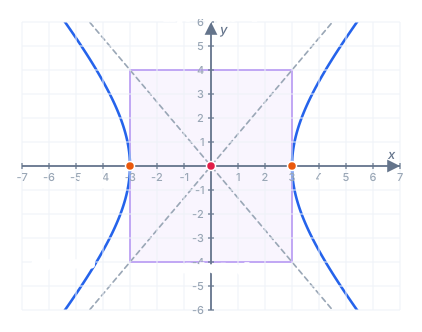
The Positive Term Decides Everything
This is the single most important rule on the topic, and it is the opposite of the ellipse rule, which is why it catches people out.
For an ellipse, the larger denominator tells you the orientation. For a hyperbola, the positive term does — and the denominators say nothing about it at all.
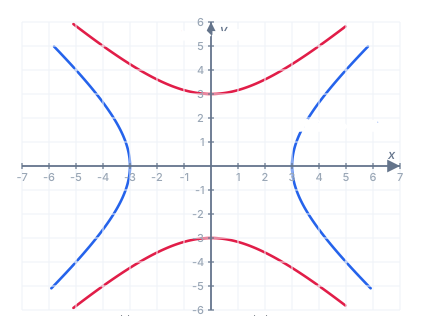
| Equation | Positive term | Opens |
|---|---|---|
| left and right | ||
| up and down | ||
| left and right | ||
| up and down |
Look at the last two rows. Both have denominators 25 and 4, but they open along different axes, because the sign moved. If you take away one thing from this lesson, make it that.
By convention
The Central Rectangle Method
You could memorise asymptote formulas for each orientation. It is easier, and much harder to get wrong, to draw a rectangle.
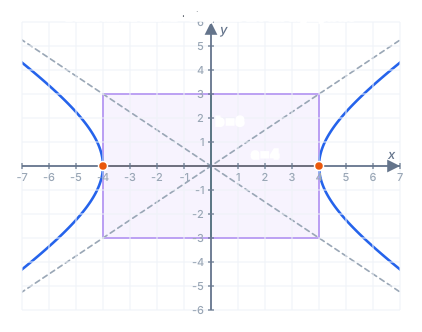
- Plot the centre
. - Mark
units along the axis the hyperbola opens along — these are the vertices. - Mark
units along the other axis. These are not on the curve; they only help build the box. - Draw the rectangle through those four marks.
- Extend the diagonals. Those lines are the asymptotes.
- Sketch each branch starting at a vertex and bending to hug the asymptotes without ever touching them.
For a horizontal hyperbola centred at the origin, the diagonals work out to
and for a vertical one,
The asymptotes are the reason a hyperbola sketch looks right or wrong. Without them, people draw branches that flatten out like parabolas; with them, the branches straighten into the diagonals as they should.
A Shifted Hyperbola
Everything above works unchanged when the centre moves — the brackets subtract the centre coordinates exactly as they do for circles and ellipses, so you negate what you see.
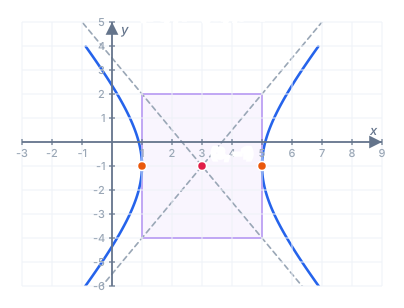
For
Ellipse or Hyperbola?
One sign separates them, and it changes everything about the picture.
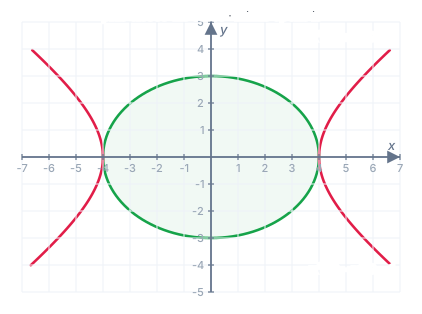
| Ellipse | Hyperbola | |
|---|---|---|
| Sign between terms | plus | minus |
| Shape | one closed curve | two open branches |
| Orientation set by | larger denominator | positive term |
| Asymptotes | none | two |
| Focus relation |
The focus relations are worth a second look, because they are so nearly the same. An ellipse subtracts; a hyperbola adds. A memory hook that works: the hyperbola’s foci lie outside its vertices, so
From General Form
An expanded hyperbola has
Convert with completing the square, then divide to reach 1. Take
The
Centre
Worked Example A: Read It Off
Give the centre, vertices and asymptotes of
Centre
Vertices
Worked Example B: A Vertical Hyperbola
Describe
The
Worked Example C: Find the Foci
Find the foci of
Foci at
Worked Example D: A Shifted Curve
Give the centre and vertices of
Centre
Vertices
Worked Example E: Identify the Conic
What curve is
The
It opens left and right,
Common Mistakes to Avoid
- Using the larger denominator to decide the orientation. That is the ellipse rule. Here only the sign matters.
- Assuming
. For a hyperbola can be the smaller of the two. - Using
. Hyperbolas add. - Drawing branches that flatten out. They straighten into the asymptotes instead.
- Letting a branch touch an asymptote. It approaches without ever meeting.
- Plotting the
marks as points on the curve. They only build the rectangle. - Dropping the sign when completing the square inside a negative bracket. Adding 1 inside a
bracket adds outside.
Where Hyperbolas Lead Next
- Navigation. LORAN and similar systems fix a position from the difference in signal arrival times, and constant difference traces a hyperbola.
- Orbits. An object exceeding escape velocity follows a hyperbolic path rather than returning.
- Cooling towers. Their hyperboloid shape is structurally strong and can be built from straight beams.
- Inverse variation. The graph of
is a hyperbola rotated 45°, which is why inverse-proportion graphs look the way they do. - Conic sections. A hyperbola is the slice steep enough to cut both halves of a double cone — the last member of the family alongside circles, ellipses and parabolas.
Practice Problems
Work each one before opening the answer.
Problem 1. Which way does
Show answer
Left and right, because the
Problem 2. Which way does
Show answer
Up and down. The
Problem 3. Give the vertices of
Show answer
Problem 4. Give the asymptotes of
Show answer
Problem 5. Give the asymptotes of
Show answer
Vertical opening, so
Problem 6. State the centre of
Show answer
Problem 7. Find the foci of
Show answer
Problem 8. Is
Show answer
An ellipse — the terms are added and the coefficients share a sign.
Problem 9. Is
Show answer
A hyperbola. The coefficients have opposite signs.
Problem 10. Convert
Show answer
Divide by 144:
Problem 11. Give the vertices of
Show answer
Centre
Problem 12. A hyperbola centred at the origin opens left and right, with a vertex at
Show answer
Quick Reference
| Task | Method |
|---|---|
| Horizontal opening | |
| Vertical opening | |
| Which way it opens | along the axis of the positive term |
| Centre | negate the numbers in the brackets |
| square root of the denominator under the positive term | |
| Vertices | |
| Asymptotes | diagonals of the |
| Asymptote slopes (horizontal) | |
| Foci | |
| Spotting one |
A hyperbola is the ellipse equation with a minus sign, and it shares the completing-the-square conversion used for circles. Its asymptotes are ordinary lines whose slopes come from the rectangle, and the sketching approach is the one from graphing equations. To drill the conversion step, try the completing the square practice problems. More Algebra lessons are available.