
Every polynomial graph eventually escapes to infinity — the only question is which way each end goes. End behavior is the description of those two escapes, and it is fixed entirely by the leading term. You can read it off a polynomial in a couple of seconds without plotting a single point, which is why it is normally the first thing you work out when sketching a curve, and why it reappears later in calculus when you compare how fast different functions grow.

What Is End Behavior?
The end behavior of a function describes what happens to
It is not about where the graph crosses the axes, how many turns it makes, or anything that happens near the origin. The end behavior of a graph is only about its two tails. A polynomial has no asymptotes and no gaps, so each tail does exactly one thing: rises without bound, or falls without bound.
Two features of the polynomial decide which:
- The degree
— the highest power of . - The leading coefficient
— the number multiplying that highest power.
Everything else is irrelevant to the ends.
How to Find End Behavior: The Four Cases
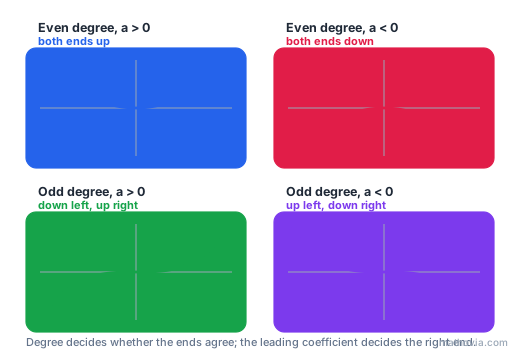
Because degree is either even or odd, and the leading coefficient is either positive or negative, there are exactly four combinations — so there are only four end behaviors a polynomial can have, and knowing how to determine end behavior comes down to placing your polynomial in one of these rows.
| Degree | Leading coefficient | Left end | Right end | Shape |
|---|---|---|---|---|
| Even | up | up | both ends up | |
| Even | down | down | both ends down | |
| Odd | down | up | falls left, rises right | |
| Odd | up | down | rises left, falls right |
Two rules are all you need to determine end behavior for any polynomial:
The degree decides whether the ends agree. An even degree sends both ends the same way; an odd degree sends them opposite ways. This is the same reason
The leading coefficient decides which way the right end goes. Positive means the right end rises; negative means it falls. Once you know the right end and whether the ends agree, the left end follows.
Writing It in Limit Notation
Describing the ends in words is fine, but the standard written form is a pair of limit statements:
That pair says “both ends up” — the even, positive case. Read
The four cases in this notation:
| Case | As | As |
|---|---|---|
| Even, | ||
| Even, | ||
| Odd, | ||
| Odd, |
Why Only the Leading Term Matters
It can feel wrong that a polynomial with six terms has its ends decided by one of them. The reason is that the powers grow at wildly different rates.
Take
By
Example 1: Reading End Behavior Off a Polynomial
For each polynomial, identify the leading term, then apply the two rules.
| Polynomial | Leading term | Degree / sign | End behavior |
|---|---|---|---|
| even, positive | both ends up | ||
| odd, negative | up left, down right | ||
| even, negative | both ends down | ||
| odd, positive | down left, up right | ||
| odd, negative | up left, down right |
Note the third and fifth rows: the polynomial is not written in descending order, so the leading term is not the first one you see. Always sort by power before you decide, or at least scan for the highest exponent rather than reading left to right.
Worked Example
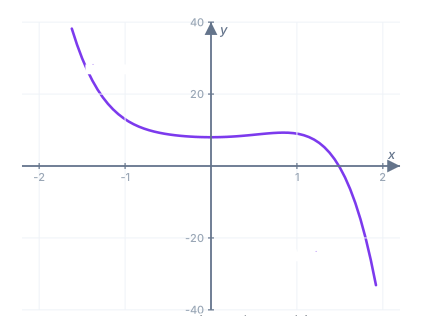
Describe the end behavior of
Step 1 — put the polynomial in descending order so the leading term is visible:
Step 2 — identify the degree and leading coefficient:
Step 3 — apply the degree rule. The degree is odd, so the two ends disagree — one rises, the other falls.
Step 4 — apply the coefficient rule. The leading coefficient is negative, so the right end falls:
Step 5 — the left end is the opposite, because the degree is odd:
In words: the graph rises on the far left and falls on the far right. The
End Behavior of Other Functions
The degree-and-sign rule is for polynomials, but every function has end behavior, and the question is always the same: what does
| Function | As | As |
|---|---|---|
| Rational, degree of top < degree of bottom, e.g. | ||
| Rational, equal degrees, e.g. | ||
| Exponential growth, | ||
| Exponential decay, | ||
| Logarithm, | not defined | |
| Square root, | not defined |
When a function levels off at a value, that value is a horizontal asymptote, and the rules for rational functions come from comparing the degrees of the top and bottom, exactly as in that lesson. Exponential end behavior is covered in graphing exponential functions.
Finding end behavior from a graph
If you only have the graph, look at the two arrows at the edges of the picture. Describe the left arrow first, then the right: “falls to the left, rises to the right” is
Common Mistakes to Avoid
- Reading the first term instead of the highest. In
the leading term is , not . A polynomial written out of order is the single most common way this goes wrong. - Letting the constant influence the ends. The
in shifts the whole curve up by eight units. Eight is nothing next to once is large, so the ends are untouched. - Assuming the number of turning points changes the ends. A degree-6 polynomial might have five turns or one; either way, even degree with a positive lead means both ends go up.
- Confusing end behavior with a horizontal asymptote. Polynomials do not have horizontal asymptotes — the tails run off to infinity rather than levelling out. Flattening tails belong to rational functions, where a horizontal asymptote genuinely can exist.
Practice Problems
Work each one before opening the answer.
Problem 1. Describe the end behavior of
Show answer
Step 1 — find the leading term:
Step 2 — degree
Both ends therefore rise.
Answer:
Problem 2. Describe the end behavior of
Show answer
Step 1 — the leading term is
Step 2 — odd degree means the ends disagree; a negative coefficient sends the right end down:
Step 3 — the left end is the opposite:
Answer: up on the left, down on the right
Problem 3. Describe the end behavior of
Show answer
Step 1 — reorder so the leading term is obvious:
Step 2 — degree
Answer:
Problem 4. A polynomial falls on the far left and rises on the far right. What can you say about its degree and leading coefficient?
Show answer
Step 1 — the two ends disagree, so the degree must be odd.
Step 2 — the right end rises, so the leading coefficient must be positive.
Answer: odd degree, positive leading coefficient — the same pattern as
Problem 5. Two students disagree about
Show answer
Step 1 — check the claimed value:
That is correct — the graph really is far below the axis at
Step 2 — but keep going. The leading term is
Beyond
Answer: the first student is right about end behavior. The second is describing the middle of the graph, not its end — this parabola simply takes until
Problem 6. Can a polynomial have one end going up and the other levelling off at
Show answer
Step 1 — levelling off at a finite height is a horizontal asymptote.
Step 2 — a non-constant polynomial’s leading term
Answer: no. Only the constant polynomial
End behavior is the cheapest information a polynomial gives up — two glances at the leading term and both tails are settled. It is also the first step of a proper sketch: fix the ends, then find the zeros to pin the middle down. The cubic functions lesson shows that combination on the simplest odd-degree case.