
Drop a ball, aim a satellite dish, or trace the cable on a suspension bridge and you get the same curve. A parabola is the graph of a quadratic — any function whose highest power of
What Makes a Curve a Parabola
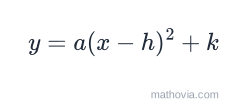
A parabola is the graph of
That
Two features define every parabola:
- One turning point, the vertex, where the curve stops falling and starts rising (or the reverse).
- A vertical mirror line through that vertex, the axis of symmetry. Fold the page along it and the two halves match exactly.
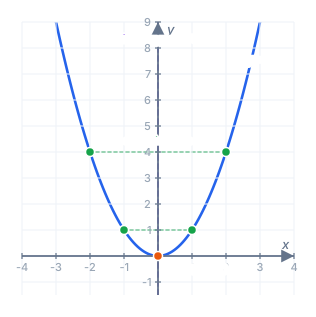
That symmetry is not decoration — it is the single most useful property when sketching, because it means every point you plot on one side gives you a second point free.
What the Coefficient a Controls
The number in front of
Its sign sets the direction. Positive
Its size sets the width. A large
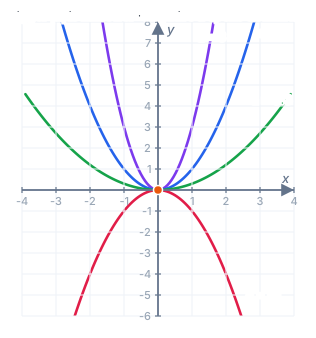
| Value of | Direction | Shape against |
|---|---|---|
| upward | narrower | |
| upward | the reference curve | |
| upward | wider | |
| downward | mirrored vertically |
A quick sanity check: at one unit right of the vertex, the curve has risen exactly
The Two Forms
Standard form is
Vertex form is
and its gift is the vertex, sitting right there as
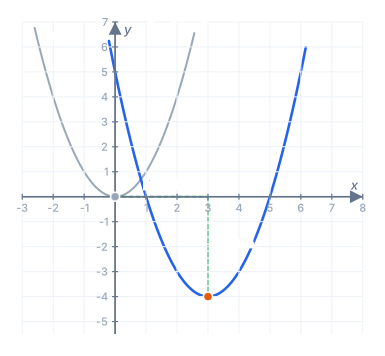
Read that way, vertex form is just
Finding the Intercepts
The
The
How many there are is decided before you solve anything, by the discriminant
| Discriminant | What the graph does | |
|---|---|---|
| two | crosses the axis twice | |
| one | just touches, vertex on the axis | |
| none | floats entirely above or below |
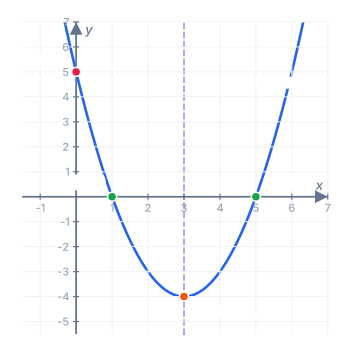
A parabola with no
The Five-Point Method
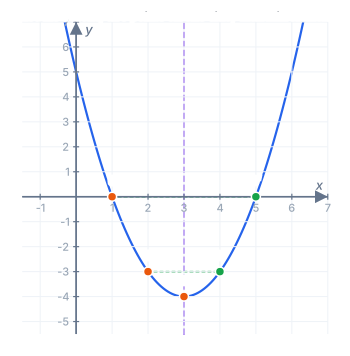
Tables of values waste effort, because symmetry means half the rows are predictable. This is faster and more accurate:
- Find the vertex. Either read it from vertex form, or use
and substitute back — the method covered in vertex and axis of symmetry. - Draw the axis of symmetry as a dashed vertical line through it.
- Plot two points on one side. One and two units across is usually enough.
- Mirror them to the other side at the same heights.
- Join the five points with a smooth curve — never straight segments, and never a sharp corner at the vertex.
Worked Example A: Sketch From Vertex Form
Sketch
The vertex is
One unit right of the vertex the curve has risen
Five points, and the
Worked Example B: Sketch From Standard Form
Sketch
The
The axis of symmetry is
For the
Plot
Worked Example C: A Downward Parabola
Describe the graph of
Because
Worked Example D: Counting the Intercepts First
How many
Negative, so none. Since
Worked Example E: Building the Equation From a Graph
A parabola has vertex
Start in vertex form:
So
Common Mistakes to Avoid
- Getting the vertex signs backwards.
means , not 3. - Assuming every parabola crosses the
-axis. Plenty do not, and “no real roots” is a complete answer. - Drawing a sharp point at the vertex. A parabola turns smoothly; only absolute-value graphs have a corner.
- Reading
as the width alone. Its sign carries the direction too. - Plotting points blindly on both sides. Symmetry halves the work.
- Forgetting
when the curve is stretched. At one unit from the vertex the rise is , not 1. - Confusing the axis of symmetry with the vertex. The axis is a line,
; the vertex is a point.
Where Parabolas Lead Next
- Maximum and minimum problems. The vertex answers every “largest area” and “greatest height” question — see vertex and axis of symmetry.
- Conic sections. A parabola is the conic you get by slicing a cone parallel to its side; circles, ellipses and hyperbolas are the rest of the family.
- Projectile motion. Under constant gravity, height against time is quadratic.
- Quadratic inequalities. Knowing where the curve sits above or below the axis solves them by inspection.
- Reflector design. A parabolic dish focuses every incoming parallel ray onto one point, which is why satellite dishes and headlight reflectors have this cross-section.
Practice Problems
Work each one before opening the answer.
Problem 1. Which way does
Show answer
Problem 2. State the vertex of
Show answer
Problem 3. State the vertex of
Show answer
Problem 4. What is the
Show answer
Problem 5. Find the
Show answer
Problem 6. How many
Show answer
Problem 7. How many
Show answer
Problem 8. Is
Show answer
Narrower, because
Problem 9. Write
Show answer
Problem 10. A parabola has vertex
Show answer
Problem 11. A parabola has vertex
Show answer
Problem 12. Sketch
Show answer
Axis
Quick Reference
| Task | Method |
|---|---|
| Standard form | |
| Vertex form | |
| Direction | |
| Width | larger |
| solve | |
| Number of | sign of |
| Axis of symmetry | |
| Rise from the vertex | |
| Fast sketch | vertex, two points, mirror both |
Parabolas are the curve half of graphing equations, and their intercepts are the roots you find in quadratic equations. The next lesson, vertex and axis of symmetry, goes deeper on locating that turning point. To drill the algebra underneath, try the quadratic equations practice problems. More Algebra lessons are available.