
Standard form is the one students tend to dismiss. It hides the slope, it hides the intercept, and it looks like extra work compared with
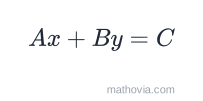
The Conventions
Any line can be written this way, but “standard form” usually carries three extra requirements:
, and are integers — no fractions, no decimals. — the leading coefficient is not negative. - No common factor.
should be reduced to .
These are conventions, not mathematics:
Graphing From the Intercepts
Here is where standard form pays. Because
For
-intercept: put . Then , so . Point . -intercept: put . Then , so . Point .
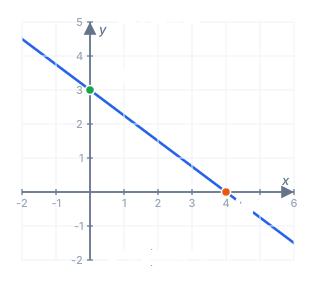
Two points, one line, no table, no rearranging. Compare that with converting to
The method has one weak spot. If
Reading the Slope Without Converting
You do not have to rearrange to get the slope. Solving
So the slope is always
Converting Between Forms
Slope-intercept to standard. Clear fractions first, then move the
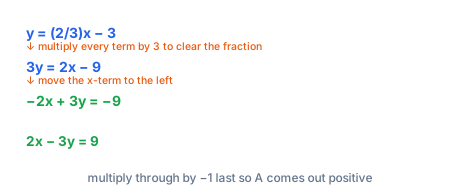
The last step catches people out. After moving terms you often have
Standard to slope-intercept. Isolate
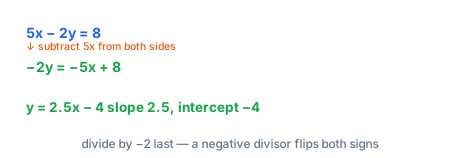
The Line Only This Form Can Write
A vertical line has no slope, so
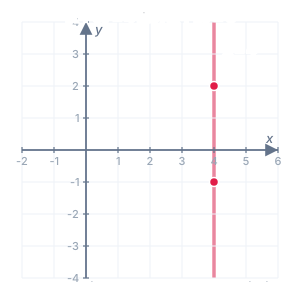
Setting
Where Standard Form Comes From Naturally
Standard form is not just a tidy-up of slope-intercept form. It is the shape equations arrive in when a problem describes a total.
- Budget constraints. Apples at $3 and bread at $4, spending exactly $12:
. Nobody would naturally write that as . - Mixture problems. 5% and 20% solutions combining to a fixed amount of acid.
- Systems of equations. The elimination method needs both equations with variables aligned on the left — that is standard form by another name.
- Coin and ticket problems. “Adult tickets $8, child $5, takings $400” is
.
In every case the constant
Worked Example A: Graph From Intercepts
Graph
: , so . Point . : , so . Point .
Plot both and draw. The slope, if you want it, is
Worked Example B: Clear the Fractions
Write
Multiply every term by 4 (the least common denominator):
Move the
Worked Example C: Reduce a Common Factor
Is
The coefficients share a factor of 3, so strictly no. Divide through:
Same line, conventional form.
Worked Example D: A Real Constraint
A stall sells mugs at $6 and prints at $9. In one day it takes exactly $180. Write the equation and find both intercepts.
: — thirty mugs and no prints. : — twenty prints and no mugs.
Only whole-number points on this segment are physically meaningful, which is a nice reminder that a line can be a model rather than the answer itself.
Worked Example E: Convert and Compare
Are
Divide the first by 2:
Common Mistakes to Avoid
- Leaving fractions in. Standard form wants integers. Multiply by the LCD first.
- Leaving
negative. Multiply the whole equation by ; every term changes sign, including . - Forgetting to reduce.
should be . - Reading the slope as
. It is ; the minus sign is part of it. - Only multiplying some terms. When clearing fractions, the constant on the right gets multiplied too.
- Using the intercept method when
. Both intercepts are the origin; pick a second point instead. - Assuming standard form is unique without the conventions.
and are the same line; only the reduced version is conventional.
Practice Problems
Work each one before opening the answer.
Problem 1. Find both intercepts of
Show answer
Problem 2. State the slope of
Show answer
Problem 3. Convert
Show answer
Problem 4. Convert
Show answer
Multiply by 5:
Problem 5. Convert
Show answer
Problem 6. Write
Show answer
Divide by 3:
Problem 7. Write the vertical line through
Show answer
Problem 8. Write the horizontal line through
Show answer
Problem 9. A line has intercepts
Show answer
Slope
Problem 10. Are
Show answer
Dividing the second by 2 gives
Problem 11. Concert tickets cost $12 in advance and $18 at the door, and takings were $1,080. Write the equation in standard form.
Show answer
Problem 12. Convert
Show answer
Multiply by 2:
Quick Reference
| Task | Method |
|---|---|
| Set | |
| Set | |
| Slope | |
| To slope-intercept | Isolate |
| From slope-intercept | Clear fractions, move |
| Vertical line | |
| Horizontal line | |
| Same line? | Reduce both fully and compare |
Standard form completes the set alongside slope-intercept form and point-slope form — see Lines for how the three fit together. The intercept method is covered further in x- and y-Intercepts, and there are more Algebra lessons available.