
Parallel is one of the few geometric ideas that becomes easier when you write it algebraically. Rather than checking that two lines never meet — which would take forever, since lines are infinite — you compare one number each.
The Rule
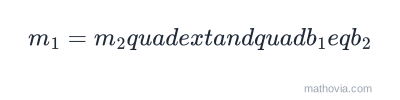
Two distinct lines are parallel exactly when their slopes are equal. The second condition matters more than it looks: without it, a line would count as parallel to itself.
The reason is straightforward. Slope measures how much a line climbs per unit across. If two lines climb at the same rate, the vertical distance between them is the same at
Testing Two Equations
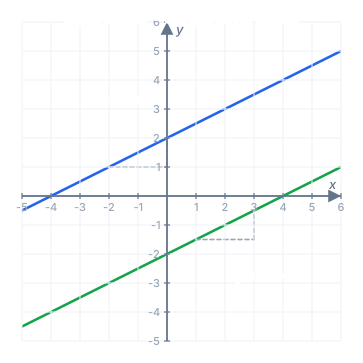
The test is always “find both slopes and compare”, but how you find them depends on the form.
Both in slope-intercept form. Read them off.
One or both in standard form. Either rearrange, or use the shortcut that a line
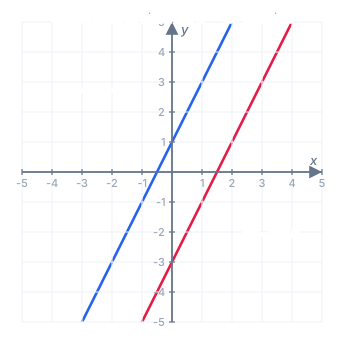
That last observation is a genuinely useful shortcut. In standard form, two lines are parallel when
The Trap: Coincident Lines
Two equations that look different can be the same line.
Always reduce both equations fully before deciding. Same slope and same intercept means one line wearing two disguises; same slope with different intercepts means genuinely parallel.
| Slopes | Intercepts | Relationship | Solutions |
|---|---|---|---|
| Different | Anything | Intersecting | Exactly one |
| Equal | Different | Parallel | None |
| Equal | Equal | Coincident | Infinitely many |
Writing a Parallel Line Through a Point
This is the standard exam question, and it has a two-step answer: steal the slope, use the new point.
Write the line parallel to
The slope is
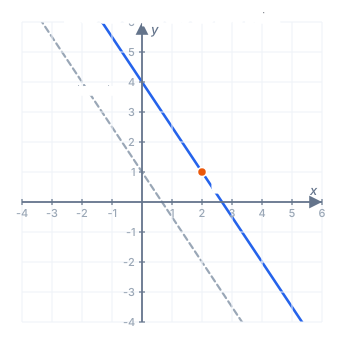
There is a shortcut worth knowing when the original is in standard form: keep
No rearranging at all.
Parallel Vertical and Horizontal Lines
The slope rule needs adjusting at the two extremes.
- Vertical lines all have undefined slope, so “equal slopes” is not a statement you can make. But
and plainly never meet, so they are parallel. Any two distinct vertical lines are parallel. - Horizontal lines all have slope 0, so the usual rule works:
and are parallel. - A vertical and a horizontal line are never parallel — they are perpendicular.
Distance Between Two Parallel Lines
The gap is constant, so it can be measured once. Put both lines in the form
For
Notice the answer is smaller than the vertical gap of 5. That is because the shortest distance is measured perpendicular to the lines, not straight up — the steeper the lines, the bigger the difference.
Parallel Lines in Systems of Equations
A system of two linear equations asks “where do these lines meet?” If they are parallel, the honest answer is nowhere, and the algebra says so.
Subtracting the second equation from the first gives
If instead the algebra collapses to something always true, like
Worked Example A: Parallel or Not?
Are
Rearrange the second:
Worked Example B: Through a Point
Write the line parallel to
Using the standard-form shortcut, keep
In slope-intercept form that is
Worked Example C: Spot the Coincident Pair
Classify
Divide the second by 2:
Worked Example D: Distance
How far apart are
Worked Example E: A Parallelogram Check
Is the quadrilateral with vertices
: slope . : slope . Parallel. : slope . : slope . Parallel.
Both pairs of opposite sides are parallel, so yes.
Common Mistakes to Avoid
- Comparing slopes before solving for
. has slope , not . - Calling coincident lines parallel. Check the intercepts too, or reduce both equations fully.
- Changing the slope when writing the parallel line. The whole point is that it stays the same; only the constant moves.
- Using the vertical gap as the distance. The distance between parallel lines is measured perpendicular to them, which is shorter.
- Assuming two lines that look parallel on a graph are parallel. Slopes of
and look identical on a small sketch. Check algebraically. - Forgetting the vertical case. Undefined slopes cannot be “equal”, but two vertical lines are still parallel.
Where This Shows Up
- Systems of equations, where parallel means no solution.
- Geometry proofs. Parallelograms, trapeziums and rectangles are all defined partly by parallel sides.
- Coordinate geometry problems asking you to complete a shape from three vertices.
- Linear programming, where the objective function slides as a family of parallel lines across a feasible region.
- Physics and modelling, where two quantities changing at the same rate but from different starting points produce parallel graphs.
Practice Problems
Work each one before opening the answer.
Problem 1. Are
Show answer
Yes — same slope 4, different intercepts.
Problem 2. Are
Show answer
No. The slopes are
Problem 3. Write the line parallel to
Show answer
Same slope, and the point is the intercept:
Problem 4. Write the line parallel to
Show answer
Problem 5. Are
Show answer
Doubling the first gives
Problem 6. Are
Show answer
Dividing the second by 3 gives
Problem 7. Write the line parallel to
Show answer
Keep
Problem 8. Find the distance between
Show answer
Problem 9. For what value of
Show answer
The second is
Problem 10. Solve the system
Show answer
Halving the second gives
Problem 11. Are
Show answer
Yes. Both are vertical, so they never meet, even though neither has a defined slope.
Problem 12. Three vertices of a parallelogram are
Show answer
Quick Reference
| Question | Answer |
|---|---|
| Parallel condition | |
| Slope from standard form | |
| Parallel in standard form | Same |
| Parallel through a point | Keep |
| Standard-form shortcut | Keep |
| Distance apart | |
| Two vertical lines | Always parallel |
| Same slope, same intercept | Coincident, not parallel |
| As a system | No solution (inconsistent) |
The companion rule for lines meeting at a right angle is in Perpendicular Lines. Both build on slope and are summarised in Lines; writing the new equation uses point-slope form. More Algebra lessons are available.