
Fold a sheet of paper in half and it’s 2 layers thick. Fold it again: 4. Again: 8, then 16, 32, 64. Each fold doubles the thickness. A list like this, where you multiply by the same number every time, is a geometric sequence. Doubling bacteria, a bouncing ball losing height, a car losing value each year and a savings account earning interest all follow the same pattern, and the formula for it is short.
What Is a Geometric Sequence?
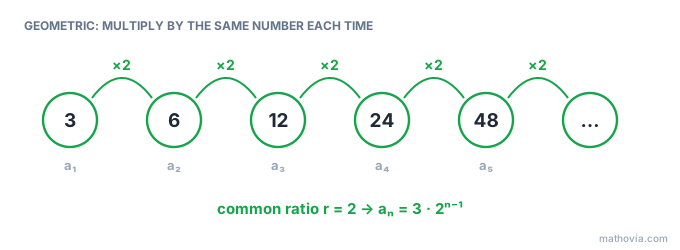
A sequence is geometric when each term is the previous term multiplied by the same non-zero number, the common ratio
| Sequence | Ratios | Common ratio |
|---|---|---|
| 3, 6, 12, 24, … | ×2, ×2, ×2 | |
| 64, 16, 4, 1, … | ×¼, ×¼, ×¼ | |
| 5, −10, 20, −40, … | ×(−2) each time | |
| 2, 4, 6, 8, … | ×2, ×1.5, ×1.33 | not geometric (it’s arithmetic) |
How to Find the Common Ratio
Divide any term by the one before it:
Check at least two pairs. If the ratios match, the sequence is geometric. For 81, 27, 9, 3, …:
The Explicit Formula
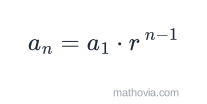
Reaching the
| Symbol | Meaning |
|---|---|
| the | |
| the first term | |
| the common ratio | |
| the term’s position |
Example. Find the 8th term of 3, 6, 12, 24, …
Step 1 — the pieces:
Step 2 — substitute:
Notice how quickly that grew. The 8th term of the arithmetic sequence 3, 6, 9, … is just 24.
The Recursive Formula
The recursive formula for a geometric sequence gives the first term and the rule “multiply the previous term by
When a question asks “what is the recursive formula for this geometric sequence?”, find
Growth, Decay and Alternating Signs
The common ratio decides how the sequence behaves:
| Common ratio | Behaviour | Example |
|---|---|---|
| grows faster and faster | 3, 6, 12, 24 | |
| shrinks toward 0 | 64, 32, 16, 8 | |
| alternates sign | 5, −10, 20, −40 | |
| constant | 7, 7, 7, 7 |
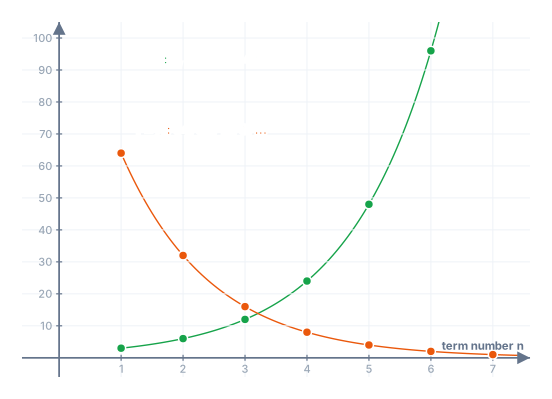
Plotted against
Finding r and a₁ From Two Terms
Example. A geometric sequence has
Step 1 — three multiplications by
Step 2 — divide back to the first term:
The sequence is 2, 6, 18, 54, 162, …
Finding Which Term Has a Given Value
Which term of 2, 6, 18, … equals 1,458?
When the power doesn’t come out neatly, solve
Worked Example: A Bouncing Ball
A ball is dropped from 10 m. Each bounce reaches 80% of the height of the one before. How high does it rise after the third bounce?
Step 1 — the rebound heights form a geometric sequence with first rebound
Step 2 — the third rebound:
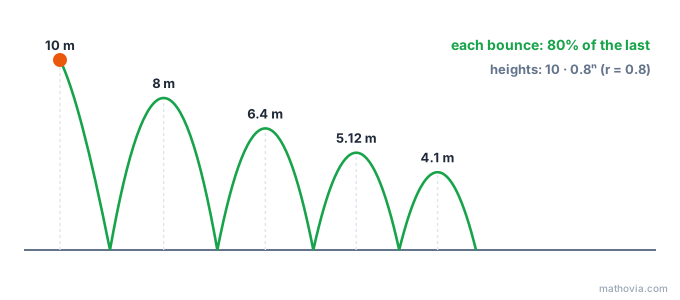
To find the total distance the ball travels, you’d add all those heights, which is a geometric series.
Common Mistakes to Avoid
- Using
instead of . The first term has had no multiplications, so the exponent is . - Multiplying before raising to the power.
, not . - Dividing the wrong way.
is a term divided by the term before it. For 81, 27, 9, , not . - Losing the sign of a negative ratio.
. Keep the brackets. - Confusing ratio and difference. If you subtract, you’re testing for arithmetic. Divide to test for geometric.
Practice Problems
Work each one before opening the answer. To check your own sequences, the geometric sequence calculator finds any term, the sum of n terms and the infinite sum.
Problem 1. Find the common ratio of 81, 27, 9, 3, …
Show answer
Answer:
Problem 2. Find the 6th term of 2, 10, 50, …
Show answer
Answer:
Problem 3. Write the explicit formula for 4, −12, 36, …
Show answer
Step 1 —
Answer:
Problem 4. Write the recursive formula for 5, 15, 45, …
Show answer
Answer:
Problem 5. A geometric sequence has
Show answer
Step 1 — three steps apart:
Step 2 — back to the start:
Answer:
Problem 6. Which term of 1, 2, 4, 8, … is 512?
Show answer
Answer: the 10th term
Adding gives arithmetic sequences; multiplying gives geometric ones. Telling the two apart quickly is a skill on its own, and it’s the subject of arithmetic vs geometric sequences.