Mathovia

Algebra / Common Graphs

Horizontal Shifts: Why Minus Moves a Graph Right

Every other transformation does what it looks like. This one does the opposite: f(x − 3) moves the graph three units to the right, not left. That single counterintuitive fact costs more marks than any other rule in graphing, so this lesson gives three separate ways to see why it is true, then covers what a horizontal shift does to the domain, the intercepts and any asymptotes.

Written by
Zohaib
Founder & Mathematics Content Creator
Published

Mathematics verification: Mathematical formulas, calculations, worked examples and solutions are reviewed for accuracy before publication.

Add 3 outside a function and the graph rises 3. Subtract 3 inside and the graph moves right 3. Most people expect left, and the mismatch between what the sign looks like and what it does is the single most reliable source of lost marks in this topic.
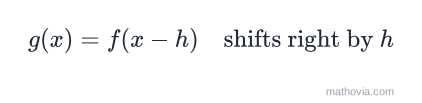
The horizontal shift form of a function
Subtracting h inside the bracket shifts the graph right by h

The Rule

shifts the graph of right by units when is positive, and left when it is negative.

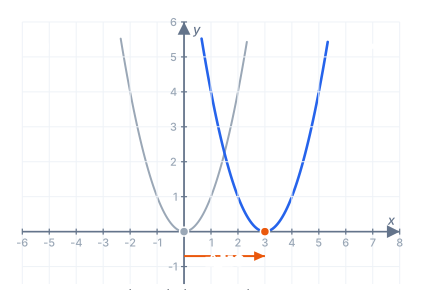
The parabola y equals x squared shown faded beside y equals f of x minus 3, which sits three units to the right, with an arrow marking the shift
Minus 3 inside the bracket, and the graph moves right 3.
Written asStandard formShift
right 3
left 4
right 1
left 10

The trick that never fails: rewrite every plus as a minus. is , so and the shift is 4 left. Doing that on paper for a term or two makes the rule automatic.

Three Ways to See Why

Different explanations land for different people, so here are three.

1. The function is running late.
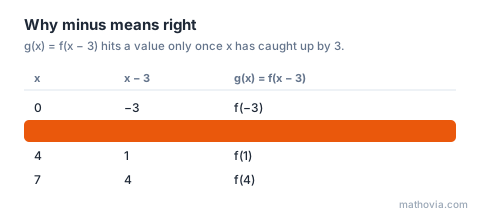
A table showing that g(x) = f(x − 3) produces f(0) only when x reaches 3, so every output arrives three units later
g reaches f's starting value only once x has caught up by 3.

computes of a number three smaller than whatever you feed it. To get out of , you must put in . Every output happens three units later than it did for — so the graph is pushed forward, to the right.

2. Solve for where the interesting bit lands. If has a vertex where its input is 0, then has its vertex where , that is at . Setting the inside to zero always tells you where the key feature moved to, and it works even when there is a coefficient on .

3. Think of it as compensation. Subtracting 3 from the input weakens it, so must be 3 bigger to compensate. Bigger means further right.

Left and Right Together

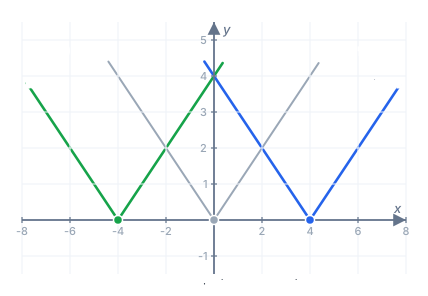
Three V-shaped graphs: the parent, one shifted left 4 by f of x plus 4, and one shifted right 4 by f of x minus 4
Plus moves left, minus moves right — the opposite of how it reads.

Both directions are the same rule. The sign inside the bracket is the opposite of the direction of travel.

Every Point Moves Sideways Only
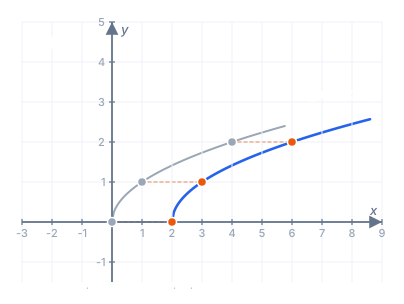
A square root curve and its shift two units right, with three pairs of points joined by horizontal dashed lines at the same heights
Heights are untouched — only the x-coordinates change.

The point rule is as simple as it gets:

The -coordinate is never touched. That is why the shape, width and orientation of the graph are all preserved — a shifted parabola is the same parabola in a different place.

What Changes and What Doesn’t

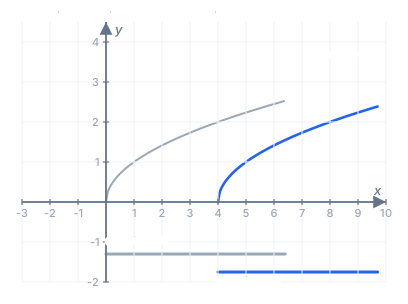
A square root curve and its shift four units right, with the two domains marked as bars beneath showing x at least zero becoming x at least four
The domain slides with the graph; the range does not move at all.
FeatureEffect of a horizontal shift
Shapeunchanged
Domainshifts by
Rangeunchanged
-interceptsshift by
-interceptusually a different value
Vertical asymptotesshift by
Horizontal asymptotesunchanged

The -intercept is the one that trips people. It does not “shift” — the line stays where it is, and the curve moving past it means a different point of the curve now sits there. Recompute it rather than sliding it.

When There Is a Coefficient on x

If has a coefficient inside the bracket, factor it out before reading the shift.

The shift is 3, not 6 — and there is also a horizontal compression by a factor of 2. Reading 6 straight off is the standard error here.

The safe method, again: set the inside to zero. gives .

Worked Example A: Read the Shift

Describe .

Right 8.

Worked Example B: A Plus Sign

Describe .

Rewrite as , so : left 2.

Worked Example C: On a Square Root

Describe against , and give its domain.

Right 5. The parent starts at , so this starts at .

Domain — shifted by 5. Range — unchanged, as always for a horizontal shift. See square root functions.

Worked Example D: A Coefficient Inside

Describe the horizontal shift in .

Factor: . The shift is right 4, together with a horizontal compression by a factor of 3.

Check by setting the inside to zero: gives . ✔

Worked Example E: An Asymptote Moves

Where is the vertical asymptote of ?

This is shifted right 6. The parent’s asymptote at moves to .

The horizontal asymptote stays at , because heights are unaffected.

Common Mistakes to Avoid

  • Reading the sign as the direction. Minus means right.
  • Not factoring out a coefficient. shifts by 3, not 6.
  • Shifting the -intercept. Recompute it; it is not carried along.
  • Changing the range. A horizontal shift never touches it.
  • Thinking the shape stretches. Every point moves the same distance, so nothing distorts.
  • Moving the horizontal asymptote. Only vertical ones move.
  • Applying it to the output. is a vertical shift, a different transformation entirely.

Where Horizontal Shifts Lead Next

  • The full picture. Function transformations puts this alongside the other three moves.
  • Vertical shifts. Vertical shifts are the well-behaved counterpart — no sign surprises.
  • Vertex form. The in is exactly this shift, which is why parabolas read the way they do.
  • Horizontal compressions. squeezes by a factor of — backwards again, for the same input-side reason.
  • Phase shift. In trigonometry the horizontal shift of a sine wave is called the phase shift, and follows this identical rule.

Practice Problems

Work each one before opening the answer.

Problem 1. Which way does move the graph?

Show answer

Right 9.

Problem 2. Which way does move the graph?

Show answer

Left 6.

Problem 3. Where is the vertex of ?

Show answer

.

Problem 4. Where is the vertex of ?

Show answer

.

Problem 5. Where does start?

Show answer

At ; domain .

Problem 6. Where does move under ?

Show answer

To . The height is unchanged.

Problem 7. What is the horizontal shift in ?

Show answer

Factor to : right 2, plus a compression by 4.

Problem 8. has domain . What is the domain of ?

Show answer

— both endpoints shift right 3.

Problem 9. has range . What is the range of ?

Show answer

, unchanged.

Problem 10. Where is the vertical asymptote of ?

Show answer

At , shifted 2 left from the parent’s .

Problem 11. Write the equation of shifted 6 left.

Show answer

.

Problem 12. has -intercept . What is the -intercept of ?

Show answer

Substitute : , so . It is recomputed, not shifted.

Quick Reference

TaskMethod
The form
Positive right by
Negative (a plus sign)left
Finding reliablyset the inside to zero and solve
With a coefficientfactor it out first
Point rule
Domainshifts by
Rangeunchanged
Vertical asymptoteshifts by
-interceptrecompute it

A horizontal shift is the counterintuitive member of the function transformations family; vertical shifts behave exactly as they read. The same appears in the vertex form of parabolas, absolute value functions and square root functions. More Algebra lessons are available.

Frequently Asked Questions

Why does f(x − 3) move the graph right instead of left?+

Because the shift acts on the input before the function runs. only produces 's value at 0 once has reached 3, so every output arrives three units later — the graph is pushed right.

Which way does f(x + 4) move the graph?+

Left 4. Written in the standard form , a plus sign means is negative: is , so and the shift is four to the left.

How do you find the horizontal shift when there is a coefficient on x?+

Factor it out first. , so the shift is 3, not 6 — and there is also a horizontal compression by a factor of 2.

Does a horizontal shift change the shape of the graph?+

No. Every point keeps its height and simply slides sideways by the same amount, so the shape, width and orientation are all identical.

Does a horizontal shift change the domain or the range?+

It shifts the domain by the same amount and leaves the range completely unchanged, because no output value is altered — only which input produces it.

What happens to the intercepts under a horizontal shift?+

The -intercepts move with the graph, shifting by . The -intercept usually changes to a different value entirely, because now hits a different part of the curve.

Does a horizontal shift move a vertical asymptote?+

Yes. A vertical asymptote is tied to an -value, so it slides by the same . A horizontal asymptote is unaffected, since the heights do not change.

Related lessons