
Every function has a set of inputs it can legally accept. Sometimes that set is everything; often it is everything except a couple of values that would break the arithmetic. Finding the domain is mostly a matter of knowing what to look for.
What the Domain Is
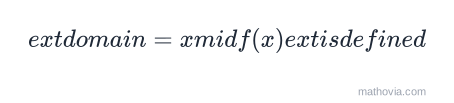
The domain is the set of all inputs for which the function produces a real output.
Visually it is the graph’s shadow on the
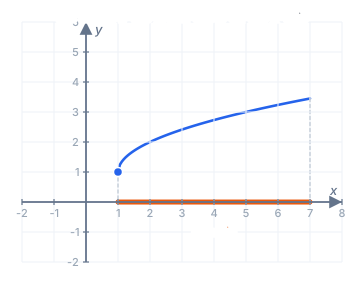
The default is generous. Start by assuming all real numbers, then take away only what genuinely fails.
The Three Restrictions
In an algebra course, almost every restricted domain comes from one of three operations.
1. Division by zero
A denominator may never be zero. Set it equal to zero, solve, and exclude those values.
For
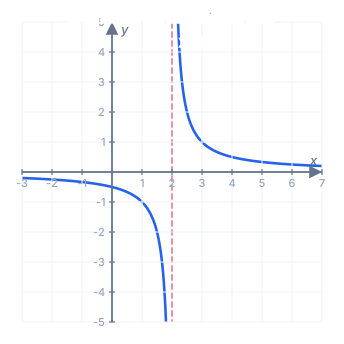
Only the denominator matters.
2. Even roots of negatives
Square roots, fourth roots and every other even root need a non-negative inside, because no real number squares to a negative.
For
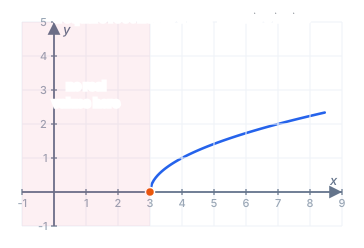
Note the
3. Logarithms of non-positives
A logarithm needs a strictly positive argument. For
Putting Restrictions Together
When a function contains more than one of these, every condition must hold at once — take the overlap.
For
- The root needs
, so . - The denominator needs
, so .
Together:
Writing the Answer
Three notations are in use, and courses vary in which they expect.
| Description | Inequality | Interval | Set-builder |
|---|---|---|---|
| Everything | all reals | ||
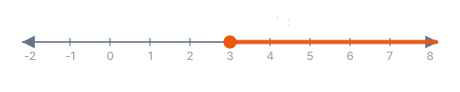
| From 3 upward | |||
| Above | |||
| All but 2 | |||
| Between 1 and 5 |
The bracket rule is worth memorising: square brackets include the endpoint, round brackets exclude it. Infinity always takes a round bracket, because you never reach it.
For more on the brackets, see Interval Notation.
Reading the Domain From a Graph
Scan left to right and note where the curve exists.
- A filled dot means that endpoint is included → square bracket.
- An open circle means it is excluded → round bracket.
- An arrow means the graph continues forever in that direction.
- A vertical asymptote is a value the graph approaches but never reaches → excluded.
- A gap in the middle means the domain is a union of pieces.
A graph running from a filled dot at
Domains From Context
When a function models something real, the situation restricts the inputs even when the algebra does not.
The area of a square of side
Similar cases turn up everywhere: a number of items must be a non-negative whole number, a time since an event cannot be negative, a percentage cannot exceed 100. Exam questions often ask for the “domain in context”, and the answer is nearly always narrower than the algebraic one.
Worked Example A: A Polynomial
Find the domain of
Nothing to break — no division, no roots, no logs. Domain: all real numbers,
Worked Example B: A Rational Function
Find the domain of
Domain: all reals except
Worked Example C: A Square Root
Find the domain of
Dividing by
Worked Example D: Two Restrictions
Find the domain of
The root needs
Domain:
Worked Example E: In Context
A rectangle has perimeter 40, so width
Algebraically the domain is all reals. In context both dimensions must be positive:
Common Mistakes to Avoid
- Excluding values that make the numerator zero. Only the denominator matters.
- Using
instead of under a root. Zero under a square root is fine. - Restricting an odd root. Cube roots accept negatives.
- Forgetting to flip the inequality when dividing by a negative.
- Simplifying away a restriction.
reduces to , but is still excluded — the original had a hole there. - Bracketing infinity squarely. It is always
and . - Ignoring context. A negative side length is not a valid input, whatever the algebra says.
Where Domain Leads Next
- Range — the matching question about outputs.
- Asymptotes and holes, which sit exactly at excluded values.
- Graphing functions, where the domain tells you how much to draw.
- Composite functions, whose domain must satisfy both functions at once.
- Inverse functions, where domain and range swap roles.
- Calculus, where continuity and differentiability are asked about only on the domain.
Practice Problems
Work each one before opening the answer.
Problem 1. Find the domain of
Show answer
All real numbers,
Problem 2. Find the domain of
Show answer
All reals except 0:
Problem 3. Find the domain of
Show answer
Problem 4. Find the domain of
Show answer
Problem 5. Find the domain of
Show answer
Problem 6. Find the domain of
Show answer
A cube root is an odd root, so there is no restriction: all real numbers.
Problem 7. Find the domain of
Show answer
Problem 8. Find the domain of
Show answer
Root needs
Problem 9. A graph runs from an open circle at
Show answer
Problem 10. Find the domain of
Show answer
Problem 11. A ball’s height after
Show answer
Problem 12. Find the domain of
Show answer
Need
Quick Reference
| Feature | Condition | Example |
|---|---|---|
| Polynomial | none | domain is all reals |
| Denominator | ||
| Even root | inside | |
| Odd root | none | |
| Logarithm | argument | |
| Root in a denominator | inside | strict, not |
| From a graph | the shadow on the | filled = included |
| In context | whatever the situation allows | lengths are positive |
The domain answers what may go in; range answers what comes out. Both belong to a function, are written with function notation, and are read off the picture in Graphing Functions. The bracket conventions are covered in Interval Notation. More Algebra lessons are available.