Mathovia

Algebra / Sequences and Series

Sigma Notation

Sigma notation is shorthand for adding up a list of terms that follow a pattern. Instead of writing 3 + 5 + 7 + 9 + 11, you write one capital Greek sigma with a formula and two limits. Once you can read it, long sums become short to write and quick to evaluate.

Practice Problems
Written by
MPhil in Mathematics, Founder of Mathovia
Published

Mathematics verification: Mathematical formulas, calculations, worked examples and solutions are reviewed for accuracy before publication. How we check our work

Write out the sum of the first 100 square numbers and you’ll fill a page: . Sigma notation writes it in one short line, . The capital Greek letter (sigma, the Greek S, for “sum”) tells you to add, and the little numbers tell you where to start and stop. It’s the standard way to write the sums of arithmetic and geometric sequences, and you’ll see it constantly in statistics and calculus.
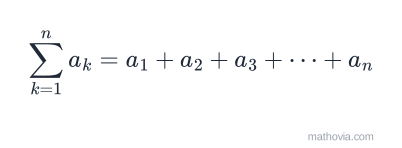
Sigma notation: the sum from k = 1 to n of a sub k equals a sub 1 plus a sub 2 plus and so on up to a sub n
What sigma notation means

How Sigma Notation Works

Every sigma sum has four parts:
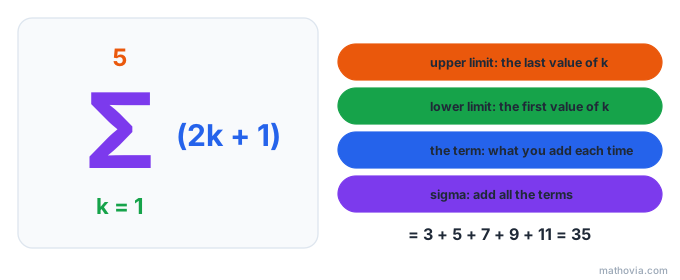
The sum from k = 1 to 5 of (2k + 1), with its parts labelled: 5 is the upper limit, k = 1 is the lower limit, 2k + 1 is the term, and sigma means add all the terms; the sum equals 3 + 5 + 7 + 9 + 11 = 35
The four parts of a sigma sum
PartExampleMeaning
index of summationthe counter; any letter works (, , are common)
lower limitthe first value of the index
upper limitthe last value of the index
termthe expression evaluated for each value of the index

The index always goes up by at a time, from the lower limit to the upper limit. The number of terms is upper − lower + 1.

How to Evaluate a Sum in Sigma Notation

  1. List the index values, from the lower limit to the upper limit.
  2. Substitute each one into the term.
  3. Add the results.

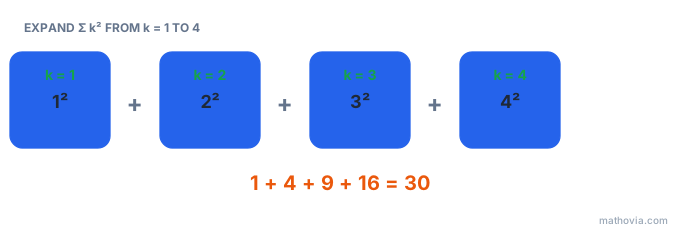
Example 1. Evaluate .

The sum of k squared from k = 1 to 4 expanded: k = 1 gives 1, k = 2 gives 4, k = 3 gives 9, k = 4 gives 16, for a total of 30
Each value of the index produces one term

Example 2. Evaluate . The index starts at this time:

That’s four terms: . Starting at instead of changes both the terms and the count, which is the most common slip with sigma notation.

How to Write a Series in Sigma Notation

Going the other way, from a written-out sum to sigma notation, takes three steps:

  1. Find a formula for the th term.
  2. Decide the limits: which value of gives the first term and which gives the last.
  3. Assemble the sigma.
Seriesth termSigma notation

Two tricks from the table are worth remembering. A factor of makes the signs alternate, starting with a plus. And the same series can be written more than one way: and are the same sum, because shifting the index and adjusting the term cancel out.

Properties of Sigma Notation

Sums can be split and constants pulled out, just like ordinary addition:

PropertyStatement
constant multiple
sum of a sum
sum of a constant

Summation Formulas

For long sums you don’t add term by term. These formulas, used with the properties above, do the work:

SumFormulaExample

Example 3. Evaluate .

Step 1 — split the sum and pull out the constant:

Step 2 — use the formulas:

Sigma Notation for Arithmetic and Geometric Series

Sigma notation is the natural way to write the sums of sequences. An arithmetic series has a linear term, and a geometric series has an exponential one:

The arithmetic series and geometric series lessons give the formulas that add these up in one step.

Common Mistakes to Avoid

  • Miscounting the terms. has terms, not 5.
  • Ignoring a lower limit of 0. includes , so it has 4 terms.
  • Applying the term to the sum instead of each value. is , not .
  • Treating a constant as one term. , not .
  • Using a formula from 1 when the sum starts elsewhere. For , subtract: .

Practice Problems

Work each one before opening the answer. To check a sum of your own, including infinite series, the summation calculator shows the terms, the formula it uses and the total.

Problem 1. Evaluate .

Show answer

Answer:

Problem 2. Evaluate .

Show answer

Answer:

Problem 3. Write in sigma notation and evaluate it.

Show answer

Step 1 — the th term is , for to :

Answer:

Problem 4. Evaluate .

Show answer

Answer:

Problem 5. Evaluate .

Show answer

Step 1 — six copies of 4:

Answer:

Problem 6. Evaluate .

Show answer

Step 1 — split the sum:

Answer:

Sigma notation tells you what to add. The next two lessons give the shortcuts for how: one formula for adding any arithmetic sequence and one for any geometric sequence.

Frequently Asked Questions

What is sigma notation?+

A compact way to write a sum. The symbol Σ (capital sigma) means 'add up', the expression after it is the term, and the numbers below and above it are the first and last values of the index. For example, means 3 + 5 + 7 + 9 + 11.

How do you evaluate sigma notation?+

Substitute each value of the index, from the lower limit to the upper limit, into the term, then add the results. For : 1 + 4 + 9 + 16 = 30. For long sums, use a formula such as .

How do you write a series in sigma notation?+

Find a formula for the kth term, decide the first and last values of k, and put them together. For 3 + 6 + 9 + … + 30, the kth term is 3k, and k runs from 1 to 10, so the sum is .

How many terms are in a sigma sum?+

Upper limit minus lower limit, plus one. has 10 terms, and has 8 − 3 + 1 = 6 terms.

What is the formula for the sum of the first n natural numbers?+

. So 1 + 2 + … + 100 = 100 × 101 ÷ 2 = 5050.

Related lessons

Calculators for this topic