
Every operation on complex numbers is ordinary algebra with exactly one extra fact available:
Adding and Subtracting Complex Numbers
Combine the real parts together and the imaginary parts together, exactly as like terms combine in a polynomial — a real number and an imaginary number are never like terms with each other.
Subtraction distributes the negative sign across both parts of the second complex number, exactly the same way it distributes across every term of a polynomial.
Multiplying Complex Numbers
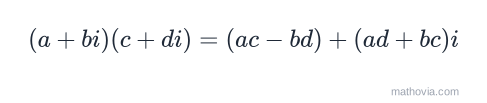
A complex number
The
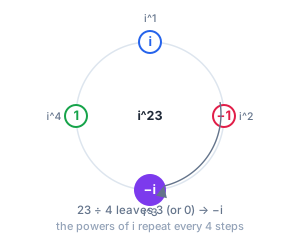
Powers of i
The powers of
| Power | Value |
|---|---|
For any power, divide the exponent by
Dividing Complex Numbers
Since
The denominator
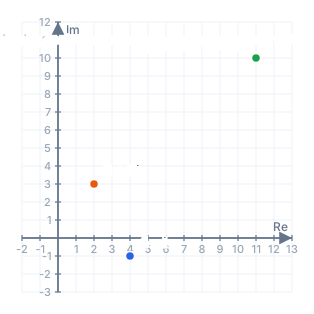
Worked Example A: Adding and Subtracting
Simplify
Step 1 — combine the first two complex numbers:
Step 2 — subtract the third, distributing the negative sign to both of its parts:
Answer:
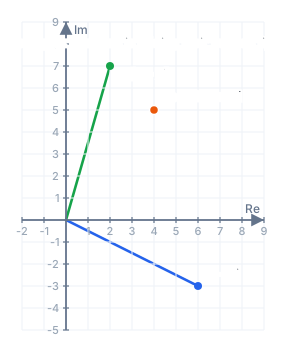
Worked Example B: Multiplying Two Complex Numbers
Multiply
Step 1 — apply FOIL:
Step 2 — replace
Step 3 — combine the real parts:
Answer:
Worked Example C: A Higher Power of i
Simplify
Step 1 — divide the exponent by
Step 2 — match the remainder
Answer:
Worked Example D: Dividing Complex Numbers
Divide
Step 1 — multiply the numerator and denominator by the conjugate of the denominator:
Step 2 — expand the denominator using the difference of squares pattern:
Step 3 — expand the numerator with FOIL:
Answer:
Common Mistakes to Avoid
- Combining real and imaginary parts as if they were like terms with each other.
cannot be simplified to or to — the two parts stay separate unless another real or imaginary term is being added to the matching part. - Forgetting to replace
with after multiplying. Leaving a term like unsimplified is not a finished answer; it must become . - Losing a sign when
turns a subtraction into an addition. becomes , not — the double negative is easy to drop by accident. - Multiplying only the denominator by the conjugate, not the numerator. Both parts of the fraction need the same multiplier, since it has to equal
to avoid changing the fraction’s value. - Writing the conjugate with the wrong sign. The conjugate of
is — only the imaginary part’s sign flips, never the real part’s. - Miscounting the cycle when evaluating a power of
. The cycle length is , not or ; dividing the exponent by and using the remainder is the reliable way to avoid a miscount.
Where This Shows Up Later
- The quadratic formula. A negative discriminant produces two complex solutions, and reporting them in
form uses exactly this lesson’s simplification rules. - Rationalizing Denominators. The conjugate trick used here to clear
from a denominator is the identical technique used there to clear a radical. - Polar and trigonometric form of complex numbers. Multiplying and dividing complex numbers in polar form later gives a much faster alternative to FOIL, once angles and magnitudes are introduced.
- Electrical engineering and signal processing. Complex number arithmetic, exactly as covered here, is the standard tool for combining alternating-current quantities in those fields.
Practice Problems
Work each problem yourself before opening the answer.
Problem 1. Simplify
Show answer
Answer:
Problem 2. Simplify
Show answer
Answer:
Problem 3. Multiply
Show answer
Answer:
Problem 4. Simplify
Show answer
Answer:
Problem 5. Multiply
Show answer
Difference of squares pattern:
Answer:
Problem 6. Divide
Show answer
Step 1 — multiply by the conjugate:
Step 2 — expand the denominator:
Answer:
Problem 7. Simplify
Show answer
Step 1 — combine the first two:
Step 2 — subtract the third:
Answer:
Problem 8. Multiply
Show answer
Step 1 — apply the perfect-square pattern (or FOIL directly):
Step 2 — replace
Answer:
Problem 9. Divide
Show answer
Step 1 — multiply by the conjugate:
Step 2 — expand the denominator:
Step 3 — expand the numerator:
Answer:
Problem 10. Simplify
Show answer
Answer:
Quick Reference
| Operation | Move |
|---|---|
| Add or subtract | Combine real parts together and imaginary parts together, separately |
| Multiply | FOIL, then replace every |
| Divide | Multiply top and bottom by the denominator’s conjugate |
| Conjugate of | |
| Complex number times its conjugate | Always |
| Any power of | Divide the exponent by |
Nothing here is really new — Adding Polynomials, Multiplying Polynomials, and the conjugate trick from Rationalizing Denominators do all the heavy lifting, with