
You know how to solve a system. The hard part of most homework and test questions is building it in the first place. Systems of equations word problems all follow the same recipe: there are two things you don’t know, and the problem tells you two facts about them. Each fact becomes an equation, and the pair of equations is the system. This lesson walks through that recipe, then applies it to the seven kinds of problem you’re most likely to meet. If you’ve solved these with a single variable before, as in the word problems lesson, you’ll find two variables make the setup much more direct.
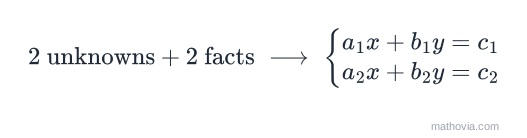
How to Set Up a System From a Word Problem
- Name the unknowns. Write down what each variable stands for, with units: ”
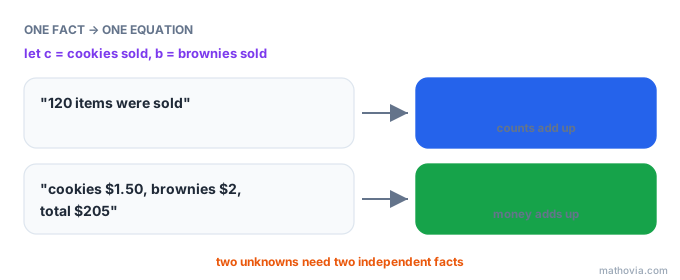
= number of cookies sold”. - Find two independent facts. Usually one is about a count or size (how many, how long) and the other about a value (how much money, how much acid, how far).
- Write one equation per fact.
- Solve with substitution or elimination.
- Answer the question asked, in words and units, and check against the original wording.
Common Types of Systems Word Problems
| Type | Equation 1 (count or size) | Equation 2 (value or rate) |
|---|---|---|
| tickets or items | ||
| coins or bills | ||
| investments | ||
| mixtures | ||
| wind or current | ||
| break-even | ||
| geometry | a perimeter or angle total | a relationship between the sides |
Notice the pattern in the first four rows: the first equation counts, and the second equation weights each count by a price, value, rate or concentration.
Example 1: Items Sold
A bake sale sold
Step 1 — unknowns:
Step 2 — equations:
Step 3 — substitute
Step 4 — back-substitute:
Step 5 — check:
The sale sold 70 cookies and 50 brownies.
Example 2: Coins and Bills
A cash drawer holds
Step 1 — unknowns:
Step 2 — equations: count
Step 3 — eliminate: multiply the count equation by
Step 4 — back-substitute:
There are 16 five-dollar bills and 14 ten-dollar bills. Check:
Example 3: Investments at Two Rates
Maria invests
Step 1 — unknowns:
Step 2 — equations:
Step 3 — substitute
Step 4 — back-substitute:
She invested
Example 4: Mixing Two Solutions
A chemist needs
Step 1 — unknowns:
Step 2 — equations. The volumes add up, and so does the amount of pure acid. The final mixture holds
Step 3 — substitute
Step 4 — back-substitute:
She should mix 10 L of the 20% solution with 20 L of the 50% solution.
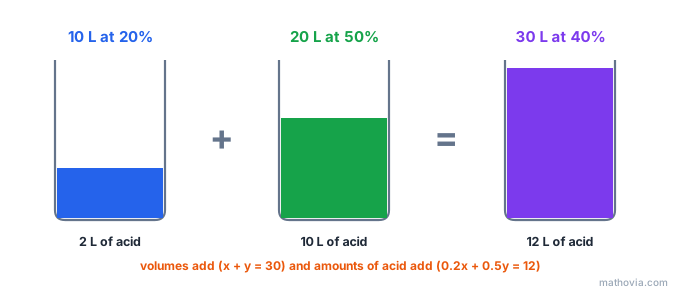
The answer makes sense:
Example 5: Wind and Current
A plane flies
Step 1 — unknowns:
Step 2 — equations. With the wind the speeds add; against it they subtract. Distance is speed times time:
Step 3 — simplify each equation:
Step 4 — add them to eliminate
The plane flies at 270 mph in still air, and the wind blows at 30 mph.
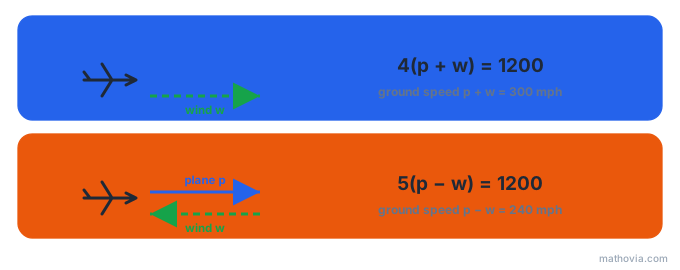
Boats in a river current work exactly the same way: downstream speed is
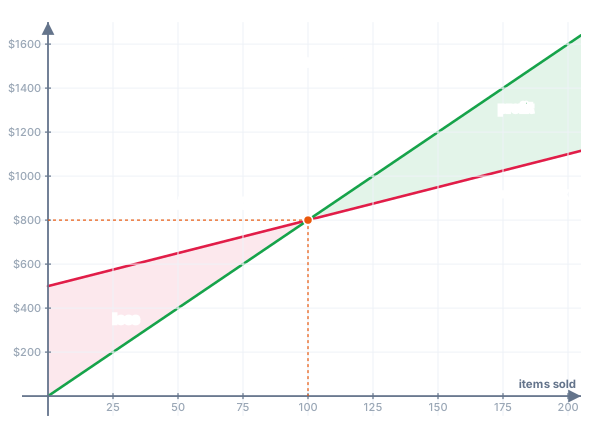
Example 6: Break-Even Point
A small business makes phone cases. Its fixed costs are
Step 1 — unknowns:
Step 2 — equations: cost
Step 3 — break-even means cost = revenue:
Step 4 — the dollar value:
The business breaks even at 100 cases, when both cost and revenue are
Example 7: Geometry
A rectangle’s length is
Step 1 — unknowns:
Step 2 — equations:
Step 3 — substitute:
Step 4 — back-substitute:
The rectangle is 15 cm by 6 cm. Check:
Choosing the Fastest Method
| What the system looks like | Fastest method |
|---|---|
| one equation is a simple total, | substitution |
| one equation already reads | substitution, or set the two expressions equal |
| two equations like | elimination by adding |
| decimals or percentages | multiply by |
Common Mistakes to Avoid
- Not defining the variables. “Let
= number of adult tickets” stops you from mixing up which value is which at the end. - Mixing counts and values.
counts items; totals dollars. Don’t set a count equal to a dollar amount. - Using percentages as whole numbers.
is , not . - Adding the wind to both legs. With the wind is
; against it is . - Stopping at one variable. If the question asks for both quantities, find both, and answer in words.
Practice Problems
Work each one before opening the answer.
Problem 1. Two numbers add up to
Show answer
Step 1 — equations:
Step 2 — add them:
Answer:
Problem 2. Movie tickets cost
Show answer
Step 1 — equations:
Step 2 — substitute
Step 3 — back-substitute:
Answer:
Problem 3. A boat travels
Show answer
Step 1 — equations:
Step 2 — add them:
Answer: boat
Problem 4.
Show answer
Step 1 — equations:
Step 2 — substitute
Step 3 — back-substitute:
Answer:
Problem 5. Candy worth
Show answer
Step 1 — equations: weight
Step 2 — substitute
Step 3 — back-substitute:
Answer:
Problem 6. Phone plan A costs
Show answer
Step 1 — equations:
Step 2 — set them equal:
Step 3 — the cost:
Answer:
That completes the toolkit for this chapter: what a system is, three ways to solve one, systems with three variables and with matrices, nonlinear systems, systems of inequalities, and now the skill of building a system from a real situation. Whenever a problem gives you two unknowns and two facts, you know what to do. Once your equations are set up, the system of equations calculator will solve them with every step shown, so you can check your work.