
Every system so far has been made of straight lines, and two straight lines can cross at most once. Swap one of them for a curve and that rule breaks. A line can slice through a parabola twice, just touch it once, or miss it entirely, and a circle and a hyperbola can cross four times. A nonlinear system of equations is any system with at least one equation like this. The methods are ones you already know, with substitution doing most of the work, but the first step is always the same: work out how many solutions to expect.

What Is a Nonlinear System?
A system is nonlinear when at least one of its equations is not of the form
| System | Shapes |
|---|---|
| parabola and line | |
| circle and line | |
| circle and hyperbola | |
| hyperbola and line |
As always, a solution is a point
How Many Solutions Are There to This Nonlinear System?
Start with the picture. A line and a parabola can relate in three ways:
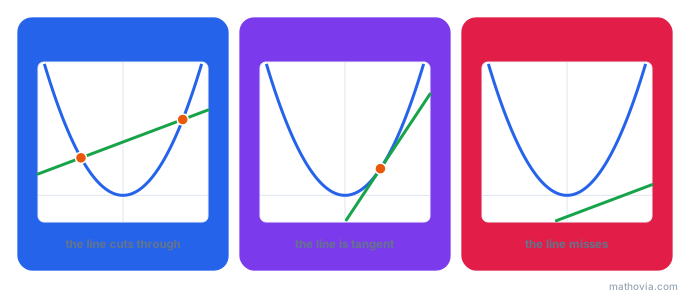
Other pairs of shapes allow more crossings:
| Shapes | Possible numbers of solutions |
|---|---|
| line and parabola | |
| line and circle | |
| two different circles | |
| two parabolas | |
| parabola and circle | |
| circle and hyperbola |
When a question asks “how many solutions are there to this nonlinear system?” and shows a graph, count the intersection points. If there’s no graph, substitute and count the real roots of the equation you get.
Counting Solutions With the Discriminant
For a line and a parabola, substituting always produces a quadratic
| Number of solutions | Picture | |
|---|---|---|
| positive | the line cuts through | |
| zero | the line is tangent | |
| negative | the line misses |
Solving a Nonlinear System by Substitution
The steps are almost the same as for linear systems:
- Solve the simpler equation (usually the linear one) for one variable.
- Substitute into the nonlinear equation.
- Solve the resulting equation, usually a quadratic, by factoring or the quadratic formula.
- Find the partner value for each root using the equation from step 1.
- Check every point in both original equations.
Step 4 is the new part. A quadratic can give two roots, so there can be two solution points, and each needs its own partner.
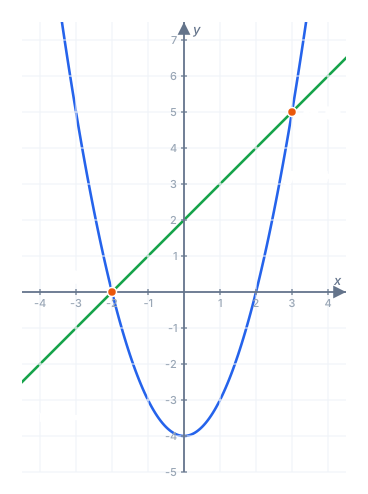
Example 1: A Line and a Parabola
Solve
Step 1 — both equations give
Step 2 — rearrange into standard form and factor:
Step 3 — two roots:
Step 4 — find each partner from
Step 5 — check in the parabola:
Answer:
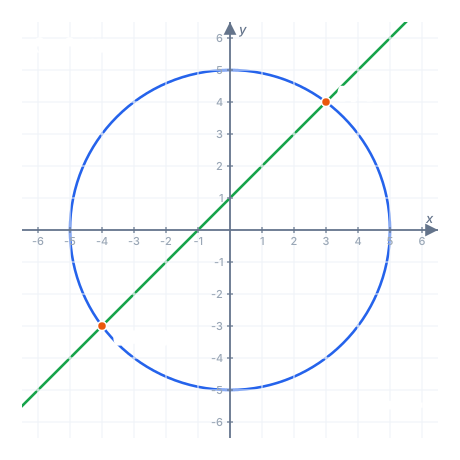
Example 2: A Line and a Circle
Solve
Step 1 — substitute
Step 2 — expand and simplify:
Step 3 — find each partner:
Step 4 — check in the circle:
Answer:
Remember to square the whole bracket:
Example 3: One Solution (a Tangent Line)
Solve
Step 1 — set the expressions equal and rearrange:
Step 2 — a double root:
Answer: one solution,
No Solution
Solve
Solving a Nonlinear System by Elimination
When both equations have the same squared terms, elimination can be faster than substitution.
Example 4: A Circle and a Hyperbola
Solve
Step 1 — add the equations to eliminate
Step 2 — substitute
Step 3 — combine: each
Answer: four solutions,
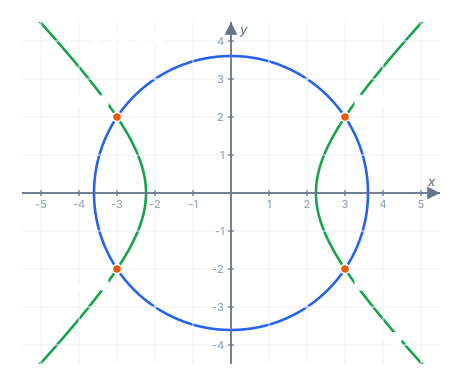
Taking a square root gives two signs. Forgetting the
Worked Example: Area and Perimeter
A rectangle has an area of
Step 1 — write the system, with length
Step 2 — simplify the perimeter equation and solve for
Step 3 — substitute into the area equation:
Step 4 — find the partners:
Both solutions describe the same rectangle: 6 m by 8 m. Check:
Common Mistakes to Avoid
- Expecting one solution. Nonlinear systems routinely have two or more. Keep going after you find the first root.
- Mismatching partners. Find each
from its own . In Example 1, is not a solution. - Dropping the negative square root.
means or . - Squaring a binomial wrongly.
. The middle term is the one people forget. - Substituting into the wrong equation for the partner. Use the linear equation when you can. Substituting into a squared equation can introduce extra sign options that aren’t real solutions.
Practice Problems
Work each one before opening the answer.
Problem 1. How many solutions does the system
Show answer
Step 1 — substitute
Answer: two solutions,
Problem 2. Solve
Show answer
Step 1 — set them equal and factor:
Step 2 — partners from
Answer:
Problem 3. Solve
Show answer
Step 1 — substitute:
Step 2 — partners from
Answer:
Problem 4. How many solutions does the system
Show answer
Step 1 — set them equal:
Step 2 — both give
Answer: two solutions,
Problem 5. Solve
Show answer
Step 1 — solve the linear equation for
Step 2 — partners:
Answer:
Problem 6. Does the line
Show answer
Step 1 — set them equal:
Step 2 — the discriminant:
Answer: no, the system has no solution
Nonlinear systems complete the toolkit for solving equations together. The last step is using all of these methods where they matter most: turning a real situation into a system and solving it.