
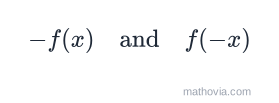
Two minus signs, two completely different results. Where the sign sits — outside the function or inside its bracket — decides whether the graph flips top to bottom or left to right.
Reflection Across the x-Axis
Negate the output and the graph flips top to bottom.
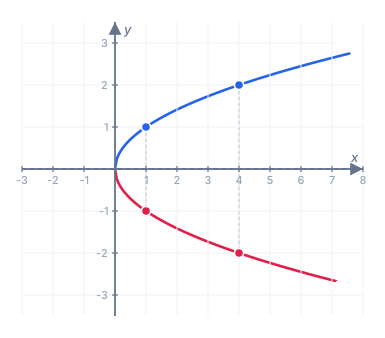
Whatever was above the
Reflection Across the y-Axis
Negate the input and the graph flips left to right.
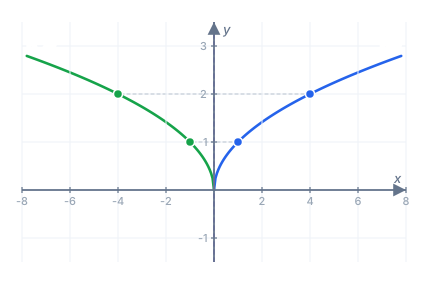
This is the inside-outside rule again: a change inside the bracket acts horizontally, a change outside acts vertically.
The Two Side by Side
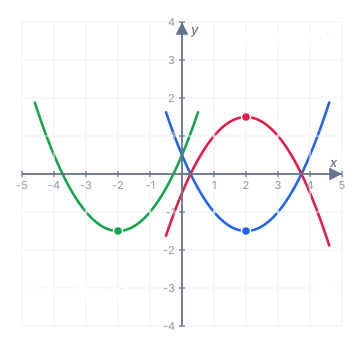
Using an off-centre curve makes the difference obvious. A parabola with vertex
Try this with a symmetric parent such as
What Each Does to a Point
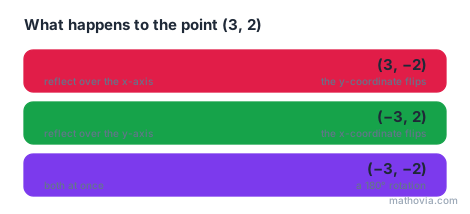
| Transformation | Point rule | Domain | Range |
|---|---|---|---|
| unchanged | flipped | ||
| flipped | unchanged | ||
| flipped | flipped |
“Flipped” for an interval means negating and swapping the endpoints: a domain of
Both at Once
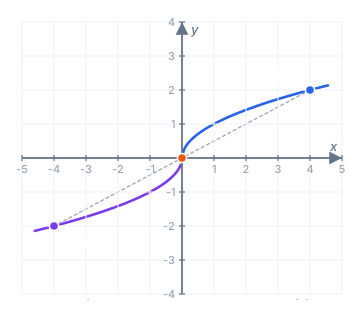
Applying both gives
Order does not matter here: reflecting vertically then horizontally gives the same result as the other way round, because the two operations touch different coordinates.
Reflections Hiding in Vertex Form
A negative
The same applies to
Careful with the vertex, though. In vertex form the reflection is across the horizontal line through the vertex, not across the
Worked Example A: Which Reflection?
Describe
Reflected across the
Worked Example B: The Other One
Describe
Reflected across the
Worked Example C: On a Concrete Function
If
Worked Example D: Domain and Range
A
The range is unchanged:
Worked Example E: A Reflection That Does Nothing
What is
Identical to the original. The graph is unchanged because it is already symmetric about the
Common Mistakes to Avoid
- Swapping the two. Outside the bracket is the
-axis; inside is the -axis. - Writing
as . They are different functions with different graphs. - Flipping the wrong coordinate.
negates ; negates . - Testing on a symmetric parent.
hides the -axis reflection entirely. - Forgetting to swap interval endpoints.
flips to , not . - Thinking
is a new reflection. It is a 180° rotation. - Reflecting the vertex in vertex form. With
applied after, the vertex stays put and only the arms flip.
Where Reflections Lead Next
- Symmetry. A graph unchanged by a reflection is symmetric — see symmetry for the even and odd tests.
- Inverse functions. An inverse is a reflection across the line
, a third mirror beyond the two axes. - The full toolkit. Function transformations fits reflections alongside shifts and stretches.
- Downward parabolas. Every negative leading coefficient is a reflection in disguise.
- Absolute value as a reflection.
reflects only the part below the axis, leaving the rest alone.
Practice Problems
Work each one before opening the answer.
Problem 1. Which axis does
Show answer
The
Problem 2. Which axis does
Show answer
The
Problem 3. Where does
Show answer
Problem 4. Where does
Show answer
Problem 5. Where does
Show answer
Problem 6. Write
Show answer
Problem 7.
Show answer
Problem 8.
Show answer
Problem 9. What is
Show answer
Problem 10. What is
Show answer
Problem 11. Describe
Show answer
The square root curve reflected across the
Problem 12. Is
Show answer
Yes — both reflections applied, which equals a 180° rotation about the origin.
Quick Reference
| Task | Method |
|---|---|
| Across the | |
| Across the | |
| Both | |
| the range | |
| the domain | |
| Flipping an interval | negate and swap the endpoints |
| Unchanged by | an even function |
| Unchanged by | an odd function |
Reflections are the flipping half of function transformations, alongside horizontal and vertical shifts. A graph that survives one unchanged has symmetry, and reflecting across