
Suppose a concert sells adult tickets and child tickets, and you know two facts: 200 tickets were sold, and the box office took in
What Is a System of Equations?
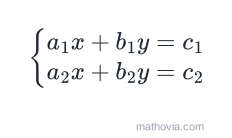
A system of equations is a group of equations that share the same variables and are meant to be solved together. When every equation is linear, it is a system of linear equations. In general form, a system of two equations in two variables looks like this:
The curly brace is a reminder that the equations belong together. Here is a concrete example:
You’ll also hear these called simultaneous equations, especially in British textbooks. The name is a good description: the equations must hold simultaneously, for the same
What Is the Solution to a System of Equations?
A solution of a system is an ordered pair
To check a pair, substitute it into each equation in turn:
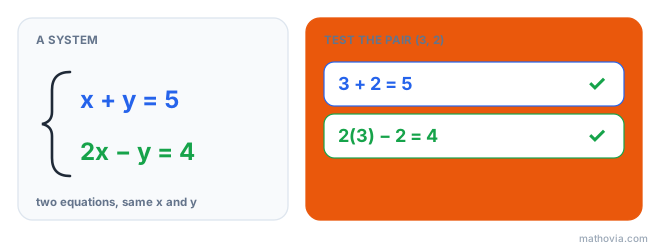
Try
What a Solution Looks Like on a Graph
Every linear equation in two variables graphs as a line, and every point on that line is a pair that satisfies the equation. A solution has to lie on both lines, so it is the point where they cross:
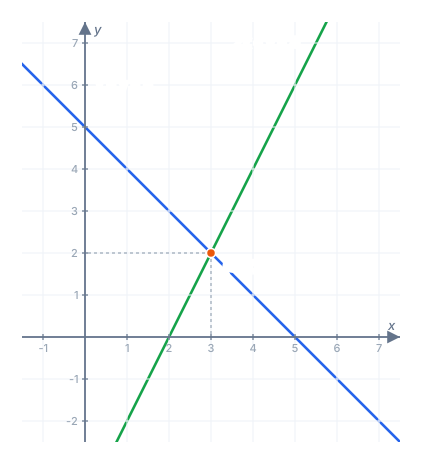
That picture explains everything else about how many solutions a system can have.
How Many Solutions Can a System Have?
Two lines in a plane can relate to each other in only three ways, so a linear system has only three possible outcomes:

| Outcome | Lines | Name | What the algebra does |
|---|---|---|---|
| exactly one solution | cross at one point | consistent and independent | gives values for |
| no solution | parallel | inconsistent | ends in a false statement such as |
| infinitely many solutions | the same line | consistent and dependent | ends in a true statement such as |
A linear system can never have exactly two or three solutions. If two different lines share two points, they are the same line, and then they share every point. The no-solution case is the one covered in more depth in the parallel lines lesson.
How to Tell the Number of Solutions Without Solving
Method 1: Compare Slopes and Intercepts
Rewrite each equation in slope-intercept form,
| Slopes | Intercepts | Number of solutions |
|---|---|---|
| different | anything | one |
| the same | different | none |
| the same | the same | infinitely many |
For example,
Method 2: Compare Coefficient Ratios
When both equations are in standard form,
| Condition | Number of solutions |
|---|---|
| one | |
| none | |
| infinitely many |
Take
Three Ways to Solve a System
Once you know a system has exactly one solution, there are three standard ways to find it. Each has its own lesson in this chapter:
| Method | Idea | Best when |
|---|---|---|
| Graphing | draw both lines and read off where they cross | you want a picture, or the answer is a whole number |
| Substitution | solve one equation for a variable and plug it into the other | one variable is already alone, as in |
| Elimination | add or subtract the equations to cancel a variable | both equations are in standard form |
Larger systems, with three or more variables, are usually handled with elimination or with matrices. To check your working with any of these methods, the system of equations calculator shows every step.
Writing a System With a Given Solution
Teachers often turn the question around: write a system of equations whose solution is
Step 1 — pick any two left-hand sides that are not multiples of each other:
Step 2 — substitute
Step 3 — write the system:
Because the two left-hand sides have different slopes, the lines cross exactly once, at
Worked Example
Gym A charges a
Step 1 — define the variables: let
Step 2 — write one equation per gym:
Step 3 — check the number of solutions: the slopes
Step 4 — both expressions equal
Step 5 — find
Step 6 — check in the other equation:
After 6 months both gyms have cost
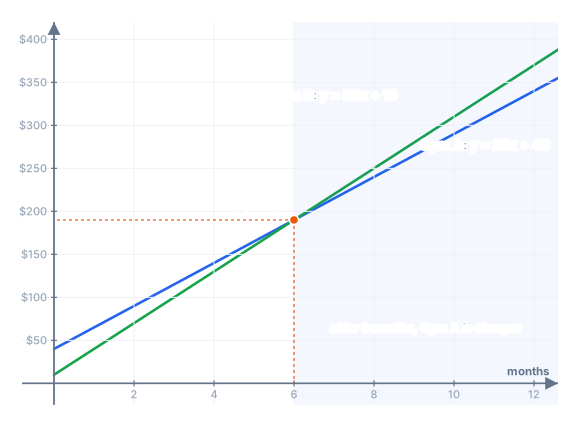
Step 4 is a small preview of the substitution method. When both equations are already solved for
Common Mistakes to Avoid
- Checking only one equation. A pair that satisfies one equation is a point on one line. It must satisfy every equation to be a solution.
- Swapping
and . The pair means , . The pair is a different point and fails the second equation above. - Thinking “no solution” means you made a mistake. If the algebra ends in a false statement like
, the lines are parallel and the correct answer is “no solution”. - Answering ”
” with ” ”. A true statement with no variable left means infinitely many solutions, not a solution of zero. - Comparing slopes before rearranging. In
the slope is , not . Solve for first.
Practice Problems
Try each one before opening the answer.
Problem 1. Is
Show answer
Step 1 — check the first equation:
Step 2 — check the second equation:
Answer: yes, it satisfies both equations
Problem 2. Is
Show answer
Step 1 — check the first equation:
Step 2 — check the second equation:
Answer: no, it fails the second equation
Problem 3. How many solutions does the system
Show answer
Step 1 — compare slopes and intercepts: both slopes are
Step 2 — same slope, different intercept means parallel lines.
Answer: no solution
Problem 4. How many solutions does the system
Show answer
Step 1 — compare the ratios:
Step 2 — all three ratios are equal, so the first equation is the second one doubled. They describe the same line.
Answer: infinitely many solutions
Problem 5. Solve the system
Show answer
Step 1 — both equal
Step 2 — substitute back:
Answer:
Problem 6. Write a system of two linear equations whose only solution is
Show answer
Step 1 — choose two left-hand sides with different slopes, for example
Step 2 — evaluate them at
Answer:
You now know what a solution is and how many to expect. The next step is finding it reliably, and the first method most people learn is solving by substitution, which builds directly on Problem 5.