
Once you have two functions, arithmetic gives you four more for free. The notation looks unfamiliar at first but the idea is as simple as it sounds: do both, then combine.
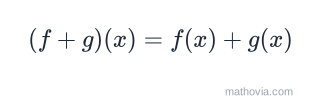
The Four Operations
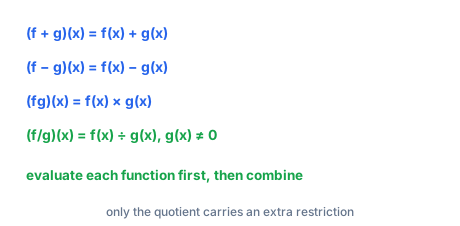
The brackets on the left are doing something specific.
Note the order matters for the two non-commutative operations:
Combining at a Single Input
The most straightforward case. Evaluate each function separately, then combine the two numbers.
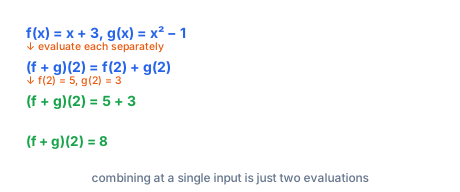
With
You could instead build the combined formula first and then substitute — both give the same answer. Evaluating separately is usually less error-prone.
Combining as Formulas
To get a general expression, substitute the rules and simplify.
With the same
Keep the brackets when subtracting. The minus sign applies to every term of
The Domain of a Combination
This is the part that earns marks. A combined function can only work where both originals work.
For the quotient there is one more condition:
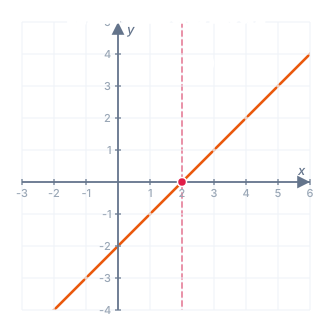
Worked case.
- Domain of
: . Domain of : all reals. - Intersection:
, which is the domain of , and . - For
, also exclude , i.e. . Domain: .
A restriction from the original functions never disappears, even if the algebra tidies up. See Domain for finding each one.
Adding Functions on a Graph
Addition has a clean visual meaning: stack the heights.
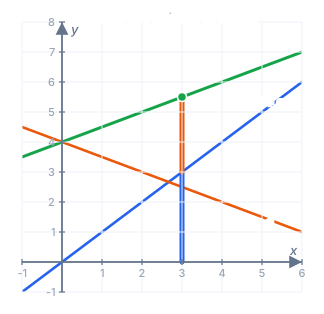
Pick an
Signs work naturally: where
Worked Example A: All Four at a Point
Worked Example B: Subtraction With Brackets
Every sign inside
Worked Example C: A Quotient Domain
Both domains are all reals, but
Worked Example D: A Restriction That Survives
The simplified formula
This is the key idea — simplification does not restore a lost domain.
Worked Example E: A Real Combination
A stall’s revenue is
Profit is the difference:
Break-even is
Common Mistakes to Avoid
- Dropping the bracket when subtracting.
. - Confusing
with . One multiplies outputs; the other is composition. - Forgetting to intersect the domains. Both functions must accept the input.
- Forgetting the extra condition on
. Zeros of are excluded. - Letting a domain restriction vanish on simplification. It survives the algebra.
- Reading
as multiplication. It is the name of the new function. - Assuming subtraction commutes.
and are negatives of each other.
Where This Leads Next
- Function composition — the other way to build a function from two, and a genuinely different operation.
- Profit, revenue and cost models, where profit is literally a difference of functions.
- Rational functions, which are quotients of polynomials.
- Partial fractions, splitting a quotient back into a sum.
- Calculus, where the sum, product and quotient rules differentiate exactly these combinations.
Practice Problems
Use
Problem 1. Find
Show answer
Problem 2. Find
Show answer
Problem 3. Find
Show answer
Problem 4. Find
Show answer
Problem 5. Find the domain of
Show answer
Problem 6. For
Show answer
Problem 7. For
Show answer
Intersection of
Problem 8. For
Show answer
Problem 9. Revenue is
Show answer
Problem 10. At
Show answer
Quick Reference
| Combination | Definition | Domain |
|---|---|---|
| intersection of domains | ||
| intersection of domains | ||
| intersection of domains | ||
| intersection, minus zeros of | ||
| Subtracting | bracket the whole of | |
| On a graph | add the heights at each | |
| product vs composition | different operations |
Arithmetic combination is one of two ways to build a new function from two old ones; the other is composition. Both rely on function notation and on working out each domain. More Algebra lessons are available.