
Every rule in Integer Exponents — product, quotient, power, zero, negative — was proven using only whole-number exponents. This lesson asks a natural next question: what if the exponent is a fraction? The answer turns out to unify two ideas you already know, roots and powers, into a single piece of notation, and every rule you already learned keeps working exactly as before.
If you only take one thing away: a rational exponent’s denominator is a root, and its numerator is a power.
What Is a Rational Exponent?
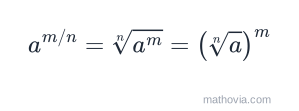
For a positive integer
That is,
For example,
A simplifying convention. Starting here, assume every variable in this lesson represents a positive real number. That avoids two headaches at once: an even root landing on a negative base, and the fact that
Why a^(1/n) Has to Mean the nth Root
This isn’t an arbitrary choice of notation — it’s forced by requiring the Power Rule from the previous lesson to keep working for fractional exponents too. Raise
So whatever
| Fractional Exponent | Radical Form | Meaning |
|---|---|---|
| The square root of | ||
| The cube root of | ||
| The fourth root of | ||
| The |
Two Equivalent Ways to Compute a^(m/n)
The last row above hints at something worth proving directly: root-then-power and power-then-root always agree.
Both sides are the Power Rule applied to the same two exponents,
Properties of Rational Exponents
These are the same eight rules from Integer Exponents, restated with
| Rule | Statement | Example |
|---|---|---|
| Product Rule | ||
| Quotient Rule | ||
| Power Rule | ||
| Power of a Product | ||
| Power of a Quotient | ||
| Zero Exponent | ||
| Negative Rational Exponent | ||
| Negative Exponent of a Quotient |
Example 1: Converting Between Radical and Exponent Form
Every radical can be rewritten as a fractional exponent, and back again, using the definitions above.
| Radical Form | Exponent Form | Value |
|---|---|---|
For the last row, the cube root applies to each factor separately (Power of a Product):
Example 2: Evaluating Numeric Rational Exponents
Each of these is fastest solved by taking the root first, then the power.
| Expression | Root First | Result |
|---|---|---|
| odd root of a negative number | ||
Example 3: Simplifying Variable Expressions
| Expression | Rule Applied | Simplified Form |
|---|---|---|
| Product Rule: | ||
| Quotient Rule: | ||
| Power Rule: | ||
| Power of a Product | ||
| Power of a Product | ||
| Power of a Product, then Power Rule | ||
| Power Rule, then Negative Exponent | ||
| Product Rule: |
The third row is worth a second look:
Choosing the Order: Root First or Power First?
Because
Same answer, but the root-first path never deals with a number bigger than 8, while the power-first path forces you to recognize that
Domain: When a Rational Exponent Isn’t a Real Number
An even root of a negative number has no real value — there is no real number that squares (or 4th-powers, or 6th-powers) to a negative result. So
Odd roots of negative numbers, by contrast, are perfectly well-defined and negative:
This creates one genuine subtlety integer exponents never had: always reduce a rational exponent to lowest terms before evaluating it with a negative base.
Worked Example A: Combining Several Rules
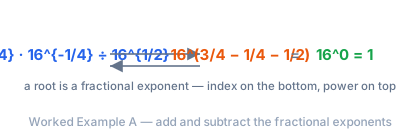
Simplify
Step 1 — apply the Product Rule to the numerator:
Step 2 — apply the Quotient Rule to divide by the denominator:
Step 3 — apply the Zero Exponent Rule:
The final answer is
Worked Example B: Coefficients, Variables, and Negative Rational Exponents
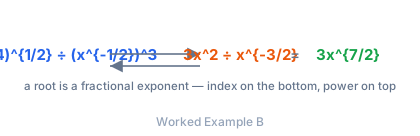
Simplify
Step 1 — apply the Power of a Product Rule to the numerator:
Step 2 — apply the Power Rule to the denominator:
Step 3 — apply the Quotient Rule to divide:
The exponent arithmetic in the last step is the part worth double-checking by hand:
Worked Example C: A Nested Radical
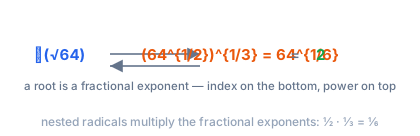
Simplify
Step 1 — rewrite both radicals as fractional exponents:
Step 2 — apply the Power Rule to combine the exponents:
Step 3 — evaluate, since
A nested radical is nothing more than two exponents multiplying — no special “nested root” rule was ever needed.
Where These Rules Show Up Later
- Simplifying radicals. Every “rationalize the denominator” or “combine these roots” problem is exponent arithmetic wearing a radical sign.
- Growth and finance formulas. Compounding interest more than once a year, or over a fractional time period, raises a base to a rational exponent like
or . - Geometry and physics scaling laws. Relationships like the period of a pendulum or the surface-area-to-volume ratio of a sphere involve exponents such as
or . - Calculus. The derivative power rule,
, applies to rational exactly as it does to integers — differentiating is just applying it with .
Common Mistakes to Avoid
- Mixing up which part of the fraction is the root. In
, the denominator is the root, not the numerator. , not . - Treating a negative rational exponent as a negative result.
, a positive fraction — the minus sign still just means “reciprocal,” exactly as with integer exponents. - Taking the power first when the numbers get ugly.
computed as then is correct but unnecessarily hard; reaches the same answer with smaller numbers. - Assuming every root of a negative number is undefined. Only even roots are.
is a perfectly ordinary real number. - Evaluating an unreduced fraction exponent on a negative base.
looks undefined (6th root of a negative), but its reduced form is fine — always simplify the exponent first. - Distributing an exponent over a sum, radical version.
. Test it: , but . - Applying the Product or Quotient Rule to different bases.
cannot be combined into one power — those rules only work when the base is identical on both sides.
Practice Problems
Work each problem yourself before opening the answer.
Problem 1. Evaluate
Show answer
Step 1 — take the cube root:
Step 2 — square the result:
Answer:
Problem 2. Evaluate
Show answer
Step 1 — take the fourth root:
Step 2 — cube it, then apply the Negative Exponent Rule:
Answer:
Problem 3. Convert
Show answer
Answer:
Problem 4. Simplify
Show answer
Answer:
Problem 5. Simplify
Show answer
Answer:
Problem 6. Evaluate
Show answer
Step 1 — evaluate each term separately:
Step 2 — add with a common denominator:
Answer:
Problem 7. Simplify
Show answer
Answer:
Problem 8. Evaluate
Show answer
An odd root of a negative number is defined and negative. Since
Answer:
Problem 9. Simplify
Show answer
Step 1 — apply the Power of a Product Rule to each factor:
Step 2 — clear the negative exponent:
Answer:
Problem 10. Explain why
Show answer
The difference is entirely about the root’s index being even (2) versus odd (3) — even roots of negative numbers are undefined in the reals, odd roots are not.
Quick Reference
| Situation | Move |
|---|---|
| Reading | Denominator |
| Evaluating | Take the root first, then the power — keeps the numbers small |
| Negative rational exponent | Move the factor across the fraction bar, same as integer exponents |
| Even root of a negative base | Not a real number |
| Odd root of a negative base | Defined, and negative |
| Negative base with an unreduced exponent | Reduce the fraction to lowest terms before evaluating |
| Different bases, or a sum inside a radical | No rule applies; evaluate or expand instead |
Radicals is the natural next stop — simplifying, combining, and rationalizing denominators all lean on what’s covered here — and later on, differentiating any power function, whole-number or fractional, uses this exact groundwork. If a rule above felt shaky, Integer Exponents walks through the integer case in more depth. The Rational Exponent Practice Problems is there for extra reps, the Algebra lessons list keeps growing, and the site’s calculators can double-check your arithmetic along the way.