Mathovia

Algebra / Common Graphs

Vertical Shifts: Moving a Graph Up and Down

After the sign trap of horizontal shifts, this transformation is a relief: f(x) + 3 moves the graph up 3, exactly as it reads. This lesson covers why the vertical case behaves normally, what it does to the range, the intercepts and any horizontal asymptote, why it can change how many x-intercepts a graph has, and how it differs from its horizontal counterpart in every respect.

Written by
Zohaib
Founder & Mathematics Content Creator
Published

Mathematics verification: Mathematical formulas, calculations, worked examples and solutions are reviewed for accuracy before publication.

Vertical shifts are the transformation that behaves. There is no sign trick, no factoring, no compensating — add 3 to the output and the graph rises 3. It is worth understanding why it is so well behaved, because that reason is exactly what makes horizontal shifts misbehave.
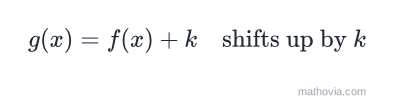
The vertical shift form of a function
Adding k outside the bracket raises the graph by k

The Rule

moves the graph up by when is positive, and down when it is negative.

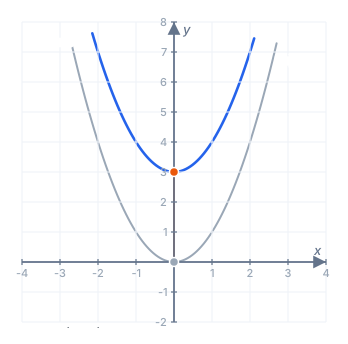
A parabola shown faded with the same parabola three units higher beside it, and an arrow marking the shift up 3
Plus 3 outside the bracket, and the graph rises 3.

That really is all of it. The reason there is no surprise here is that is added after has done its work. The function computes its output, then 3 is added — so the output is genuinely 3 bigger, and the point sits 3 higher.

Compare , where the subtraction happens to the input, before the function runs, and has to be compensated for. That is the whole difference, and it is covered in horizontal shifts.

Up and Down

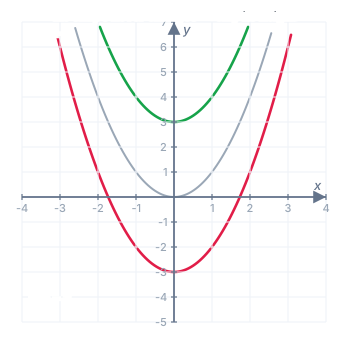
Three parabolas stacked: the parent, one three units higher and one three units lower
Same curve, three heights. Nothing about the shape changes.

The point rule is the mirror image of the horizontal one:

The -coordinate is untouched. Width, orientation and curvature are all preserved.

What Changes and What Doesn’t

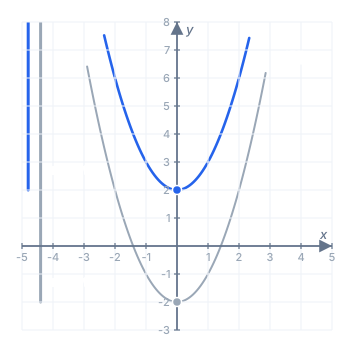
Two parabolas with their ranges marked as vertical bars at the left, showing y at least negative 2 becoming y at least 2 after a shift up 4
The range rises with the graph; the domain is untouched.
FeatureEffect of a vertical shift
Shapeunchanged
Domainunchanged
Rangeshifts by
-interceptshifts by
-interceptsmay move, appear or vanish
Horizontal asymptotesshift by
Vertical asymptotesunchanged

Two of these are worth dwelling on.

The -intercept shifts cleanly. It is an output, and every output moves by . This is the opposite of a horizontal shift, where the -intercept has to be recomputed from scratch.

The -intercepts do not simply shift. They are where the graph meets a fixed line, and the graph is moving relative to that line. Lift by 3 and the two intercepts move closer together; lift it by 4 and they merge into one; lift it by 5 and they disappear. The count itself can change, which never happens under a horizontal shift.

Horizontal Versus Vertical

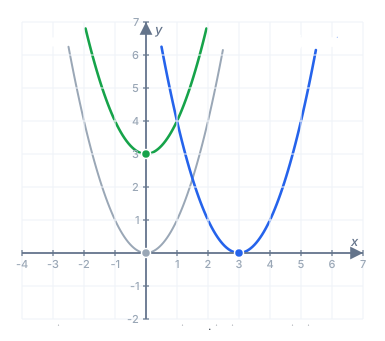
One parabola shown with two transformations: plus 3 outside moving it up, and minus 3 inside moving it right
The position of the number relative to the bracket decides everything.
Acts onthe outputthe input
Directionverticalhorizontal
Sign behavesnormallyreversed
Moves therangedomain
-interceptshifts by recompute
Asymptote affectedhorizontalvertical

and look almost identical on the page and do completely different things. Check whether the number is inside or outside the bracket before anything else.

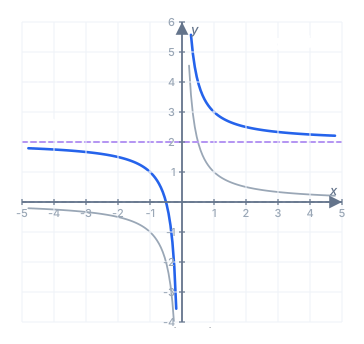
Asymptotes Rise Too

The reciprocal curve and the same curve shifted up 2, with its horizontal asymptote raised from y equals 0 to y equals 2
A horizontal asymptote is a height, so it moves with the graph.

is the reciprocal curve lifted 2. Its horizontal asymptote moves from to ; its vertical asymptote stays at , because no -value has changed. This is how rational functions end up with asymptotes at heights other than zero.

Worked Example A: Read the Shift

Describe .

Down 11.

Worked Example B: The Range Moves

has range . What is the range of ?

. The domain is unchanged, whatever it was.

Worked Example C: Intercepts Disappearing

How many -intercepts does have, and ?

has two, at .

Adding 12 gives , whose vertex is at — above the axis, so none. The shift lifted the curve clear of the -axis.

Worked Example D: On a Square Root

Describe and give its domain and range.

Down 4. It starts at .

Domain — unchanged. Range — shifted down 4.

Worked Example E: Both Shifts at Once

Describe , and say where ends up.

Right 2 and up 5.

The point rule combines: .

Common Mistakes to Avoid

  • Confusing with . Outside is vertical, inside is horizontal.
  • Shifting the domain. A vertical shift never touches it.
  • Sliding the -intercepts by . They move relative to a fixed axis, and can vanish entirely.
  • Leaving a horizontal asymptote behind. It rises with the graph.
  • Moving the vertical asymptote. It does not move at all.
  • Expecting a sign trick. There isn’t one here; plus means up.
  • Applying the shift before a stretch. In the stretch comes first — see function transformations.

Where Vertical Shifts Lead Next

  • The full set. Function transformations covers how this combines with the other three.
  • Vertex form. The in is exactly this shift — see parabolas.
  • Reflections. Reflections are what happens when goes negative rather than changing.
  • Solving by shifting. “How far must this curve move to touch the axis?” is a vertical-shift question in disguise.
  • Baseline modelling. A fixed fee added to a variable cost is a vertical shift of the cost graph.

Practice Problems

Work each one before opening the answer.

Problem 1. Which way does move the graph?

Show answer

Up 8.

Problem 2. Which way does move the graph?

Show answer

Down 2.

Problem 3. Where is the vertex of ?

Show answer

.

Problem 4. Where does move under ?

Show answer

To . The -coordinate is unchanged.

Problem 5. has domain . What is the domain of ?

Show answer

, unchanged.

Problem 6. has range . What is the range of ?

Show answer

.

Problem 7. How many -intercepts does have?

Show answer

None — the vertex sits one unit above the axis.

Problem 8. What is the horizontal asymptote of ?

Show answer

.

Problem 9. What is the vertical asymptote of ?

Show answer

, unchanged by a vertical shift.

Problem 10. Is the same as ?

Show answer

No. The first moves up 3; the second moves left 3.

Problem 11. Write the equation of moved down 6.

Show answer

.

Problem 12. has two -intercepts. What vertical shift leaves it with exactly one?

Show answer

Up 16, giving , which touches the axis only at the origin.

Quick Reference

TaskMethod
The form
Positive up by
Negative down
Point rule
Domainunchanged
Rangeshifts by
-interceptshifts by
-interceptsmay move, appear or vanish
Horizontal asymptoteshifts by
Vertical asymptoteunchanged

Vertical shifts are the straightforward half of function transformations, and their good behaviour is exactly what horizontal shifts lack. The is the same one in the vertex form of parabolas, and lifting a rational function is how its horizontal asymptote ends up somewhere other than zero. More Algebra lessons are available.

Frequently Asked Questions

What does f(x) + k do to a graph?+

It moves the whole graph vertically: up by when is positive, down when it is negative. The shape is unchanged — every point simply rises or falls by the same amount.

Why do vertical shifts not have the sign problem horizontal ones do?+

Because a vertical shift is applied to the output, after the function has already run. Nothing is being compensated for, so genuinely means up 3. Horizontal shifts act on the input beforehand, which is what reverses them.

Does a vertical shift change the domain or the range?+

It shifts the range by and leaves the domain completely unchanged. Every input is still allowed; only the outputs move.

What happens to the y-intercept under a vertical shift?+

It shifts by exactly , because the -intercept is an output value and every output moves by . This is the opposite of a horizontal shift, where the -intercept must be recomputed.

Can a vertical shift change the number of x-intercepts?+

Yes. Lifting a parabola whose vertex is below the axis can reduce its two -intercepts to one and then to none, because the -axis is a fixed line the graph moves relative to.

Does a vertical shift move a horizontal asymptote?+

Yes, by . A horizontal asymptote is a height, so it rises with the graph. A vertical asymptote is tied to an -value and does not move at all.

Is f(x) + k the same as f(x + k)?+

No, and confusing them is a common error. shifts vertically by ; shifts horizontally by in the opposite direction. The position of the relative to the bracket decides which.

Related lessons