
Every technique in Linear Equations solves an equation once it’s already written down. The actual difficulty in a word problem happens before that — turning a paragraph of English into an equation in the first place. This lesson gives that translation step a repeatable process, then works through the problem types that show up most often: numbers, geometry, motion, mixtures, and interest.
Every worked example below ends the same way: solve the equation using last lesson’s techniques, then translate the number back into an answer to the actual question — the two steps are equally important, and skipping the second one is one of the most common ways to lose credit on an otherwise correct solution.

A Five-Step Process for Word Problems
- Read the problem and identify what’s being asked. Underline or restate the actual question in your own words before writing anything.
- Assign a variable to the unknown. Let the variable represent the specific quantity the problem asks for, and write every other unknown quantity in terms of that same variable.
- Write an equation that models the relationship described. Translate the sentence describing how the quantities relate into algebra, using the table below.
- Solve the equation using the techniques from Linear Equations.
- Check the solution against the original problem, not just the equation — an answer that solves the equation but doesn’t make sense in context (a negative length, a fractional number of coins) means the equation needs to be fixed, not the arithmetic.
Translating Words into Algebra
| Phrase | Algebra |
|---|---|
| A number increased by 5 | |
| 5 less than a number | |
| Twice a number | |
| A number decreased by 5, then doubled | |
| The sum of two consecutive integers | |
| Half of a number | |
| 5 more than three times a number | |
| A second number is 5 more than twice the first | second number |
The single most useful habit here is writing every unknown quantity in terms of the one variable assigned in step 2 — a problem with three unknowns almost never needs three variables, just three expressions built from one.
Number and Consecutive Integer Problems
Consecutive integers are integers that follow one after another, like
Geometry Applications
The most common geometry word problems use the perimeter formula for a rectangle,
Substituting an expression like that into the perimeter formula turns two unknowns into one, which is exactly what makes the resulting equation linear and solvable.
Distance, Rate, and Time
The relationship
Percent and Mixture Problems
Percent problems convert a percentage to a decimal and multiply it by the base quantity: ”
Simple Interest
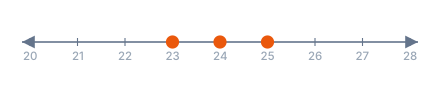
Worked Example A: Consecutive Integers
The sum of three consecutive integers is
Step 1 — assign a variable. Let the smallest integer be
Step 2 — write an equation for their sum:
Step 3 — solve:
Step 4 — answer the actual question. The three integers are
Step 5 — check:
Worked Example B: Geometry Perimeter
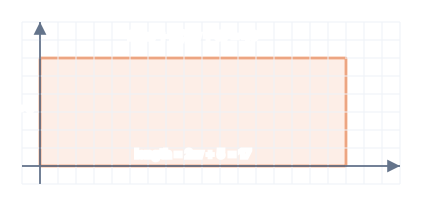
A rectangle’s length is
Step 1 — assign a variable. Let the width be
Step 2 — substitute into the perimeter formula:
Step 3 — solve:
Step 4 — find the length and check it makes sense. The length is
Step 5 — check:
Worked Example C: Distance, Rate, and Time
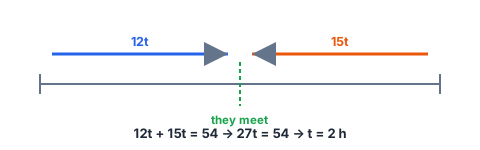
Two cyclists start from the same point and ride in opposite directions, one at
Step 1 — assign a variable. Let
Step 2 — write an expression for each distance and add them:
Step 3 — solve:
Step 4 — check the answer makes sense in context.
Step 5 — check:
Worked Example D: A Percent Mixture Problem
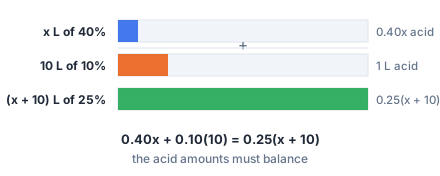
How many liters of a
Step 1 — assign a variable. Let
Step 2 — write an equation balancing total acid before and after mixing:
Step 3 — solve:
Step 4 — answer the question.
Step 5 — check:
Common Mistakes to Avoid
- Solving for
and stopping there. If the problem asks for the length, the width, or an integer other than the first one, alone usually isn’t the final answer — always translate back to the quantity the problem actually asked for. - Using a different variable for every unknown. This usually produces one equation with two unknowns, which can’t be solved on its own. Write every unknown in terms of the same variable instead.
- Skipping the units.
only comes out right when rate and time use matching units — mixing hours with minutes, or miles with feet, gives a numerically wrong answer even with perfectly correct algebra. - Forgetting to convert a percent to a decimal.
is in an equation, not . - Accepting a solution that doesn’t make sense in context. A negative length, a fractional number of people, or a physically impossible rate means the equation was set up wrong — go back to step 3, not step 4.
- Setting up the perimeter formula with both sides as the same variable. A rectangle’s length and width are generally different; conflating them turns a rectangle problem into a square problem by accident.
- Adding rates instead of adding distances. In the meeting-cyclists example, the two distances add to the total, not the two rates by themselves — rate needs to be multiplied by time first.
Where This Shows Up Later
- Systems of equations. Word problems with two genuinely independent unknowns, rather than one expressed in terms of the other, are usually solved as a system instead of forcing everything into one variable.
- Quadratic applications. Area problems, projectile motion, and some geometry problems use this exact five-step process but end in a quadratic equation instead of a linear one.
- Equations with More Than One Variable. Formulas like
, , and all reappear there, solved for a different letter instead of a number. - Rational equation applications. Work-rate problems (“how long would it take two people working together”) use this same five-step setup, applied to a rational equation instead of a linear one.
Practice Problems
Work each problem yourself before opening the answer.
Problem 1. The sum of two consecutive integers is
Show answer
Step 1 — assign a variable. Let the smaller integer be
Step 2 — write an equation:
Step 3 — solve:
Answer: the integers are
Problem 2. Four times a number, decreased by
Show answer
Step 1 — assign a variable and write an equation:
Step 2 — solve:
Answer: the number is
Problem 3. A rectangle’s length is
Show answer
Step 1 — assign a variable. Let the width be
Step 2 — substitute into the perimeter formula:
Step 3 — solve:
Answer: the width is
Problem 4. The sum of three consecutive even integers is
Show answer
Step 1 — assign a variable. Let the smallest even integer be
Step 2 — write an equation:
Step 3 — solve:
Answer: the integers are
Problem 5. Two trains leave the same station at the same time, traveling in opposite directions, one at
Show answer
Step 1 — assign a variable. Let
Step 2 — write an equation adding the two distances:
Step 3 — solve:
Answer:
Problem 6.
Show answer
Step 1 — substitute into the simple interest formula:
Step 2 — solve:
Answer: the interest rate is
Problem 7. How many liters of a
Show answer
Step 1 — assign a variable. Let
Step 2 — write an equation balancing total alcohol:
Step 3 — solve:
Answer:
Problem 8. A number increased by
Show answer
Step 1 — write an equation:
Step 2 — solve:
Answer: the number is
Problem 9. Twelve less than five times a number is the same as the number increased by
Show answer
Step 1 — write an equation:
Step 2 — solve:
Answer: the number is
Problem 10. The perimeter of a triangle is
Show answer
Step 1 — assign a variable. Let the first side be
Step 2 — write an equation for the perimeter (sum of the three sides):
Step 3 — solve:
Answer: the sides are
Quick Reference
| Word problem type | Core relationship |
|---|---|
| Consecutive integers | |
| Consecutive even or odd integers | |
| Rectangle perimeter | |
| Distance, rate, time | |
| Percent of a quantity | percent (as a decimal) times the quantity |
| Mixture | (amount)(concentration), added across ingredients, equals (total amount)(final concentration) |
| Simple interest | |
| Every problem | Assign one variable, write every other unknown in terms of it, solve, then check against the original question |
The equations themselves, once set up, lean directly on Linear Equations — and for formulas solved for a different letter, Equations with More Than One Variable picks up from here. Solutions and Solution Sets has the vocabulary behind checking a candidate answer, if that’s worth a refresher. More of the Algebra lessons are available too.