
When you solve a system by elimination, the letters just come along for the ride. Every step changes the numbers, but
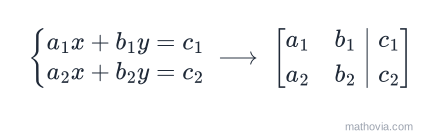
What Is an Augmented Matrix?
A matrix is a rectangular grid of numbers. The augmented matrix of a linear system has:
- one row for each equation,
- one column for each variable, in the same order in every row,
- and one extra column for the constants, set off by a vertical bar that stands in for the equals signs.
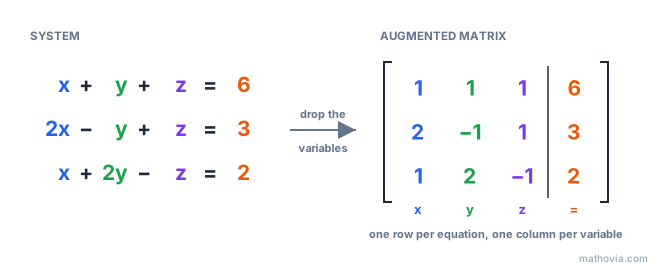
The same system written both ways:
A variable with no visible number in front has coefficient
Coefficient Matrix vs Augmented Matrix
The coefficient matrix is just the part to the left of the bar, the coefficients of the variables. The augmented matrix “augments” it with the column of constants:
Which Matrix Represents the System of Equations?
Writing the matrix correctly is mostly about lining things up. Two things trip people up: missing variables and equations that aren’t in standard form.
Write the augmented matrix for:
Step 1 — put every equation in standard form, with variables on the left in the order
Step 2 — copy the coefficients, using
The zeros matter. Leaving a gap instead of a
Which System Represents the Matrix?
Going the other way is just as quick: attach the variables to the columns and put the equals sign back where the bar is. The matrix
represents
A
The Three Row Operations
To solve a system with its matrix, you transform the matrix step by step. Only three moves are allowed, and each one matches something you could do to the equations themselves without changing the solution:
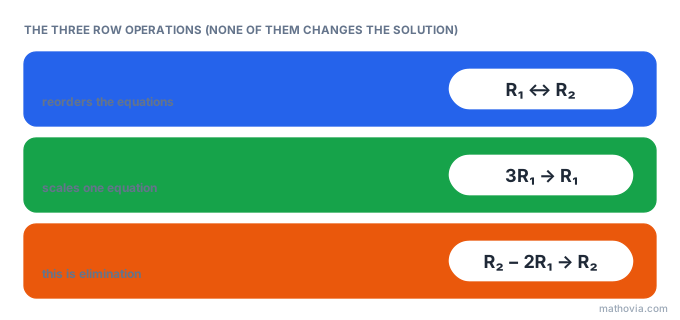
| Operation | Notation | Equation version |
|---|---|---|
| swap two rows | list the equations in a different order | |
| multiply a row by a non-zero number | multiply both sides of an equation by | |
| add a multiple of one row to another | the elimination method |
The goal is to create zeros below (and, for Gauss-Jordan, above) the main diagonal, one column at a time.
Row-Echelon Form and Reduced Row-Echelon Form
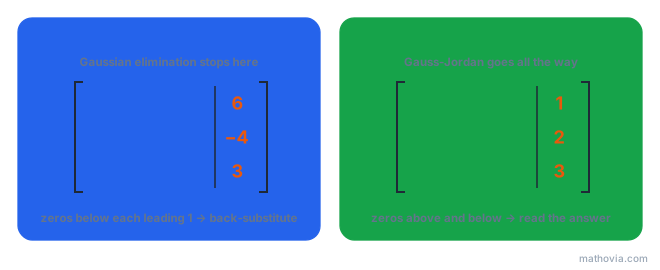
| Row-echelon form (REF) | Reduced row-echelon form (RREF) | |
|---|---|---|
| Below each leading entry | zeros | zeros |
| Above each leading entry | anything | zeros |
| Leading entries | usually made | always |
| Reached by | Gaussian elimination | Gauss-Jordan elimination |
| Last step | back-substitution | read off the last column |
Gaussian Elimination vs Gauss-Jordan Elimination
Both methods use the same row operations. Gaussian elimination stops at row-echelon form and finishes with back-substitution, which is the triangular-form technique from systems with three variables. Gauss-Jordan elimination keeps going until the left side is the identity matrix, so each row reads “variable = number”. Gaussian takes fewer row operations; Gauss-Jordan needs no back-substitution. On paper, use whichever you find tidier.
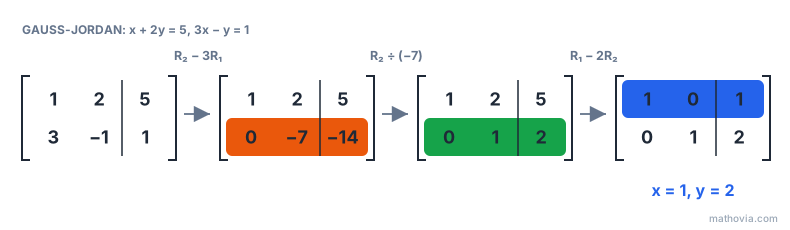
Example 1: Gauss-Jordan Elimination on a 2 × 2 System
Solve
Step 1 — write the augmented matrix:
Step 2 — make a zero below the first leading 1 with
Step 3 — make the second leading entry 1 with
Step 4 — clear the entry above it with
Step 5 — read the answer: the rows say
Example 2: Gaussian Elimination on a 3 × 3 System
Solve
Step 1 — the augmented matrix:
Step 2 — clear the first column with
Step 3 — swap
Step 4 — clear below it with
Step 5 — back-substitute from the bottom row up:
Answer:
No Solution and Infinitely Many Solutions in Matrix Form
The final matrix also tells you when there isn’t exactly one solution.
A row
and the second row says
A row of all zeros means infinitely many solutions (when there are as many equations as unknowns). For
Only one real equation is left,
Each value of
Common Mistakes to Avoid
- Skipping zeros for missing variables.
is the row , not . - Mixing up the column order. Every row must list the variables in the same order, usually
. - Applying an operation to only part of a row.
changes every entry of , including the constant after the bar. - Multiplying a row by zero. That deletes an equation. Scaling must use a non-zero number.
- Misreading the final matrix. In row-echelon form you still need back-substitution; only reduced row-echelon form shows the answer directly.
Practice Problems
Work each one before opening the answer.
Problem 1. Write the augmented matrix for
Show answer
Step 1 — one row per equation, columns
Answer: rows
Problem 2. Which system of equations does this augmented matrix represent?
Show answer
Step 1 — attach
Answer:
Problem 3. Write the augmented matrix for
Show answer
Step 1 — fill in zeros for the missing variables:
Answer: rows
Problem 4. Solve
Show answer
Step 1 —
Step 2 —
Answer:
Problem 5. A system’s augmented matrix reduces to rows
Show answer
Step 1 — this is reduced row-echelon form, so each row reads directly:
Answer:
Problem 6. A system’s augmented matrix reduces to rows
Show answer
Step 1 — the second row means
Step 2 — a false equation means the system is inconsistent.
Answer: no solution
Matrices work for any number of linear equations, but every equation so far has been a straight line or a flat plane. When one of the equations is a curve, such as a parabola or a circle, the system is nonlinear, and substitution becomes the main tool again.