
Of every exponent rule, the negative-exponent rule is the one most likely to get misread as “make it negative.” It doesn’t. A negative exponent is an instruction to move a factor to the other side of a fraction bar and make the exponent positive again — nothing about the resulting value’s sign changes because of it. This lesson isolates that single rule and works it from every angle: plain numbers, fractions, products, and multi-variable expressions.
If you’ve already read Integer Exponents, the core definition below will look familiar — this lesson goes several worked examples deeper into negative exponents specifically, since they cause more simplification errors than any other single exponent rule.
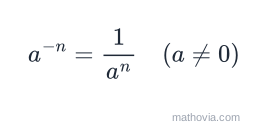
What Does a Negative Exponent Mean?
A negative exponent means “take the reciprocal of the positive power.” It is not an operation performed on the exponent’s sign in isolation — it’s an instruction that relocates the entire factor
Notice what happened: the base
Negative Exponents Are Never Negative Numbers
This is the single most common misreading of the rule, so it’s worth stating twice.
| Expression | Common wrong answer | Correct answer | Why |
|---|---|---|---|
| The exponent moves the factor; it doesn’t negate the value | |||
| Reciprocal, not opposite | |||
| Here the base itself is negative, which is a separate fact |
The third row is worth studying carefully: the result is negative only because the base
Negative Exponents on Products and Quotients
The negative-exponent rule combines with the product and quotient rules exactly the way you’d expect, since a negative exponent is still just an exponent.
| Rule | Statement | Example |
|---|---|---|
| Negative exponent, single base | ||
| Negative exponent of a product | ||
| Negative exponent of a quotient |
The quotient row deserves a second look: flipping the fraction before applying the exponent is almost always faster than distributing the negative exponent across the top and bottom separately, even though both methods give the same answer.
Moving Factors Across the Fraction Bar
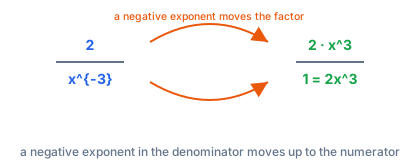
The fastest way to handle negative exponents in a mixed expression is a single visual rule: a factor with a negative exponent can move across the fraction bar if its exponent’s sign flips at the same time.
The
Two guardrails. This shortcut only relocates factors (things being multiplied), never terms (things being added or subtracted): in
Negative Exponents with Multiple Variables
When several variables each carry a negative exponent, apply the same relocation rule to each one independently, then rewrite the whole expression with only positive exponents left.
Each variable’s exponent is evaluated on its own:
Worked Example A: A Numeric Negative Exponent
Evaluate
Step 1 — apply the negative exponent rule:
Step 2 — evaluate the power in the denominator:
Answer:
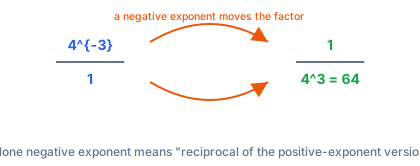
Worked Example B: A Negative Exponent on a Quotient
Evaluate
Step 1 — flip the fraction and drop the negative sign:
Step 2 — apply the power of a quotient rule:
Answer:
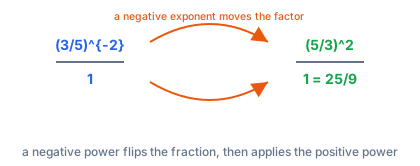
Worked Example C: Simplifying a Variable Expression
Simplify
Step 1 — apply the quotient rule base by base, subtracting exponents:
Step 2 — move the negative-exponent factor across the fraction bar:
Answer:
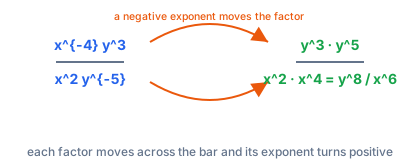
Worked Example D: A Negative Exponent Already in a Denominator
Simplify
Step 1 — recognize that the negative exponent moves
Step 2 — write the simplified form:
Answer:
Common Mistakes to Avoid
- Treating the negative exponent as a negative number.
, a small positive fraction, not . - Moving a coefficient that has no exponent attached.
; the never had a negative exponent, so it stays in the numerator. - Forgetting the exponent’s sign flips when a factor moves. A factor doesn’t just relocate — its exponent’s sign flips as part of the same move; leaving the sign unchanged after moving is a different, wrong expression.
- Applying the shortcut to a term instead of a factor. In
, the is added to ; it cannot be relocated across a fraction bar on its own. - Distributing a negative exponent over a sum.
; the negative-exponent (and every exponent) rule only ever applies to a single factor or a product/quotient, never to a sum. - Confusing a negative base with a negative exponent.
is negative because the base was negative to start; with a positive base is not.
Where This Shows Up Later
- Exponent Rules. The negative-exponent rule is one entry in the complete reference table there, used alongside the product, quotient, and power rules in combined problems.
- Rational Exponents. A negative rational exponent, like
, combines this same reciprocal idea with a root: . - Scientific notation. Very small measurements are written with a negative power of ten, such as
, which is nothing more than this rule applied to base . - Rational Expressions. Simplifying an algebraic fraction to “no negative exponents” uses this exact relocation rule as its very last cleanup step.
Practice Problems
Work each problem yourself before opening the answer.
Problem 1. Evaluate
Show answer
Answer:
Problem 2. Evaluate
Show answer
Step 1 — apply the negative exponent rule to the base
Step 2 — evaluate the denominator (an even power of a negative number is positive):
Answer:
Problem 3. Evaluate
Show answer
Answer:
Problem 4. Simplify
Show answer
The exponent applies only to
Answer:
Problem 5. Simplify
Show answer
Step 1 — apply the negative exponent of a product rule:
Step 2 — expand the denominator:
Answer:
Problem 6. Simplify
Show answer
Step 1 — apply the quotient rule to each base:
Step 2 — move the negative-exponent factor to the denominator:
Answer:
Problem 7. Simplify
Show answer
The negative exponent moves
Answer:
Problem 8. Simplify
Show answer
Step 1 — flip the fraction and drop the outer negative sign:
Step 2 — move
Answer:
Problem 9. Simplify
Show answer
Step 1 — rewrite each term with a positive exponent (this is a sum, so the rule applies to each term separately, not to the whole expression at once):
Step 2 — combine with a common denominator of
Answer:
Problem 10. Simplify
Show answer
Step 1 — apply the outer exponent to every factor inside:
Step 2 — move the negative-exponent factors to the denominator:
Answer:
Quick Reference
| Situation | Move |
|---|---|
| Rewrite as | |
| Rewrite as | |
| Flip the fraction, drop the minus sign: | |
| Coefficient next to a negative-exponent variable | The coefficient never moves unless it has its own exponent |
| A negative exponent inside a sum | Rewrite that one term only — the shortcut never applies across a |
| Value of the result | Always the same sign as the base raised to that (positive) power — the exponent’s negativity never flips the sign |
With this rule solid on its own, Exponent Rules puts it back together with the product, quotient, and power rules for combined problems, and Rational Exponents stretches the same reciprocal idea to fractional powers. Integer Exponents has the full derivation from repeated multiplication, if that’s worth revisiting. The Negative Exponent Practice Problems is there for practice, and the Algebra lessons page has the rest of what’s published.