
Every function is a set of instructions. An inverse function is the same instructions run backwards: multiply by 3 and add 6 becomes subtract 6 and divide by 3. Getting from one to the other is mechanical once you know the procedure.
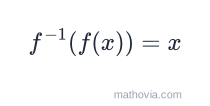
The Definition
Put another way: if
The notation is a trap.
— the inverse function — the reciprocal
Completely different. If you need the reciprocal, write
Only One-to-One Functions Have Inverses
Reversing a function swaps every input and output. For the result to be a function, each output must have come from exactly one input — which is the definition of one-to-one.
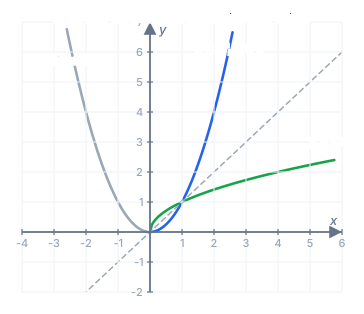
The fix is to restrict the domain. Keep only
How to Find the Inverse of a Function: Swap and Solve
Three steps, in this order.
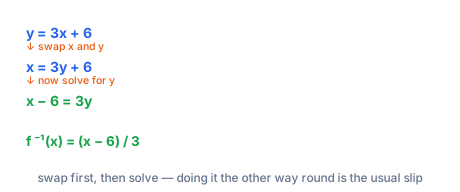
- Write
. - Swap
and . - Solve for
, then rename it .
For
So
Swapping before solving is what keeps this reliable. Solving first and swapping afterwards reaches the same place but leaves more room for error, and the intermediate lines stop meaning anything.
There is a useful sanity check built into the method: the inverse should undo the operations in reverse order.
Checking by Composition
Do not trust the algebra alone — compose both ways.
For the pair above:
Both directions return
Graphing Inverse Functions: a Mirror in y = x
Because every pair
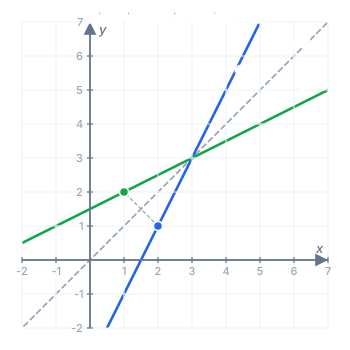
Two consequences follow immediately.
The graph of an inverse can be drawn without any algebra — fold the paper along
Any point where the graph meets
This also gives a second way to see the one-to-one requirement: reflecting a graph across
Domain and Range Swap
Since inputs and outputs trade places, so do the two sets.
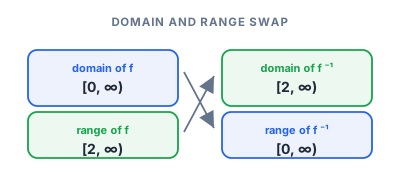
For
This is often the only way to get the inverse’s domain right. Solving
Inverses You Already Know
| Function | Inverse | Restriction |
|---|---|---|
| none | ||
| none | ||
| none | ||
| needs | ||
| none | ||
| its own inverse |
That last row is a self-inverse function — reflecting
Worked Example A: A Linear Function
Find the inverse of
Check:
Worked Example B: A Fraction
Find the inverse of
So
Worked Example C: A Restricted Quadratic
Find the inverse of
Only the positive root is taken, because the restriction
Worked Example D: A Rational Function
Find the inverse of
Collect the
The “collect and factor” step is the whole technique whenever
Worked Example E: Domain and Range
Domain of
So
Worked Example F: A Real Reversal
Celsius to Fahrenheit is
Which is the familiar Fahrenheit-to-Celsius formula. The two conversions are inverse functions, which is why applying both returns the temperature you started with.
Common Mistakes to Avoid
- Reading
as a reciprocal. It is the inverse function. - Solving before swapping. Swap
and first. - Forgetting the domain restriction. The inverse’s domain is the original’s range.
- Inverting a function that is not one-to-one. Restrict the domain first.
- Taking both roots when undoing a square. The restriction picks one.
- Checking only one composition. Verify both directions.
- Undoing operations in the original order. Reverse them — last operation first.
- Forgetting to collect terms when
appears twice. Gather and factor.
Where Inverses Lead Next
- Logarithms, defined as the inverse of the exponential function.
- Inverse trigonometric functions, each on a restricted domain for exactly this reason.
- Solving equations, since applying an inverse to both sides is what isolating a variable really is.
- Unit conversions, which come in inverse pairs.
- Calculus, where the derivative of an inverse relates directly to the derivative of the original.
- Cryptography, where encryption and decryption are inverse functions.
Practice Problems
Work each one before opening the answer.
Problem 1. Find the inverse of
Show answer
Problem 2. Find the inverse of
Show answer
Problem 3. Find the inverse of
Show answer
Problem 4. Find the inverse of
Show answer
Problem 5. Find the inverse of
Show answer
Problem 6. Verify that
Show answer
Problem 7. Why does
Show answer
It is not one-to-one —
Problem 8. If
Show answer
Problem 9.
Show answer
Domain
Problem 10. Find the inverse of
Show answer
Problem 11. Find the inverse of
Show answer
Problem 12. A graph of
Show answer
Quick Reference
| Item | Rule |
|---|---|
| Definition | |
| Requirement | |
| Finding it | Write |
| Checking it | Compose both ways; both give |
| Graph | Reflection in |
| Points | |
| Domain of | Range of |
| Range of | Domain of |
| Inverse function vs reciprocal — different | |
| Not one-to-one | Restrict the domain first |
Inverses require a one-to-one function and are verified with composition. The domain and range swapping is the step most often missed. More Algebra lessons are available.