
Logarithmic equations are the mirror image of exponential equations: there the unknown was trapped in an exponent and a logarithm set it free; here the unknown is trapped inside a logarithm and an exponential sets it free. They show up whenever a formula already contains a log — pH, decibels, the Richter scale, the time formulas from growth and decay — and you need to work backwards to the quantity inside.

The Two Tools
Every logarithmic equation is solved with one of these, often after some tidying up:
| Form of the equation | Tool | Result |
|---|---|---|
| convert to exponential form | ||
| one-to-one property |
The tidying up is the logarithm rules: when there are several logs on one side, condense them into a single log first, so the equation matches one of the two forms above.
The Steps for Solving Log Equations
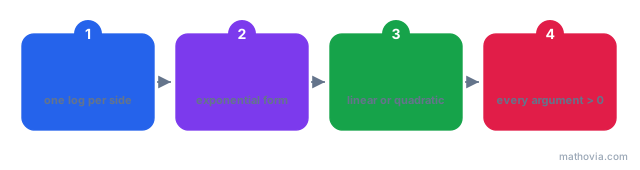
- Condense each side to a single logarithm (or a single log and a number) using the product, quotient and power rules.
- Remove the logarithm: convert to exponential form, or set the arguments equal.
- Solve the resulting equation — often linear, sometimes quadratic.
- Check every answer in the original equation. Any value that makes an argument zero or negative is extraneous and must be rejected.
Step 4 is not optional. Condensing can quietly enlarge the domain —
Type 1: A Logarithm Equal to a Number
Convert straight to exponential form. This is how to get rid of a logarithm when the other side is a constant:
Check:
Type 2: A Logarithm Equal to a Logarithm
If both sides are single logs with the same base, drop the logs and set the arguments equal:
Check:
Type 3: Several Logarithms — Condense First
When one side has two or more logs, combine them with the product or quotient rule before removing the log.
Then
Example 1: Logarithmic Equations Examples
| Equation | After removing the log | Candidates | True solution |
|---|---|---|---|
In the last three rows the negative candidate is extraneous: it would put a negative number inside
Solving Exponential and Logarithmic Equations: Which Tool?
| The unknown is… | Example | Undo it with |
|---|---|---|
| in an exponent | a logarithm: | |
| inside a logarithm | an exponential: | |
| in an exponent with base | ||
| inside | base |
Each function is removed by applying its inverse — which is the whole reason logarithms and exponentials come as a pair.
Worked Example
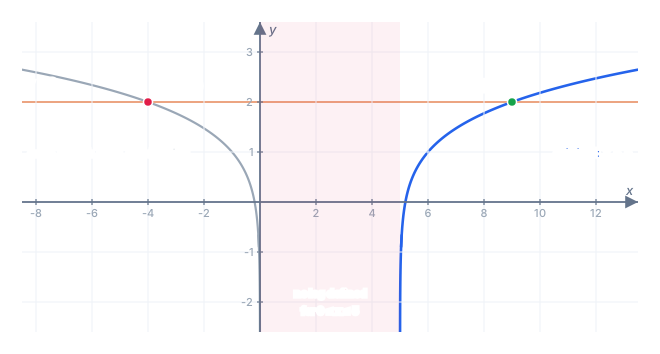
Find the true solution of
Step 1 — condense with the product rule:
Step 2 — convert to exponential form:
Step 3 — rearrange into a quadratic:
Step 4 — factor and solve:
Step 5 — check each candidate in the original equation. For
For
So the true solution is
Common Mistakes to Avoid
- Skipping the check. Extraneous solutions are routine in logarithmic equations. Substitute every candidate into the original equation, not the condensed one.
- Dropping logs that are not alone.
does not give . Condense first: , so . - Converting with the wrong base.
means , and means — not or . - Rejecting a negative answer automatically. A negative
is only extraneous if it makes an argument non-positive. In , is valid, since .
Practice Problems
Work each one before opening the answer.
Problem 1. Solve
Show answer
Step 1 — convert to exponential form:
Step 2 — solve and check:
Answer:
Problem 2. Solve
Show answer
Step 1 — the base of
Step 2 — divide by
Answer:
Problem 3. Solve
Show answer
Step 1 — same base on both sides, so set the arguments equal:
Step 2 — check both arguments:
Answer:
Problem 4. Solve
Show answer
Step 1 — condense and convert (base
Step 2 — solve the quadratic:
Step 3 — check:
Answer:
Problem 5. Solve
Show answer
Step 1 — condense the left side with the quotient rule:
Step 2 — set the arguments equal and solve:
Step 3 — check:
Answer:
Problem 6. Solve
Show answer
Step 1 — condense and convert:
Step 2 — solve the quadratic:
Step 3 — check:
Answer:
That completes the toolkit for this chapter: you can now evaluate, graph, rewrite and solve both exponential and logarithmic functions. For a review of where it all started, return to the exponential functions lesson or browse the full list of algebra lessons.