
A four-term polynomial usually can’t be factored with a single greatest-common-factor step, since no one factor typically divides all four terms. Factoring by grouping solves this by splitting the four terms into two pairs, factoring each pair’s own greatest common factor separately, and checking whether the two resulting binomials happen to match — which, when they do, means one more factoring step finishes the job.
What Is Factoring by Grouping?
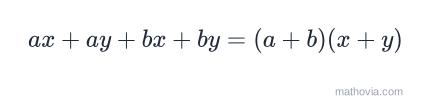
Split into two pairs, factor the GCF out of each pair, and compare what’s left inside the parentheses:
Both pairs left behind the identical binomial
Grouping a Four-Term Polynomial
Step 1 — split into two pairs and factor the GCF out of each:
Step 2 — both pairs produced the same binomial,
Rearranging Terms When the First Grouping Doesn’t Work
Occasionally the terms as written don’t group into matching binomials on the first attempt. Reordering the four terms — most commonly swapping the middle two — often reveals a pairing that does work.
Grouped in this order,
Using Grouping to Factor a Trinomial: The AC Method
A trinomial
- Multiply
and . - Find two numbers that multiply to
and add to . - Rewrite the middle term
as the sum of those two numbers’ terms, turning the trinomial into an equivalent four-term polynomial. - Factor the resulting four-term polynomial by grouping, exactly as above.
The two numbers that multiply to
Worked Example A: Grouping in the Order Given
Factor
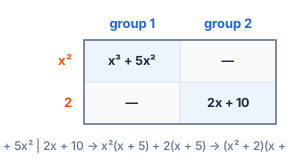
Step 1 — factor the GCF out of each pair:
Step 2 — factor out the matching binomial:
Answer:
Worked Example B: Grouping After Rearranging
Factor
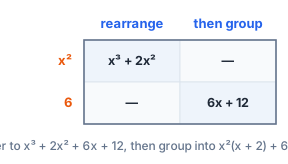
Step 1 — the terms as given don’t group cleanly; rearrange to put the matching-degree terms together:
Step 2 — factor the GCF out of each pair:
Step 3 — factor out the matching binomial:
Answer:
Worked Example C: The AC Method on a Trinomial
Factor
Step 1 — compute
Step 2 — find two numbers that multiply to
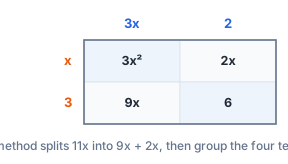
Step 3 — split the middle term and group:
Step 4 — factor out the matching binomial:
Answer:
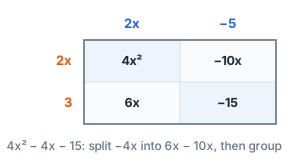
Worked Example D: The AC Method with a Negative Middle Term
Factor
Step 1 — compute
Step 2 — find two numbers that multiply to
Step 3 — split the middle term and group:
Step 4 — factor out the matching binomial:
Answer:
Common Mistakes to Avoid
- Giving up after the first pairing fails. If the terms as written don’t group cleanly, rearranging them (usually swapping the middle two) is a normal part of the process, not a sign of a mistake.
- Finding two numbers that add to
but forgetting they must also multiply to . Both conditions are required simultaneously — a pair that only satisfies one of them doesn’t work. - Factoring out a GCF with the wrong sign from the second pair. If the second pair starts with a negative term, factoring out a negative GCF (matching Worked Example D’s pattern) is usually what makes the two binomials actually match.
- Stopping after factoring each pair separately, without the final step. The matching binomial still needs to be factored out one more time — two partially-factored pairs are not the final answer.
- Assuming every four-term polynomial groups successfully. Some polynomials genuinely don’t factor by grouping (or at all); after trying both reasonable pairings, it’s fine to conclude that grouping doesn’t apply.
- Splitting the middle term with the wrong sign in the ac method.
needs to split into two terms whose coefficients literally add to , including sign — double-check the addition, not just the product.
Where This Shows Up Later
- Factoring Quadratics. The ac method introduced here is one of the two standard techniques for factoring a trinomial with a leading coefficient other than
, covered in full there. - Factoring Higher-Degree Polynomials. Grouping extends naturally to polynomials with six terms (three pairs) or a four-term structure hiding inside a higher-degree expression.
- Solving quadratic equations by factoring. Factoring
into is exactly the step that turns a quadratic equation into two simple linear ones via the zero product property. - Simplifying Rational Expressions. A numerator or denominator that groups into a product is often the key to cancelling a rational expression down to lowest terms.
Practice Problems
Work each problem yourself before opening the answer.
Problem 1. Factor
Show answer
Answer:
Problem 2. Factor
Show answer
Answer:
Problem 3. Factor
Show answer
Answer:
Problem 4. Factor
Show answer
Answer:
Problem 5. Factor
Show answer
Step 1 — compute
Step 2 — find two numbers multiplying to
Step 3 — split and group:
Answer:
Problem 6. Factor
Show answer
Step 1 — compute
Step 2 — find two numbers multiplying to
Step 3 — split and group:
Answer:
Problem 7. Factor
Show answer
Step 1 — compute
Step 2 — find two numbers multiplying to
Step 3 — split and group:
Answer:
Problem 8. Factor
Show answer
Step 1 — rearrange so matching-degree terms sit together:
Step 2 — group and factor each pair:
Answer:
Problem 9. Factor
Show answer
Step 1 — compute
Step 2 — find two numbers multiplying to
Step 3 — split and group:
Answer:
Problem 10. Factor
Show answer
Answer:
Quick Reference
| Situation | Move |
|---|---|
| Four-term polynomial | Split into two pairs, factor the GCF from each, then factor out the matching binomial |
| First pairing doesn’t match | Rearrange the terms (commonly swapping the middle two) and try again |
| Trinomial with leading coefficient | Compute |
| Second pair starts negative | Factor out a negative GCF from that pair so the binomials match |
| After grouping | Check whether either resulting factor can be factored further (like a difference of squares) |
| Grouping doesn’t work at all | Some polynomials are prime — try both reasonable pairings before concluding this |
Factoring Quadratics puts this ac method next to the simpler leading-coefficient-of-1 case and the special product patterns, so it’s a natural place to head next. For the single-pair skill this is built from, see Greatest Common Factor; for grouping applied to bigger polynomials, see Factoring Higher-Degree Polynomials. The Factoring by Grouping Practice Problems has practice waiting, and the Algebra lessons list has more topics being added.