
Adding
What Is a Partial Fraction?
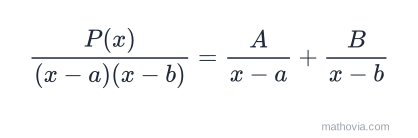
A partial fraction is one of the simple pieces a complicated rational expression breaks into — a single term whose denominator is one factor of the original denominator. Finding those pieces is called partial fractions decomposition, and it is the only thing this lesson does.
and are the partial fractions of .
Nothing is approximated. The sum equals the original for every value of
The Degree Check Comes First
Partial fractions only apply to a proper rational expression — one whose numerator has a strictly lower degree than its denominator.
| Expression | Numerator degree | Denominator degree | Proper? |
|---|---|---|---|
| yes | |||
| no | |||
| no |
If it is not proper, run polynomial long division first. The quotient stays as it is and only the remainder fraction gets decomposed.
Example of the fix. For
Now the leftover piece is proper, and only
Partial Fraction Decomposition Rules
Factor the denominator completely, then read one rule per factor. Every factor of the denominator contributes its own term or terms to the sum.
| Factor in the denominator | Terms it contributes |
|---|---|
| one term per power, each with a linear numerator |
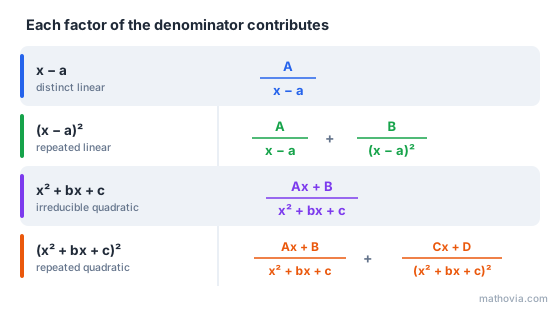
A repeated factor needs every power, not just the highest. Writing only
“Irreducible” means irreducible over the real numbers. Check the discriminant:
The Method in Four Steps
| Step | What you do |
|---|---|
| 1 | Check the degree; divide first if the fraction is improper |
| 2 | Factor the denominator into linear and irreducible quadratic pieces |
| 3 | Write the decomposition form, with a lettered constant for each term |
| 4 | Clear denominators and solve for the constants |
For step 4 there are two ways to finish, and they can be mixed freely:
- Substitute convenient values. Each root of the denominator kills all but one constant, giving it in a single line. This is fastest for distinct linear factors.
- Compare coefficients. Expand both sides and match the coefficient of each power of
. This is what you need when a quadratic factor leaves constants that no substitution isolates.
Worked Example: Two Distinct Linear Factors
Decompose
Step 1 — degree check. The numerator is degree
Step 2 — the denominator is already factored, into two distinct linear factors.
Step 3 — write the form, one constant per factor:
Step 4 — multiply through by
Substitute
Substitute
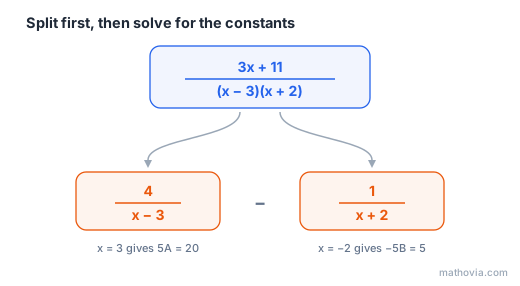
Always check by recombining. Here
Worked Example: A Repeated Linear Factor
Decompose
Step 1 — the form gets a term for each power of the repeated factor:
Step 2 — clear denominators by multiplying through by
Step 3 — substitute
Step 4 — compare the coefficients of
Only one substitution was available here, because the denominator has a single root. Coefficient comparison finished the job.
Worked Example: An Irreducible Quadratic Factor
Decompose
Step 1 —
Step 2 — clear denominators:
Step 3 — substitute
Step 4 — expand the right side and collect powers:
| Power of | Left side | Right side | Gives |
|---|---|---|---|
The constant row repeats what substitution already gave, which is exactly the redundancy you want — it confirms the other two rows.
Common Mistakes to Avoid
- Skipping the degree check. An improper fraction produces an inconsistent system, and the usual reaction is to hunt for an arithmetic error that is not there.
- Giving a repeated factor one term.
needs three terms, with denominators , and . - Putting a constant over a quadratic. An irreducible quadratic takes
on top, not . One constant is not enough to match both a linear and a constant term. - Leaving a factorable quadratic whole.
looks like a quadratic factor, but it is and belongs in the linear rules. - Forgetting to factor the denominator completely. The rules apply to fully factored denominators; a half-factored one gives a form that cannot be solved.
- Not checking the answer. Recombining the pieces takes one line and confirms every constant at once.
Practice Problems
Work each before opening the answer.
Problem 1. Decompose
Show answer
Step 1 — write the form:
Step 2 — clear denominators:
Step 3 — substitute
Step 4 — substitute
Answer:
Problem 2. Write the decomposition form for
Show answer
Step 1 —
Step 2 —
Step 3 —
Answer:
Five constants for a degree-
Problem 3. Why can
Show answer
Step 1 — compare degrees. The numerator is degree
Step 2 — the fraction is improper, so the degree check fails.
Answer: divide first. Long division gives
Problem 4. Decompose
Show answer
Step 1 — a repeated linear factor needs both powers:
Step 2 — clear denominators:
Step 3 — substitute
Step 4 — compare the coefficients of
Answer:
Problem 5. Decompose
Show answer
Step 1 —
Step 2 — clear denominators:
Step 3 — substitute
Step 4 — compare the coefficients of
Answer:
Problem 6. A student treats
Show answer
Step 1 — check the discriminant:
Step 2 — a zero discriminant means a repeated real root, so the quadratic factors.
Answer:
Decomposition is where the algebra of this chapter meets the rest of mathematics: the pieces it produces are exactly the forms that rational functions are analysed through, and the same splitting turns an otherwise intractable integral into a sum of routine ones. Everything it relies on — factoring, long division, and comfort with rational expressions — is already in this chapter.